Integrated weed management for professional sites
Prevent the growing medium. Remove established growth. Treat regrowth at the right stage.
Kersten brings sweeping, mechanical renovation, hot water, hot air and electric treatment into one practical programme. Choose the method around the surface, weed maturity, access, available carrier and what must happen to the arisings afterwards.
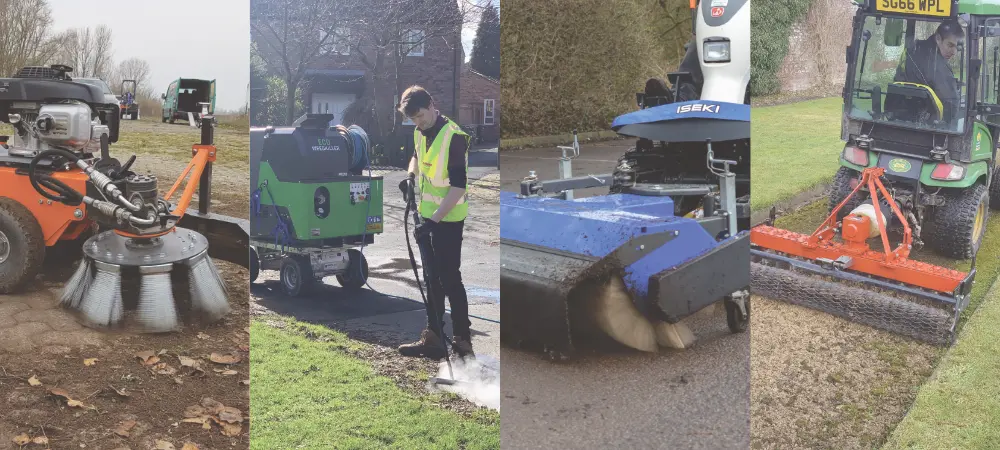
The fastest treatment is not always the cheapest programme. Remove soil and detritus first so fewer, younger weeds remain to treat.
Choose by site condition
What is the quickest appropriate intervention?
A mature perennial in deep soil needs a different response from young annual weeds in paving joints. Start with the condition, then match the equipment and route logistics.
Prevent establishment
Loose leaves, soil, grass clippings and detritus are present, but weeds are not yet deeply rooted.
Plan sweeping and collection →Brush hard surfaces
Established growth and compacted material occupy paving joints, kerb lines, tarmac edges or concrete.
Compare weed brushes →Renovate gravel
Weeds are rooted through a compacted gravel layer and drainage or surface structure has deteriorated.
See gravel renovators →Treat with hot water
A residue-free thermal route with heat transfer into joints and shallow growing medium suits the site.
Compare hot-water systems →Treat with hot air
Young active weeds must be treated quickly and propane, weather and fire controls can be managed.
Compare hot-air systems →Treat electrically
A trained professional team needs selective or full-width electro-physical treatment.
See electric systems →| Site problem | Starting method | What it changes | Important limitation |
|---|---|---|---|
| Loose material before weeds establish | Sweeper, gully brush, vacuum or collector | Removes nutrients and moisture-retaining growing medium | Must be repeated before material decomposes |
| Rooted weeds in hard-surface joints | Mechanical weed brush | Disrupts plants and removes compacted soil | Creates arisings and may be aggressive on weak surfaces |
| Rooted weeds in compacted gravel | Gravel path renovator | Cuts below roots and releases the compacted layer | Loosened weeds must be cleared and the finish restored |
| Recurring weeds, quiet/public-facing route | Hot water | Transfers thermal energy into plant tissue and shallow growing medium | Water, heating, refill and repeat-treatment logistics |
| Young annual weeds on defined routes | Hot air | Thermally shocks exposed plant tissue | Less penetration into soil; propane and fire controls required |
| Selective plants or specialist programme | Electric treatment | Passes controlled high-voltage energy through plant tissue | Training, PPE, power package and exclusion zones required |
Mechanical weed management
Reset hard surfaces from detailed edges to municipal routes.
Mechanical weed brushes remove the plant and the material supporting it. Match brush aggression, working width, drive and carrier to the surface; then sweep or collect the loosened material.
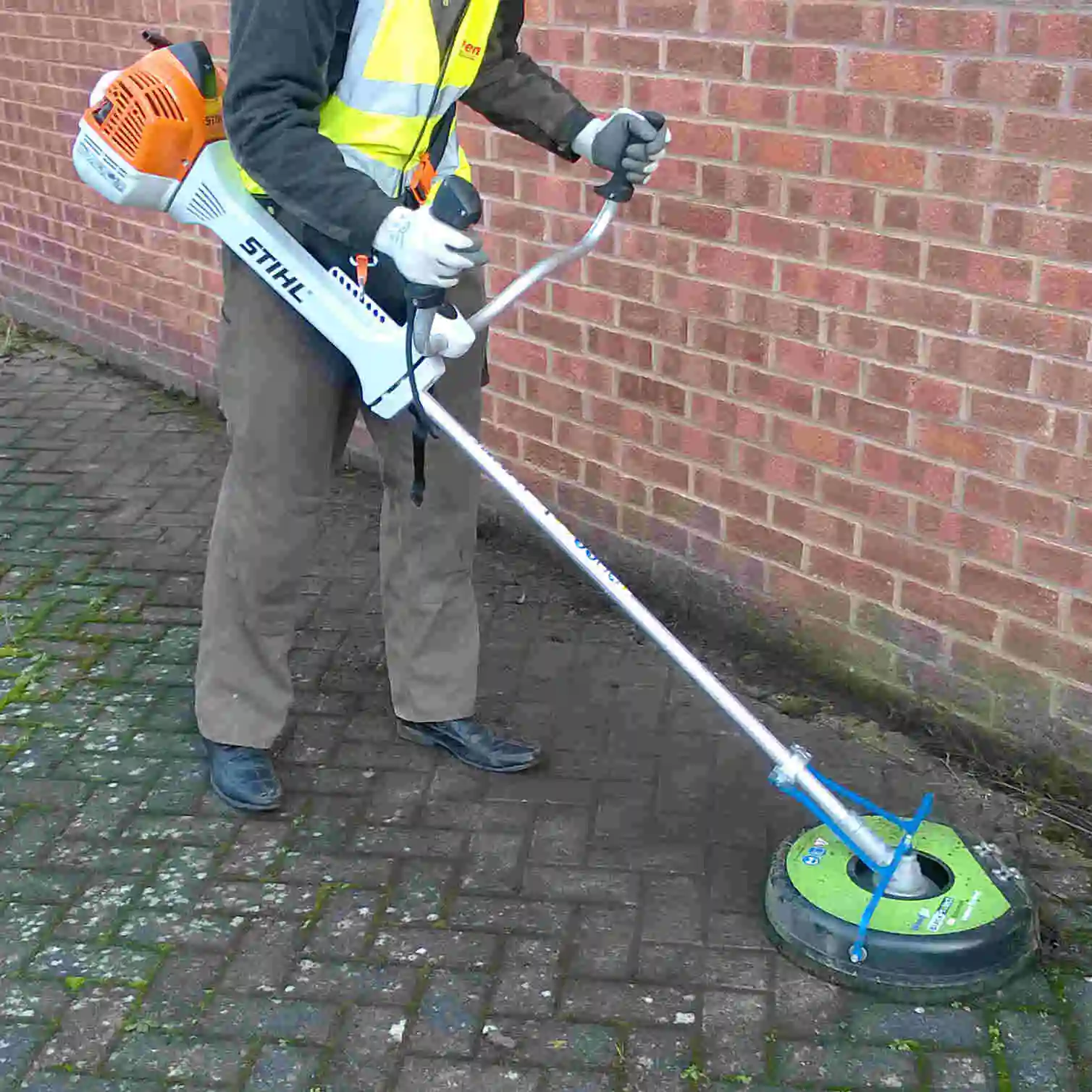
Handheld detailed work
WeedGo QuickPro for Stihl FS360–FS460
A mechanical weed-brush conversion for compatible high-output Stihl brushcutters, suited to edges, corners and street furniture.
Choose it when: access and precision matter more than broad-area productivity.
Checking current price…Live price from product page
View WeedGo QuickPro →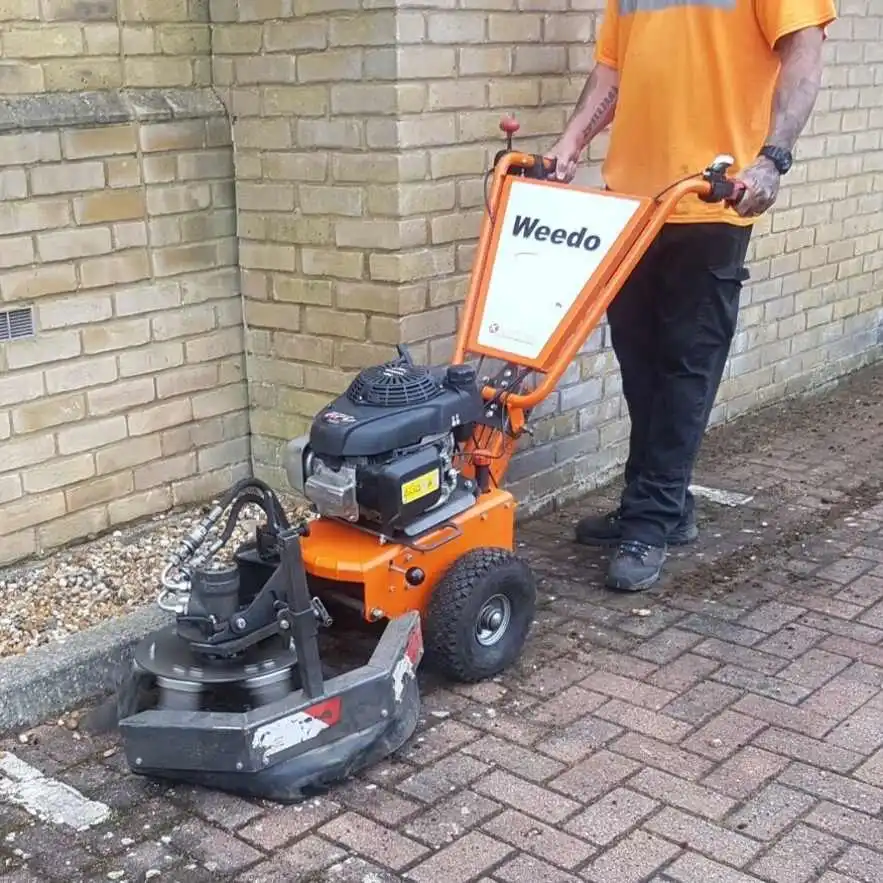
Dedicated pedestrian machine
Weedo II
A compact self-contained machine for repeated mechanical weed, moss and compacted-soil removal on hard surfaces.
Choose it when: one compact machine must perform routine corrective work without a separate power unit.
Checking current price…Live price from product page
View Weedo II →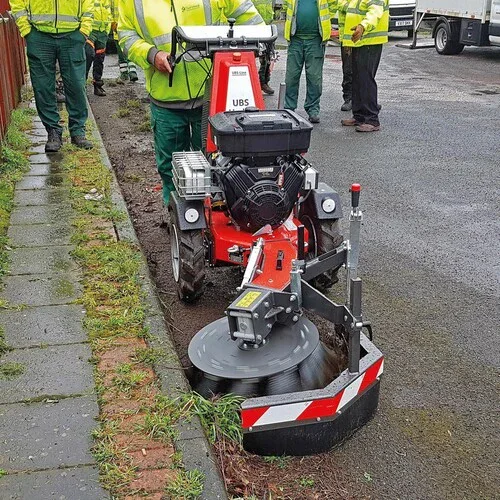
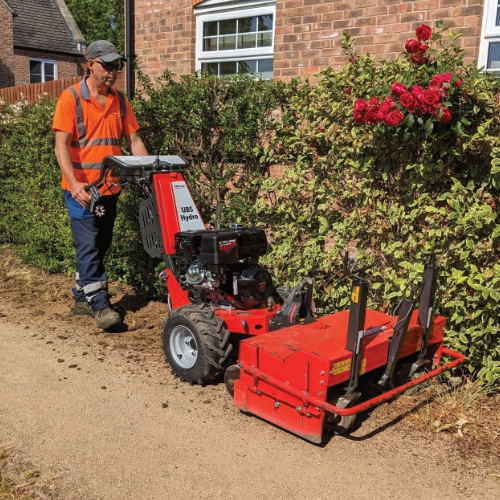
Pedestrian attachment
WKB 60 M-U 70
Mechanical-drive 60 cm attachment for compatible UBS Hydro, Alpin and Matador M-Trac carriers.
Choose it when: a compatible multi-attachment carrier should handle both corrective weeding and other seasonal work.
Checking current price…Attachment price; carrier separate
View WKB 60 →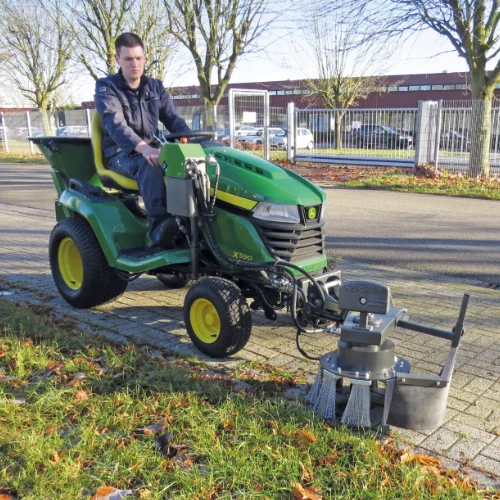
Ride-on mower solution
WKB-H-K-FKDR
Front-mounted hydraulic WKB head for specified ride-on mower families using the appropriate FKDR/HYDR linkage system.
Choose it when: a compatible ride-on mower can become a higher-output weed-management carrier.
Checking current price…Attachment price; linkage separate
View WKB-H-K-FKDR →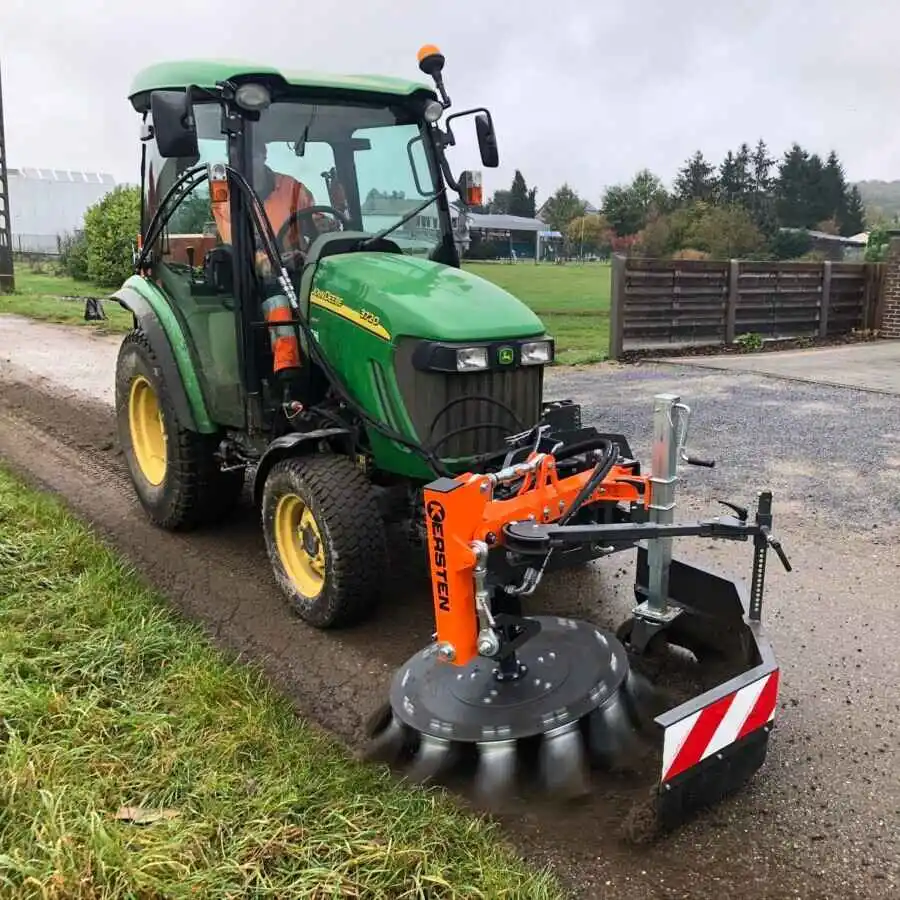
Compact tractor hydraulics
UB 6080 H
Professional front-mounted hydraulic weed brush for compatible compact tractors and municipal carriers.
Choose it when: large hard areas justify a tractor-mounted head and the complete hydraulic installation can be matched.
Checking current price…Plate, controller and bracket may be separate
View UB 6080 H →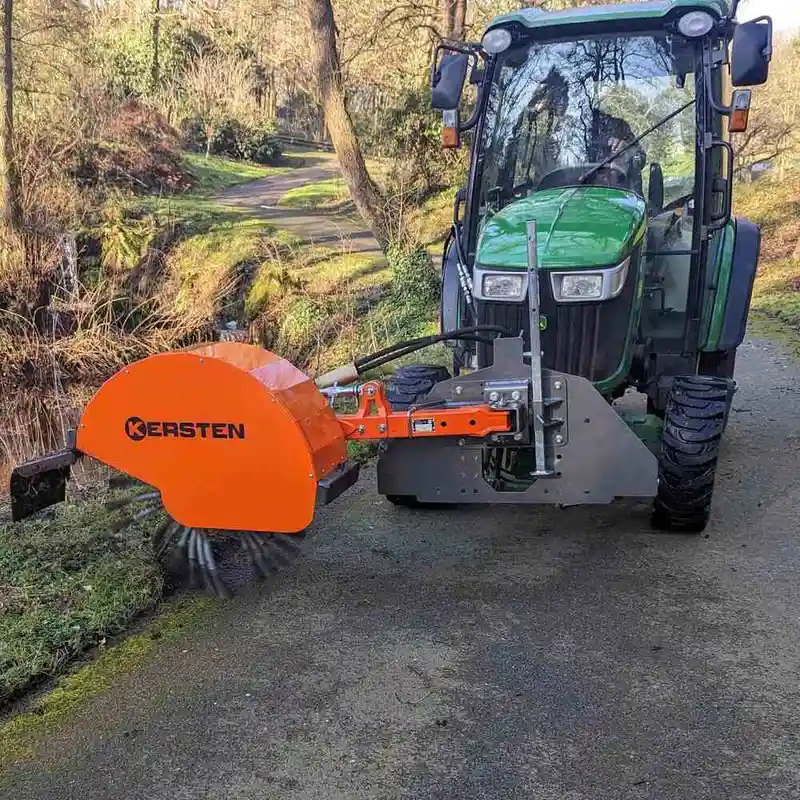
Loader and tool carrier
UB EASY PAK DS
Heavy-duty hydraulic package with plastic-coated flat-wire braids for high-output recovery of neglected paved areas.
Choose it when: robust productivity across broad neglected routes matters more than pedestrian access.
Checking current price…Attachment package; carrier frame separate
View UB EASY PAK DS →Rooted weeds in unsealed surfaces
Cut beneath the roots and reopen compacted gravel.
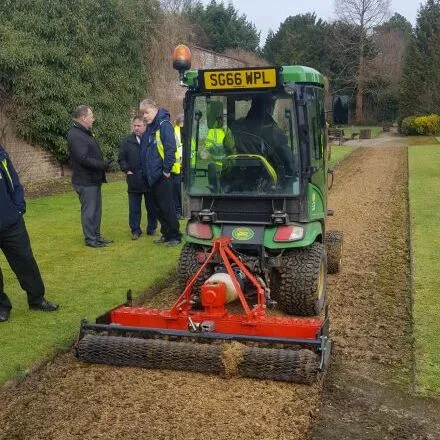
A gravel renovator is not simply a surface brush. Its counter-rotating tools release the compacted layer, lift weeds and growing medium, and make the usable aggregate available for clearing and grading.
Restricted-access gravel
WE 090 M-U 70
Pedestrian attachment for lifting weeds, loosening compacted gravel and restoring drainage where tractors cannot work.
Choose it when: parks, cemeteries and estate paths need below-root renovation without compact-tractor access.
Checking current price…Attachment price; carrier and tools separate
View WE 090 →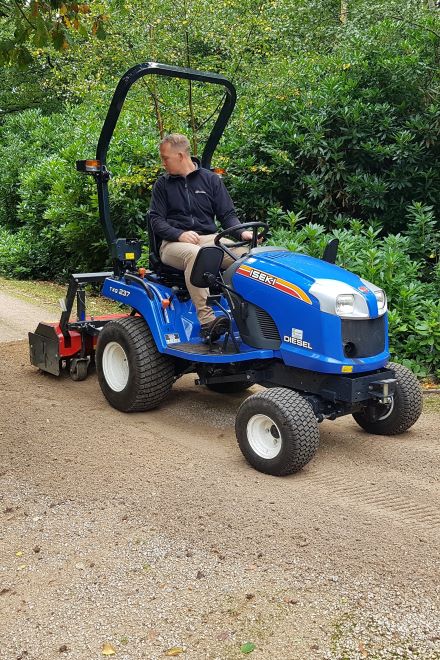
Compact tractor renovation
WE 110 M-DP
Compact PTO renovator with counter-rotating tools and depth adjustment for paths, drives and narrow estate routes.
Choose it when: a compact tractor must renovate narrower gravel paths and estate access routes.
Checking current price…Live price from product page
View WE 110 →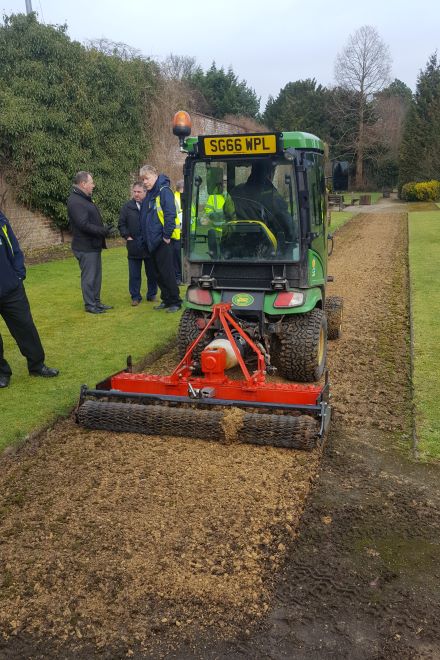
Higher-output gravel
WE 150 M-DP
Wider tractor-mounted renovator for broad paths, drives and estate roads with rooted weeds and deep compaction.
Choose it when: larger gravel areas demand more output while still cutting beneath established roots.
Checking current price…Live price from product page
View WE 150 →Do not stop when the weeds reach the surface: remove loosened weeds and contaminated material, then grade or redistribute the retained gravel. Leaving the arisings allows the growing medium to settle back into the route.
Hot-water weed control
Carry thermal energy into joints and shallow growing medium.
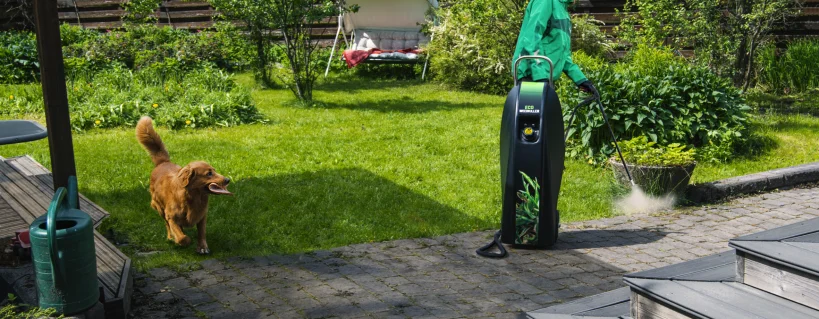
Eco Weedkiller applies controlled water above 100°C. Stored-hot-water machines suit quiet planned routes; PRO systems heat on demand for longer professional work. Performance still depends on species, maturity, growing-medium depth, water volume, technique and repeat timing.
Compact stored hot water
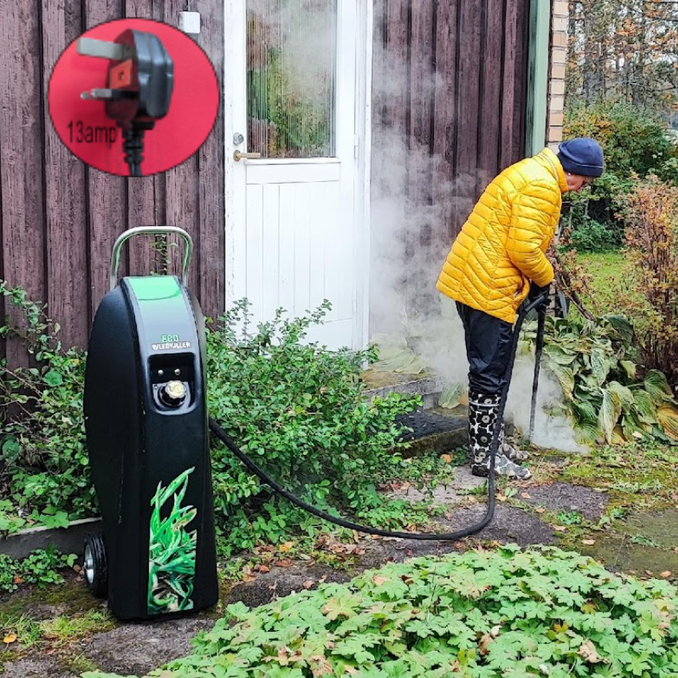
EWK Garden 2 kW
Plug-in 25-litre unit for gardens, courtyards and detailed work near an ordinary electrical supply.
Choose it when: the work is compact and access to a standard socket matters.
Checking current price…Live price from product page
View EWK Garden 2 kW →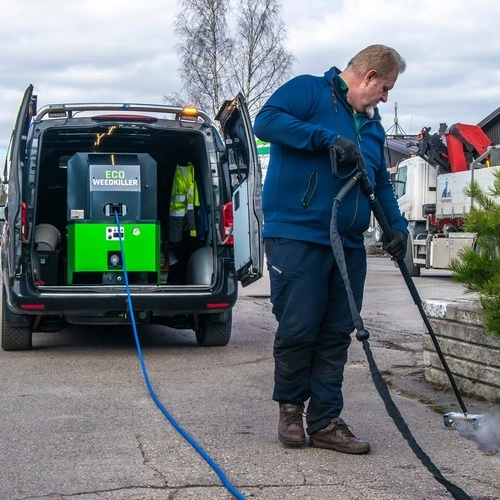
Professional pedestrian
EWK SP Pro Mini
A 150-litre stored-hot-water machine bridging small garden equipment and vehicle-mounted systems.
Choose it when: professional capacity is needed without dedicating a vehicle to the treatment unit.
Checking current price…Live price from product page
View EWK SP Pro Mini →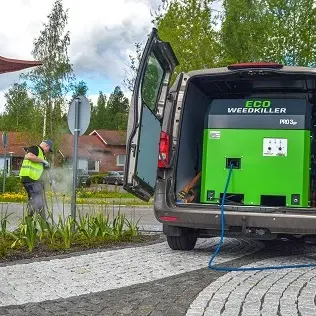
Longer quiet routes
EWK SP6
The 600-litre stored-hot-water option for greater route capacity without an engine running during treatment.
Choose it when: quiet operation and fewer refill interruptions suit a scheduled route.
Checking current price…Live price from product page
View EWK SP6 →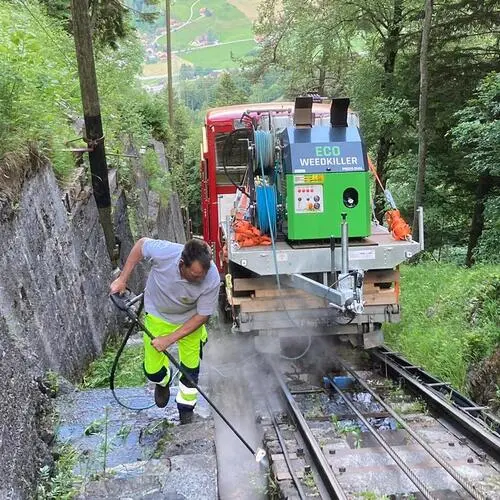
Two-operator output
EWK PRO20 Dual
An integrated on-demand system supplying one or two operators for high-output professional route work.
Choose it when: two operators must work opposite sides of a route from one vehicle.
Checking current price…Live price from product page
View EWK PRO20 Dual →Hot-water planning: remove excessive leaves, soil and bulky growth first. Allow for water supply, heating or charging, safe hot-water handling, PPE, drainage, runoff and repeat visits.
Hot air and controlled flame
Treat young weeds quickly where propane and fire controls fit the route.
Hot air is strongest against young, actively growing weeds. Clear combustible detritus first and assess wind, dryness, nearby materials, public access and local operating restrictions.
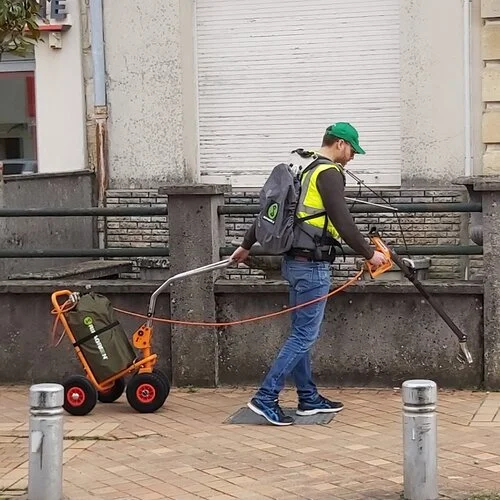
Flexible lance kit
Ripagreen Easy+ Kit
Trolley and backpack configurations let one team move between continuous routes and awkward access.
Choose it when: a lance must handle open routes, steps and fragmented sites.
Checking current price…Live price from product page
View Ripagreen Easy+ →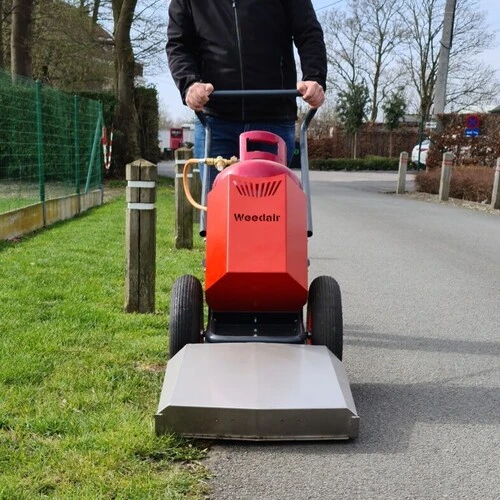
Defined pedestrian route
HOAF WeedAir 50iB
Walk-behind unit with battery ignition and digital monitoring for repeatable treatment on hard surfaces.
Choose it when: paths and paved areas suit a contained walk-behind treatment pattern.
Checking current price…Live price from product page
View WeedAir 50iB →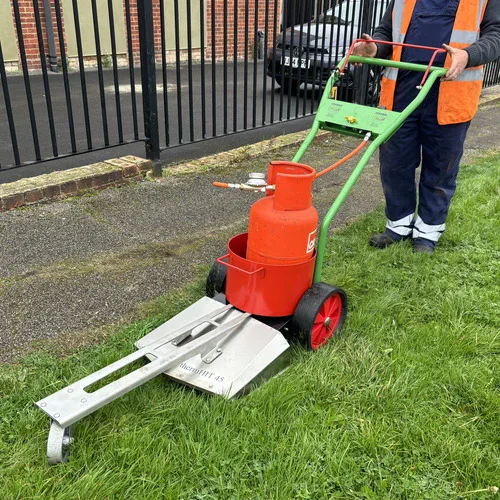
Hooded treatment zone
HOAF ThermHit 45
Compact hooded 45 cm machine for pavements, paths and repeated professional pedestrian work.
Choose it when: a compact enclosed treatment zone is preferable on regular pedestrian routes.
Checking current price…Live price from product page
View ThermHit 45 →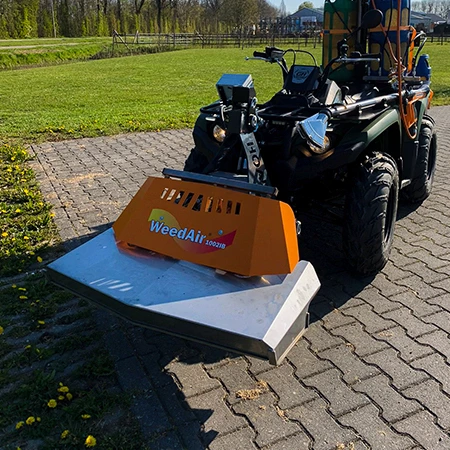
Tractor-mounted hot air
HOAF WeedAir 1002 IB
Front-mounted 100 cm system with three main and two side burners for longer routes and work around edges.
Choose it when: a compatible compact tractor must cover wider, longer hard-surface routes.
Checking current price…Attachment price; integration may be separate
View WeedAir 1002 IB →Professional electric treatment
Choose a full-width pedestrian array or selective lance.
Electric equipment applies controlled high-voltage energy through plant tissue. It requires trained operators, specified power equipment and PPE, controlled access and appropriate weather conditions.
Full-width pedestrian electric
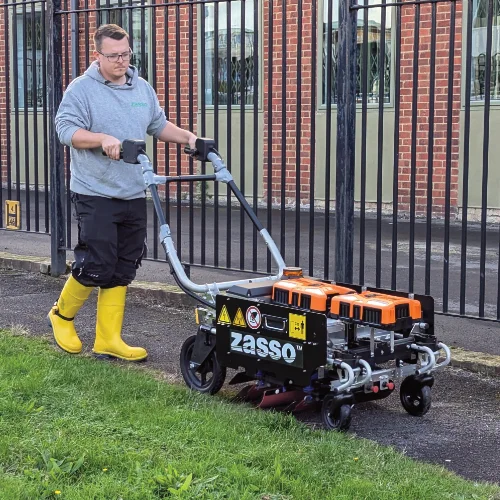
Zasso Zap Weeder 5.3
Battery-powered walk-behind system whose flexible electrodes treat vegetation across a continuous strip.
Choose it when: a trained team needs repeatable full-width electric treatment on hard-surface routes.
Checking current price…Batteries, charger and PPE may be separate
View Zap Weeder 5.3 →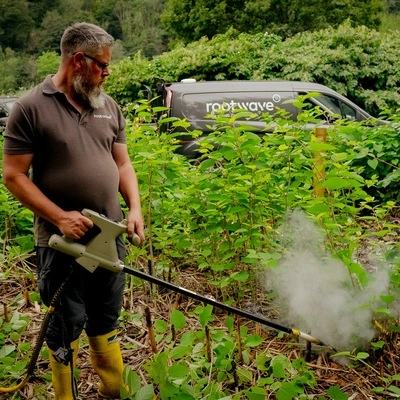
Selective electric treatment
Kersten Electric Weedkiller Lance
Long treatment lance for individual weeds and difficult invasive plants where selective contact is required.
Choose it when: selective treatment matters more than surface-area output, including difficult individual plants.
Checking current price…Generator, PPE and training may be separate
View Electric Weedkiller Lance →Prevention and year-round maintenance
Make the surface less able to support weeds.
Weeds on hard surfaces commonly establish in accumulated soil and organic material—not in the intact surfacing itself. Remove that layer, keep edges clear and intervene while growth is young.
Build prevention around removal and collection.
Choose the collection method by material volume, access and carrier. A gully brush helps clear kerb lines; a sweeper and collector handle loose material; vacuum and mounted collectors help where material must be removed from the route.
Winter
Remove soil, leaf residue and compacted growing medium while routes are less actively growing.
Spring
Treat young emerging weeds early, before roots and stored energy become harder to manage.
Summer
Control grass clippings, edge migration and missed weeds; collect arisings after mechanical work.
Autumn
Remove leaf fall before it decomposes, blocks drainage and creates next season’s seedbed.
Keep the complete system in view
See how prevention, mechanical removal and treatment work together.
The original Kersten IWM video remains on this replacement page. Use it alongside the selector above to plan a sequence—not just purchase a single treatment tool.
Kersten guidance and casework
Plan the programme around soil depth, surface and timing.
These practical articles explain the mechanical foundation, prevention by design, hot-water treatment and specialist electric work.

Mechanical foundation
The mechanical element of an IWM strategy
Why removing soil and detritus changes which weeds can establish and improves later treatment.
Read the article →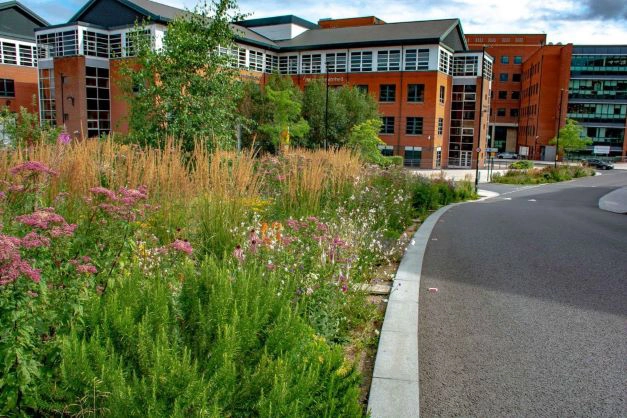
Prevention by design
Considering weed prevention in greener cities
See how planting, edging and surface choices influence the maintenance burden on adjacent hard areas.
Read the article →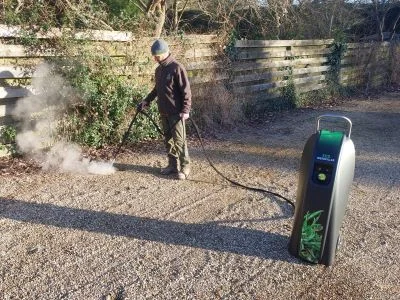
Hot-water treatment
Why the soil is where the fight is won
Understand heat transfer, growing-medium depth and why hot-water technique must match the root zone.
Read the article →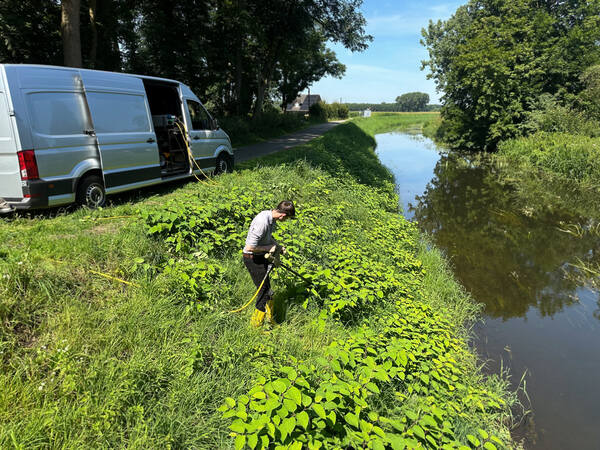
Electric treatment
Treating hard surfaces and soil with electricity
Compare treatment patterns and understand why the electrical system must match the target and surface.
Read the article →The weeds are the symptom. The detritus is the cause
A practical route from a reactive spraying schedule to a documented Integrated Weed Management programme — built on your statutory duties, your surface condition and your own numbers.
Before we talk about machines
What the rest of this pack covers
The legal framework you work inside, the mechanism that connects weeds to potholes, how to measure and classify a surface before choosing a method, the treatment hierarchy, then a page on each family of equipment — and only after that, the cost model, the capacity arithmetic and how to commission an audit.
Product recommendations come last, and only after a conversation about your surfaces.
Free demonstration
The quickest way to settle an argument about output is a measured trial on your own surface, with your own operators. We are happy to arrange one at no cost.
The framework you work inside
Weed management is rarely governed by one duty. It sits across cleansing, highway maintenance, pesticide regulation and work equipment law at the same time — which is why a programme built only around a spraying calendar tends to satisfy none of them well.
UK Pesticides National Action Plan 2025
A UK-wide framework promoting Integrated Pest Management, lower dependency and reduced risk from pesticides, while accepting that targeted use may remain justified where alternatives are ineffective or unavailable. A direction of travel, not an overnight ban — and not, in itself, a universal annual return to Defra for every council.
Environmental Protection Act 1990, s.89
Duty bodies must, so far as is practicable, keep relevant land clear of litter and refuse and keep certain highways clean. The Code of Practice on Litter and Refuse confirms that for highway cleanliness this includes removing detritus. Detritus is the growth medium. Removing it serves the cleansing duty and the weed programme in the same pass.
Highways Act 1980
The maintenance duty under s.41, together with duties concerning obstruction and the public's right of passage, means vegetation encroaching on the running surface, footway or sightlines is a highway matter, not only an appearance one. Anchored roots that open joints and lift edges become a defect question long before they become a weed complaint.
PPPR 2011 · Sustainable Use Regs 2012 · Official Controls 2020
Products must be authorised and used to label by competent operators, with use minimised — particularly on hard and sealed surfaces where run-off risk is highest. Professional users and distributors must also register under the 2020 Regulations. Where use is challenged, an enforcing authority works from the evidence available. Records are the defence.
HSWA 1974 · PUWER 1998
Work equipment must be suitable for the task and conditions, maintained in efficient working order, and used only by people given adequate training and information. Moving from a knapsack to a powered brush or a thermal system changes the risk profile, not just the method. Thermal and electric systems add LPG handling, scalding, fire and electrical exclusion controls to the assessment.
Run-off from sealed surfaces
Hard surfaces drain quickly to gullies and watercourses, so amenity applications carry a disproportionate risk to raw water quality relative to the area treated. This is a recurring driver behind catchment partnerships and local reduction commitments. Mechanical extraction and thermal treatment remove that pathway rather than managing it.
Two things worth separating in any policy paper
First, the legal duty and the strategic benefit are different arguments and carry different evidential weight. Second, no single intervention proves compliance and no single weed proves a breach — land type, practicability, responsibility and the current statutory code all bear on it. This page is a summary for discussion, not legal advice. Confirm the duties, registrations and record-keeping that apply to your organisation and jurisdiction.
What the plan actually asks for
Three things: uptake of Integrated Pest Management, reduced risk and impact from pesticides, and stronger safe practice through training, equipment checks, storage and competence.
What it does not do is ban amenity pesticide use, or create a blanket national reporting return by itself. That distinction matters. A policy written on the assumption of a ban tends to be abandoned the first time a site genuinely needs a targeted treatment, and a programme built to satisfy an imagined return usually collects the wrong data.
The defensible position is a documented hierarchy — prevention first, non-chemical suppression second, justified targeted use where it remains necessary — with records that explain each decision.
The cleansing connection · England
Because the highway-cleanliness duty includes detritus removal, mechanical detritus management can support both cleanliness outcomes and an IWM strategy at once. The grades below are a simplified planning lens — always work from the current statutory code for the full standard.
Why non-chemical methods sometimes disappoint
Usually because they were asked to do the wrong job. A surface treatment can suppress visible growth without removing accumulated material or anchored roots, so the site regrows on schedule and the method takes the blame. Review where, when and why it was used before concluding it does not work.
Where to begin
With a representative baseline rather than the whole network. Review policy, treatment records, contracts and surface condition across a manageable sample, then use the results to choose a focused pilot with clear operational and environmental measures.
One mechanism, four budgets
Weeds are the visible middle stage of a longer chain. Most authorities pay for that chain four times over, through four separate budgets held by teams with no operational connection to each other.
Soil, grit, leaf litter and vehicle-derived material collect at kerb edges, in joints and around drainage ironwork.
That accumulation is a growth medium. Weeds root into it. This is what generates weed complaints.
The same material, now bound by roots, moves into gully pots and channels. Blocked-gully complaints follow.
With drainage obstructed, water sits at the road edge and in the sub-base instead of being carried away.
Saturated sub-base plus ordinary winter freeze–thaw produces defects faster than a drained one would.
Four service streams. Four teams. Four budgets. One common upstream mechanism.
Why the framing changes the answer
Most weed management reports treat weeds as the problem and ask which treatment kills them most cheaply. That question has no good answer once chemical options are restricted, because every non-chemical treatment is slower and more expensive per weed.
Reframing around the growth medium changes what is being bought: not a weed killer, but a reduction in the rate at which four separate services generate work. That is a maintenance proposition rather than a horticultural one, and it belongs in highway asset management as much as in grounds maintenance.
The physical mechanism
Freeze–thaw damage needs two things at once: sub-freezing temperature, and water. The temperature is uncontrollable. The water is not.
Cold does little harm to a dry substrate. Damage occurs once saturation passes the threshold at which ice formation generates destructive internal pressure. Where kerb-line detritus and blocked gullies retain standing water, the same winter that would have done negligible damage instead acts on a substrate primed for it.
What to look for in your own records
Co-location. Match weed, blocked-gully, gully-vegetation and carriageway repair records by street. Streets carrying records in several categories are the ones to survey first.
Why measurement comes first
Complaint data tells you where the public has noticed a problem. It cannot tell you whether the material at that location will lift out with a brush or has already bonded into the surface — and those two conditions carry very different costs.
The absence of a complaint is not evidence of good condition; it only shows that nobody reported one. And by the time a weed is visually prominent enough to be reported, the earliest and cheapest intervention opportunity has usually passed.
Two measurements settle it, and both can be taken by a supervisor in an afternoon. Depth, using a gauge at standardised positions in the kerb channel. And root anchorage, using the Kick Test.
Why depth alone is not enough
Two locations can measure exactly the same depth and need completely different responses. In one, the roots are still floating in the accumulated material and the whole mass lifts out. In the other, roots have found their way into a joint or a crack and bonded into the pavement.
The distinguishing variable is time, not depth. Above-ground weed height is a poor proxy for what is happening inside the surface, which is why the test is a physical one.
The Kick Test · apply controlled lateral pressure at the base of the growth and watch what happens
The distinction is physically observable rather than a matter of judgement: the mass either lifts with the detritus or it breaks. That is what makes it usable by a whole team rather than only by a specialist.
Doing it properly
Measure depth at several representative points rather than one. Record whether the surface is already intact or damaged, as a separate field from the depth reading. Apply only controlled pressure, and follow your normal site safety procedures — this is work at ground level, often beside a live carriageway. Escalate any suspected structural defect for competent inspection rather than deciding it on the test alone. And document the procedure so it is applied consistently: paired assessment during the first season is worth doing to align recording between teams and settle how borderline cases are logged.
The four stages
Put depth and the Kick Test result together and every location falls into one of four stages. Stages 2 and 3 share the same 11–25mm depth band, and that is exactly the point: they look identical on a gauge and differ by an order of magnitude in cost.
Cross-section, left to right: vegetation above the surface, the accumulated detritus it grows in (coloured), the pavement surface (dark rule) and the sub-base beneath. From Stage 3 the roots have crossed the surface into the pavement itself.
Indicator species · a first read before you measure
The Bracknell evidence
The framework on the previous pages is not an opinion. Kersten UK, Bracknell Town Council and Complete Weed Control are running a controlled multi-site trial to test it with measurements, and the results are published.
Brush first, then treat
Across five comparable sites at the first pesticide application in June 2026, plots that were mechanically brushed beforehand used 1,133ml of active substance against 2,218ml on spray-only plots. Removing the detritus cut both the target area and the weed biomass needing treatment.
What output actually depends on
500–1,000 m/day
A realistic range where significant overburden, anchored growth, repeat positioning or slower cleanup limits progress.
Up to 3,500 m/day
One mechanical pass on path edging and kerb lines followed by a road sweeper, achieved by an operator who had refined the whole system rather than treating the machine as a standalone process.
Winter
Accumulated material is most visible, and the work happens before spring germination — which is what suppresses the following year's annuals.
The treatment hierarchy
Integrated Weed Management is not swapping one treatment product for another. It is a documented hierarchy that starts by reducing the conditions which let vegetation establish in the first place. The equipment pages that follow are arranged in the same order.
Prevention and extraction
Manage detritus, edges, joints and drainage before a stable growth medium develops. This is also the tier that discharges the cleansing duty.
- Weed brushes — Section 08
- Sweeping and collection — Section 09
- Gravel renovation and grading — Section 10
- Stage 2 extraction before anchorage
Non-chemical suppression
Thermal, electric and other physical methods, selected around surface, access, scale and objective — after the growth medium has been reduced, not instead of reducing it.
- Hot air — Section 11
- Hot water — Section 12
- Electro-thermal — Section 13
- Always sequenced behind a mechanical reset
Targeted pesticide use
Where pesticide use remains necessary, justify the decision, use the least-risk suitable approach and keep records that explain it.
- Targeted rather than routine broadcast use
- Invasive-species plans where required
- Competent operators, lawful products
- Treatment records and review
A twelve-month roadmap
Sample representative sites, record current practice, measure detritus and surface condition, and identify where early intervention offers the strongest return.
Select methods around the audited need, review contract specifications, arrange demonstrations, and make sure operators and supervisors understand the programme.
Apply the hierarchy on a controlled set of sites. Monitor condition, treatment frequency, recolonisation, hours and pesticide use against the baseline.
Extend what worked, revise specifications and frequencies, plan capital work for advanced defects, and report through your own governance processes.
Record at site level
Location, surface type and responsible service; detritus depth and surface condition as separate fields; indicative stage and Kick Test result; indicator and invasive species; the intervention, date, labour and equipment; product and quantity where applicable; and follow-up condition.
Report at programme level
Share of sites by stage; sites moving towards prevention against those deteriorating; pesticide use and treatment frequency against baseline; cleansing and extraction coverage; complaints, defects and repeat visits; cost per site or cycle; training and equipment-inspection status.
Weed brushes
The brush is the machine the framework points at: it lifts the accumulated material and the root system out of the joint as one mass, while the window is still open. Tool aggressiveness, plate orientation, rotation direction, pressure and edge reach decide the result far more than working width does.
| Range | Carrier | Head | Where it fits |
|---|---|---|---|
| WeedGo | Professional brushcutters | Conversion | Joints, edges, street furniture and places no wheeled machine reaches. Low transport and access requirement; spot work rather than broad-area output. |
| Weedo II | Dedicated pedestrian platform | 50 cm | Six-tool rotating plate with adjustable tool position and direction, for repeated route work on smaller paved sites, housing land and contractor rounds. |
| WKB 40 / WKB 60 | Kersten pedestrian carriers | 40 and 60 cm | Hydraulic or PTO drive routes, Versa and Hausa replacement sections, and an optional edge cutter on suitable WKB 60 configurations. |
| UB 6080 H / MK / MH | Compact and municipal tractors | 60 and 80 cm | Carrier-specific bracket and controller, with MH configurations adding integrated hydraulic movement. High edge reach for overburden and established growth. |
| UB EASY FL / DS / VB | Larger tractors and loaders | ~80 cm radial ~84 cm vertical | Heavy-duty Versa, flat-wire and vertical edging heads for verge encroachment and high-output clearing. |
Full range and current prices: kerstenuk.com/Weed-brush-attachment-series
Working tools change the outcome
Versa combination tools lift and sweep in one action. Hausa twisted wire extracts more aggressively where material is compacted hard against the kerb face. Flat-wire and vertical tools handle specialist edging. Sections are consumables and their wear rate is a real cost line — price them separately.
Specify these four things
Integrated collection, so material is not redistributed back into the drainage pathway. Reach into the kerb channel, gully approaches and ironwork surrounds. The ability to lift the full root crown at Stage 2 rather than sever the stem. And declared hand-arm vibration magnitude with permitted daily trigger time.
Sweeping and collection
Sweeping is the cheapest intervention in the programme and the only one that stops the cycle before it starts. It removes soil, leaves, grit and moss fragments before they stabilise into a growth medium, and it is what holds a treated route at Stage 1 once extraction has reset it.
| Family | Carrier | Roller | Notes |
|---|---|---|---|
| EFKM, K-series, De-Moss | Two-wheel tractors and pedestrian carriers | Typically 90–130 cm width | Mechanical or hydraulic drive by carrier. Standard poly-combi roller, or a de-moss roller where moss dominates. |
| FKM 37, HKM/FKM 40, KM 45 | Ride-on mowers, sub-compact and compact tractors | 37–45 cm | Front or rear, mechanical, PTO or hydraulic, with manual or hydraulic angling. Estate routes and block paving. |
| KM 52, KM/FKM 60, KM 70 | Medium and large tractors, loaders, municipal carriers | 52–70 cm | Heavy hydraulic or duplex-chain drive with pendulum suspension. For soil, stones, leaves and municipal debris volumes. |
| Collector boxes and gully brushes | Fitted to compatible sweepers | Sized to family | Retain dense soil, moss, grit and sand. A gully brush presents edge material to the main roller. |
| Vacuum nozzles and mounted collectors | Tractor mounted | Route dependent | Transfer loosened arisings into a collector or trailer. Best after material is already loosened — not a substitute for extraction. |
Roller diameter and working width are separate decisions: width affects route output, diameter affects material capacity and debris size.
Where sweeping stops and brushing starts
Use a sweeper where the problem is loose soil, leaves, moss fragments or detritus sitting on the surface. Use a weed brush where material is rooted or compacted into joints and edges and needs extraction rather than movement. A sweeper run over Stage 2 growth tidies the appearance and leaves the mass in place.
Always collect
Released soil and roots left in joints or at the edge simply become next season's seedbed — and material brushed off a surface either goes into a collector or into the drainage system.
Gravel renovation and grading
On an unsealed route the growth medium is inside the surface rather than sitting on it. Heavily used gravel compacts, traps detritus and holds moisture, which creates exactly the damp, nutrient-rich environment weeds and moss need — and impairs the drainage that kept the surface sound.

| Model | Role | Width | Carrier and starting point |
|---|---|---|---|
| WE 090 M-U 70 | Pedestrian renovation | 90 cm · 152 kg | Kersten UBS Hydro or Alpin on K70 quick attach. Restricted-access paths in parks, cemeteries and estates. |
| WE 110 M-DP | Tractor renovation | 110 cm · 124 kg | CAT 1 / CAT 1N. Narrow estate routes and compact tractor widths. |
| WE 150 M-DP | Tractor renovation | 150 cm · 156 kg | CAT 1 / CAT 1N. Broad paths, drives and higher-output deep renovation. |
| PH 100 Mini | Grading and levelling | 100 cm | From 30 hp, CAT 1 linkage. Narrow tracks and restricted grading work. |
| PH 130 Mini | Grading and levelling | 130 cm | From 35 hp. General estate, park and countryside routes. |
| PH 150 Mini | Grading and levelling | 150 cm | From 38 hp. Wider tracks and estate roads. Water-fillable roller adds consolidation mass. |
A renovator addresses rooted growth and compaction; a grader addresses potholes, levels, camber and material distribution. Full range: kerstenuk.com/gravel-path-renovators-and-graders
Angled knives for loose and self-binding gravel: they cut beneath roots and release the upper layer. Carbide chisels where crushed stone or water-bound material is too compacted for knives to open. Thick weed-brush tools for tarmac sub-base and similar firm surfaces where moss must come off without the deeper knife treatment. Test depth on a representative area first.
Usable gravel stays available for redistribution — the objective is to lift weeds, roots and contaminated material, not to remove the stone.
Five steps, in order
Survey depth, stone type, drainage, edges and access. Renovate at the right tool and depth. Clear the arisings — rake, blow or collect. Grade to restore levels and camber. Maintain with raking and sweeping before compaction rebuilds. Leaving the loosened weeds and soil on the route lets it settle back and rebuild the growing medium, which is the commonest way a renovation wastes its own effort.
Hot air
The lightest non-chemical route logistically, because it carries propane rather than water. Ripagreen mixes roughly 94% ambient air with 6% gas, so the heat is directed rather than flamed.
A leaf needs only brief exposure at around 76–80°C to sustain terminal damage: the cells burst and the plant can no longer photosynthesise. Charring is not the objective — it means wasted dwell time and slower output. Strongest on young annual growth and moss, and strongest of all once detritus has been removed, because soil and leaf litter shield plant tissue and add fire risk.
| Range | Format | Key figures | Where it fits |
|---|---|---|---|
| Ripagreen Mobility | Backpack lance | 40 cm diffuser · 45–76 kW · 5–6 kg cylinder | Steps, narrow paths, beds, graves, street corners and uneven ground, where the operator must work independently. |
| Ripagreen Easy / Easy+ | Trolley lance | 13 kg cylinder · 40 cm width | Longer pedestrian routes, with Easy+ adding a backpack option for mixed-access sites. |
| Ripagreen Autonomy | Vehicle supported | 15 m hose reel · 1 or 2 lances · 10–15 kg cylinders | Larger routes worked from a support vehicle with automatic hose reels, without losing targeted application. |
| HOAF ThermHit | Handheld and wheeled | 15, 25, 45 and 75 cm | Infrared radiation combined with hot air, shielded for controlled treatment close to obstacles. |
| HOAF WeedAir | Pedestrian hooded | 50–75 cm · Infra Plus | Paths, car parks and public spaces where a contained treatment zone and a consistent working width matter. |
| HOAF WeedAir / TWB | Carrier mounted | 75–125 cm | Highways, estates and large hard-surface routes, with access under benches and close to edges. |
Full range: kerstenuk.com/thermal-hot-air-weed-removers
Where it wins
No water to carry, no tank to refill and no charging supply, so one operator can cover dispersed small sites that would defeat a water-based route. It is unaffected by spray drift, which widens the usable working window across a season.
What to control
Dry combustible material is the main hazard — another reason to sweep or brush first. LPG handling, public access, thin plastics, reflected heat and proximity to street furniture all belong in the site assessment, with the controls it identifies written into the method statement.
Hot water
A contact treatment that conducts heat into plant tissue and the upper soil profile, which gives it more effect below the surface than hot air. The trade is logistics: water has to be carried, heated and replaced.
Two architectures. Stored-energy systems pre-heat the water and treat almost silently, which suits stop-start routes and noise-sensitive sites. On-demand systems heat continuously for long shifts, multiple operators, rapid refilling and combined cleaning work. Plan around 2 to 2.5 litres per square metre at full vegetation cover, estimating the actively vegetated area rather than the whole route.
| Range | Type | Key figures | Where it fits |
|---|---|---|---|
| Eco Weedkiller Garden | Compact stored | 25 L · 2 kW on 13 A or 3 kW on 16 A · 3 m hose | Gardens, courtyards, small landscapes and localised treatment. Around 8–10 m² per fill. |
| Pro SP Mini / 3 / 6 | Professional stored | 150–600 L · about 6 L/min · 20 m reel | Nearly silent in use. Roughly 60–75, 100–150 and 240–300 m² respectively. For quiet routes and sites where combustion at the treatment point is undesirable. |
| Pro 10 / Pro 20 Dual / Pro 30H | On demand | 99–101°C · up to 80 m hoses · 1 or 2 operators | Long routes with continuous refilling, and combined weed control, pressure washing and cleaning. The Pro 30H is a hydraulic vehicle system. |
The Pro 20 offers selectable 10 or 20 L/min output, reaching the higher figure with two users, with published fuel consumption of 11 litres per hour on one user and 20 on two. Full range: kerstenuk.com/Eco-Weedkiller-Hot-Water-Weed-Management
Refilling decides the day, not the machine
Water supply is usually the limiting factor rather than fuel range. If a bowser travels far between fills, refill time can dominate the shift and make an output figure quoted in metres per hour meaningless.
Record treatment time, refill time and travel time separately from the first day of any pilot. It is the cheapest data collection in the programme, and it tells you whether the answer is a bigger tank, a second bowser or a different route order.
Treat early, treat less
Young, fleshy plants hold less stored energy and need less heat, so the same tank covers more ground. That efficiency is only available on a network already reset. A programme that waits until growth is visually prominent operates at a materially higher cost per metre — the intervention window argument, expressed in litres.
Electro-thermal weeding
Electrical current is the delivery mechanism; heat is the mode of action. Current passes through the plant and generates resistive heat inside the tissue, damaging chlorophyll and vascular structure from within and acting toward the root zone rather than heating only the exposed surface.
That makes it the method with the most effect on species that regrow from below, and the only one of the three with neither a flame, a plume nor a water tank at the treatment point. It is also the one with the highest competence requirement, and it should be specified as such.

| Range | Format | Key figures | Where it fits |
|---|---|---|---|
| Zasso Zap Weeder | Walk-behind, surface contact | 60 cm · 1.5–3 km/h · up to 4 hours | Paving joints, paths and kerbs where a consistent treatment width is wanted. Close electrode spacing suits shallow-rooted hard-surface growth. |
| Kersten Electric Lance | Handheld, targeted | 3, 4 or 5 kV · 170 cm lance · 20 m cable | Isolated plants, beds, fence lines, awkward corners and species needing precise contact rather than a full-width electrode array. |
| Zasso CityZas | Compact tractor mounted | 1.2 m · 18 kW · 65 hp+ · up to 4 km/h | Repeatable full-width treatment on paths, verges and municipal routes from a smaller carrier, with a front module and generator package. |
| Zasso Urban XPA | Reach arm, tractor mounted | 7.2 m reach · up to 36 kW · 8 kV · 200 hp+ | Verges, barriers, banks and roadside furniture that cannot be treated directly in front of the carrier. High-output professional route work. |
Full range: kerstenuk.com/electric-weeding-equipment
Choosing between the three non-chemical methods
All three produce thermal damage, but the route planning, training and safety controls differ substantially. Hot air is lightest logistically and strongest on young annuals and moss. Hot water reaches furthest into the upper soil profile and suits noise-sensitive and stop-start work, at the cost of water logistics. Electric acts through the plant structure toward the root and avoids both flame and water, at the cost of generator capacity, trained operators and controlled exclusion zones. None of them is a substitute for removing the growth medium first: sequenced behind extraction, all three work on a smaller area, on younger growth, at a lower cost per metre.
What it fits
Most of this hangs off machines an authority or contractor already runs. A single pedestrian power unit or compact tractor can carry a sweeper, a weed brush, a renovator and a collector across the year, which changes the capital conversation considerably.
| Carrier you may already run | Sweeper | Weed brush | Gravel | Collection |
|---|---|---|---|---|
| Professional brushcutterCompatible models | — | WeedGo conversion | — | — |
| Dedicated pedestrian unitWeedo II | — | 50 cm six-tool plate | — | — |
| Pedestrian power unitKersten UBS, K-series | EFKM, De-Moss | WKB 40 / WKB 60 | WE 090 quick-attach | Collector box |
| Ride-on mowerWith FKDR linkage | FKM 37, HKM/FKM 40 | Selected WKB routes | — | Collector box |
| Compact tractorWith front linkage | FKM 40, KM 45 | UB 6080 H / MK / MH | WE 110, WE 150, PH Mini | Vacuum nozzle |
| Tractor, loader or municipalHighways duty | KM 52, KM/FKM 60, KM 70 | UB EASY FL / DS / VB | WE 150, PH 150 | Mounted collector |
Indicative only. A mounted attachment is a complete system — mounting interface, PTO, hydraulic flow and pressure, lift capacity, axle load, visibility and working width all have to be confirmed against your exact carrier. Send us the machine details and we will check it.
Three checks before ordering anything
Define the material. Depth, anchorage, moisture, compaction and debris size, measured rather than described. Confirm the carrier. Mounting interface, PTO, hydraulic flow and pressure, lift capacity, axle load, visibility and required working width.
Specify the complete pass. Working tool, pressure or depth, dust control, collection arrangement, discharge route and replacement consumables. A machine bought without the collection arrangement is only half a system.
One carrier, a whole year of work
The same power unit that brushes weeds in winter sweeps leaves in autumn, clears light snow and spreads salt in the cold months, and maintains artificial surfaces through the summer. Utilisation across seasons is usually what turns a marginal business case into an obvious one — and it is the argument that gets a machine past a capital panel.
Where the money sits
A cheap pass can be an expensive programme. The distinction is not that a manual programme removes nothing — it removes less, and cannot reach material compacted hardest against the kerb face, in gully approaches and around ironwork. That fraction sits exactly where drainage loading and anchorage risk are highest.
Unit cost model, per linear metre of kerb line
| Component | Current manual | Year 1 mechanised | Year 2+ maintenance |
|---|---|---|---|
| Operative or machine cost | £0.332 | £0.231 | £0.231 |
| Detritus extracted | About 75% of available | 100% | 50% of Year 1 mass |
| Disposal cost | £0.426 | £0.568 | £0.284 |
| True total per linear metre | £0.758 | £0.799 | £0.515 |
| Problem resolved? | No — residual accumulates | Yes — initial reset | Yes — condition maintained |
Machine rate from a contractor case study; manual rate from an anonymised contractor benchmark; accumulation modelled at 5.68 kg per linear metre from trial measurement, with disposal at £100 per tonne as a market-rate assumption. Replace every one of these with your own measured figures at the first season.
How much of it is detritus?
CIRIA guidance puts sediment and organic material at 55% to 75% of urban gully blockage, with structural failure, tree roots and construction damage accounting for the rest. Applying the lower bound to reactive attendance cost gives a conservative floor.
Where a council records gully vegetation as a category distinct from general blockage, that is its own drainage team recording plant material rather than silt as the obstruction.
Two numbers to ask any supplier for
The Year 2 arithmetic, not an efficiency claim. Year 1 lifts the whole accumulated deposit, however many seasons it represents. Year 2 lifts only what was deposited in the intervening season onto a cleared surface. If a location carries N years of accumulation, the reduction between the two is roughly 1 − (1 ÷ N). A 50% assumption therefore equates to assuming your kerb lines hold two years of soil — cautious on any network that has never had a systematic extraction programme.
Sizing the programme
A financial model can price treating a whole network without asking whether the machines exist to do it. Programme scope is limited by machine capacity before it is limited by budget, and councils have committed to programmes on the wrong basis and then found the scope was never achievable.
Seasonal capacity = units × output per unit per day × productive field days
Field days allow for weather, access, parking suppression, the seasonal window and machine availability, so they are materially lower than the calendar season. Output per day is the figure most likely to be wrong, and the one a first season should establish first, because everything else follows from it.
Working planning values
| Planning input | Working value | What it produces |
|---|---|---|
| Mechanical extraction output | 2,200 lm/day | About 264 km per unit per season |
| Mechanical productive field days | 120 per year | |
| Thermal output, soil still in place | 4,500 lm/day | Thermal capacity sequenced behind extraction exceeds mechanical capacity |
| Thermal output, after mechanical reset | 9,000 lm/day | |
| Thermal productive field days | 100 per year |
The sequencing dividend
Thermal output roughly doubles when deployed behind extraction rather than on surfaces still carrying their soil layer. Deploying it ahead of extraction halves its effective output. The operational rule is simple: extract first, then treat.
Mechanical extraction is therefore the binding constraint on the whole programme. The size of the extraction fleet determines how much of the network can be reset in a year, and the route list should be set to the capacity you hold rather than to the planning envelope.
Phase the capital commitment
The fleet assumptions above rest on productivity figures you have not yet measured. Hire, or a short initial period, generates exactly the same evidence at a much lower commitment — and a measured pilot on high-risk routes with matched comparators replaces the model's largest assumptions with your own numbers before anything is bought at scale.
A weed management audit
The two tests in Section 03 are the ones an audit runs. It is built from the commissioning authority's own operational records, supported by a physical site survey, and it is the sensible first step before changing method at scale.
What you supply
Weed, blocked-gully and gully-vegetation complaints with dates and locations. Highways repair job records. Public liability claims history. Budget allocations for cleansing, weed management and reactive carriageway repair. Network length by asset type. Access for a site survey.
Most councils hold all of it already. It typically sits in four systems owned by three teams, which is part of what the audit addresses.
What you receive
A full written audit, with the underlying analysis and figure source data available for independent review. An action schedule that lifts into a service plan or committee paper. A measurement framework for the first operating season, and predefined criteria for a Year 2 decision to scale, narrow or stop.
The three assessment strands
| Strand | What it does |
|---|---|
| Desktop review | Published policy, capital and revenue allocations, gully attendance records and claims history, to quantify current financial and administrative exposure. |
| Operational data analysis | The four datasets cross-referenced by location, with road hierarchy and ward controls applied, and the seasonal interaction tested separately because it is independent of street matching. |
| Physical field audit | Depth gauge measurement at standardised kerb positions, and the Kick Test at fixed points, producing both the targeting information and the baseline against which the following year is measured. |
How findings are rated
Green
Stage 1 detritus. Asset clean, drainage unobstructed, preventive maintenance costs contained.
Amber
Stage 2, roots still floating. Operational expenditure escalating; physical extraction not yet routine.
Red
Stage 3 anchored roots or Stage 4 advanced accumulation. The preventive window has closed.
What an audit does not do
It does not determine legal liability, certify compliance, or guarantee a saving, and it cannot establish a causal share of carriageway spend from observational data alone — which is why attribution is presented as scenarios and first-season measurement comes before scaling. Where the data does not support a finding, the audit says so, and some audits find the problem concentrated in a small part of the network. Those are useful findings too.
We wish you every success, and hope this guide helps you achieve what you are aiming for — whether you choose to buy from us or not.
Frequently asked questions
Choosing a sustainable weed-management route
Final selection depends on the plant, growing medium, surface sensitivity, access, carrier, utilities and operating controls.
What should happen before buying a treatment machine?
Survey where the weeds are rooted, how much soil or detritus is present, the surface condition, access, water or power availability, carrier compatibility and how arisings will be removed. Correcting the growing conditions often reduces the treatment workload substantially.
When is a weed brush better than thermal treatment?
A weed brush is the stronger starting point when established plants and compacted growing medium must be physically removed from hard-surface joints or edges. Thermal work is generally more efficient after the bulk material has gone and remaining weeds are treated young.
Should gravel weeds be brushed or treated with heat?
Light or isolated growth may be treated, but a compacted route with widespread rooted weeds often needs renovation below the root zone. A gravel path renovator also restores drainage and surface structure. The loosened arisings must then be removed and the gravel finish rebuilt.
How do hot water and hot air differ?
Hot water carries substantial thermal energy into joints and shallow growing medium and is available in quiet stored-water and high-output on-demand formats. Hot air treats exposed foliage quickly and is particularly useful on young weeds, but has less penetration into soil. Both require repeat timing and site-specific safety controls.
Is electric weed control suitable for general grounds teams?
It is professional high-voltage equipment rather than a casual replacement for a brush or thermal lance. Operators need the specified training, PPE, power package and working-zone controls. It can be useful where selective or full-width electro-physical treatment fits an organised programme.
Will one pass prevent weeds returning?
No. New seed and organic material continue to enter the site. Long-term results depend on repeated prevention, early intervention, collection of arisings, drainage and edge management, plus scheduled follow-up treatments appropriate to the chosen method.
Do tractor-mounted weed-management attachments fit directly onto the front linkage?
Usually not. The complete installation may require a front linkage, PTO or hydraulic power, an ABR interface bracket and controls before the attachment can operate. Confirm the whole chain rather than ordering from working width alone.
Build the programme around your real site.
Tell Kersten the surface, weed type and maturity, approximate area, access, current carrier and preferred operating window. The team can help specify the reset, treatment and collection stages together.