
Utility vehicle attachments
Your UTV.
More than transport.
Sweep site routes, move autumn leaves and tackle snow and ice. Put the vehicle you already use to work with an attachment matched to its mounting, power and carrying capacity.
Start with the job
What should your UTV tackle next?
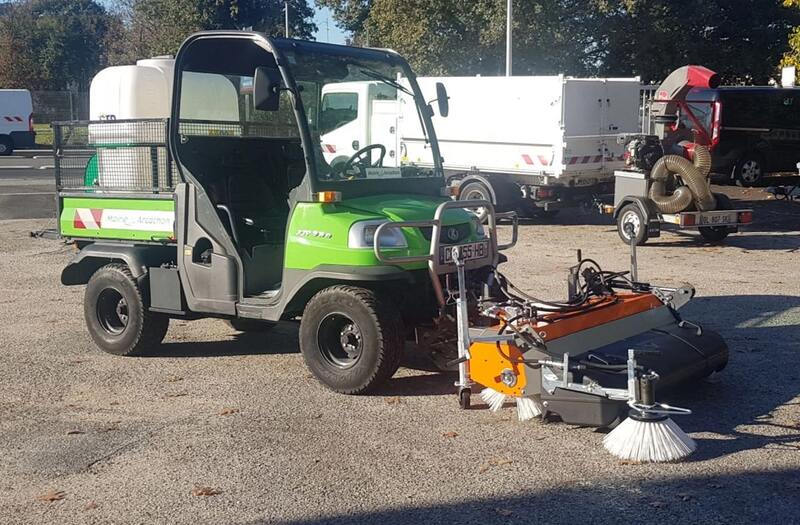
Sweep paths and yards
Lift loose dirt and debris; add collection where it needs removing.

Clear autumn leaves
Move light material into a planned collection area.

Open snowy routes
Compare receiver-mounted and hydraulic linkage-mounted blades.

Spread salt and grit
Choose the hopper, controls and mounting around your route.
Choose the working tool
A useful attachment. A complete installation.
Compare selected Kersten, Faulkner Brothers and Lehner equipment below. Each installation needs checking against your exact UTV model; a suitable mounting point alone does not confirm power or load capacity.
7 selected attachments. Compare the tools around your job.
Sweep the surface. Collect what should leave it.
A powered roller loosens and moves surface debris. A collector changes the result from moving material aside to taking it away, helping prevent leaves and dirt accumulating along the next edge.
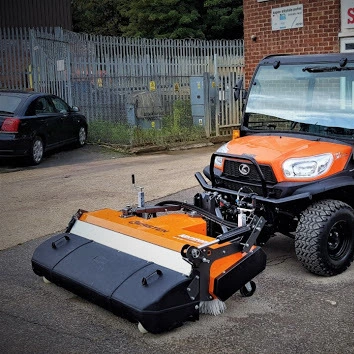
Front hydraulic sweeping
Kersten KM 15045 H
The 45 cm roller and individually adjustable gauge wheels let you set brush contact to the surface. Pendulum suspension helps the attachment follow changes in ground level.
Choose it when: You need regular hard-surface sweeping and can provide the correct front mounting and continuous hydraulic drive.
- 150 cm working width · 45 cm roller
- 20 L/min listed oil-flow requirement
- ABR 45 mounting bracket required
- Optional collector, gully brush and dust suppression
Specify the finish
Build around your surface and debris.
Open sweeping: Angle the brush to move debris to a planned edge or collection point.
Collection: Add the correct collector when debris must be lifted from the route. Include its weight and collected material in the load calculation.
Kerb work: A gully brush reaches material beside the main roller. Check the additional width and hydraulic services.
Dust control: Discuss suppression where needed, including the weight of a full water tank.
Make brush speed work with travel speed. Kersten’s Kubota RTV case study uses a separate auxiliary hydraulic system to run the sweeper and linkage. Confirm the available continuous flow at your intended working speed, plus pressure, return arrangements and cooling.
Move leaves before they become a surface problem.
A blower suits routes where leaves can be directed into a collection area. Plan the discharge so material stays clear of drains, neighbouring routes and people.
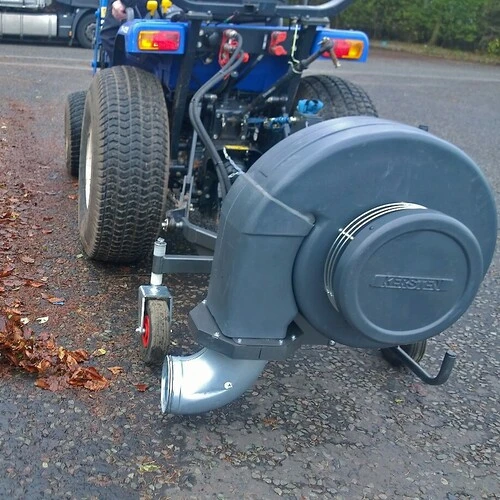
Higher-flow hydraulic option
Kersten LBV 6900 H
Hydraulic fan drive provides a vehicle-mounted leaf-clearing option where the carrier can supply the required oil flow. The standard right-hand outlet has an adjustable scoop; alternative outlet controls are optional.
Choose it when: Your proposed UTV installation has a verified 40 L/min hydraulic supply and suitable front mounting.
- 40 L/min recommended oil flow
- ABR-LBV bracket required
- Right-hand discharge as standard
- Optional variable-direction outlet
Check the power first
A sweeper hydraulic kit is not automatically a blower kit.
The listed Kubota RTV auxiliary kit provides an attachment motor circuit of up to 30 L/min. The LBV 6900 H lists 40 L/min. Those figures do not establish a compatible pairing.
Ask Kersten to confirm a suitable power and mounting arrangement for the exact vehicle before choosing this blower.
Fan drive and outlet control are separate requirements. A hydraulic rotating outlet needs the appropriate additional service.
Choose the snow blade around the vehicle.
A Faulkner Brothers receiver-mounted plough provides an integrated-battery lift route. A Kersten linkage-mounted blade suits an installation with the appropriate front linkage, bracket and hydraulic controls.
Receiver-mounted · integrated battery
Faulkner Brothers 1.8 m UTV plough — electric lift
Raise and lower the blade electrically using its integrated battery and supplied charger. Set the blade angle manually in one of three positions; electric lift does not mean electric angling.
Choose it when: Your UTV has an approved front 2-inch receiver installation and you want powered lift without drawing lift power from the vehicle.
- 180 cm blade width · 60 cm blade height
- 95 kg listed weight
- Electric lift/lower · manual three-position angling
- Aluminium blade · replaceable urethane edge

Front linkage · hydraulic angling
Kersten SCHN 16060 FK-ABR
A spring-protected blade with adjustable skids and hydraulic angling. The front linkage provides lift and lower; the correct connecting bracket completes the mounting.
Choose it when: You are specifying a hydraulic front-linkage system, as demonstrated in Kersten’s Kubota RTV winter installation.
- 160 cm blade width · 60 cm blade height
- 118 kg listed blade weight
- Hydraulic angling · 28° listed pivot angle
- Mounting bracket additional
Listing photograph shows a tractor installation. UTV fitment requires its own approved linkage and bracket.
Specify the complete winter setup. Check front receiver or linkage approval, axle loads, ground clearance and blade coverage when angled. Allow for the spreader and its material if carrying both tools together. Discuss storage wheels, lighting and replacement edges as part of the quotation.
Choose control first. Then choose hopper size.
Lehner’s 12 V spreaders work without hydraulic or mechanical PTO drive. POLARO E models let you adjust dosage and spreading width from the driver’s seat; the in-body POLARO L uses a screw conveyor to feed material from its larger hopper.
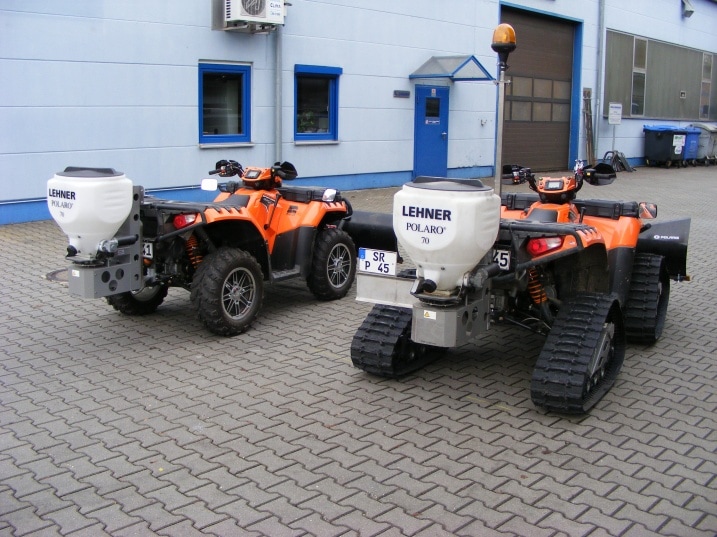
Compact hopper · electric dosing
Lehner POLARO 70 E
Cab-controlled dosage and spinner speed suit shorter routes and frequent changes between narrow paths and wider areas.
Choose it when: A smaller hopper suits the vehicle and refill points, and you want dosage adjustment from the seat.
- 70 litre hopper · 29 kg empty weight
- 12 V supply · LAS4 control panel
- 0.8–6 m adjustable spreading width
- Electric dosage · separate agitator and spinner motors
Kersten uses this installation photograph for the 70 litre listing. Confirm the E controller and vehicle-specific bracket.

More capacity · electric dosing
Lehner POLARO 170 E
A larger hopper with driver-controlled dosage and spreading width. Size the filled load against the mounting and axle ratings before extending your route between refills.
Choose it when: You need more material on board and your UTV and mounting can carry the complete working load.
- 170 litre hopper · 42 kg empty weight
- 12 V supply · LAS4 control panel
- 0.8–6 m adjustable spreading width
- Stainless steel frame, agitator and disc
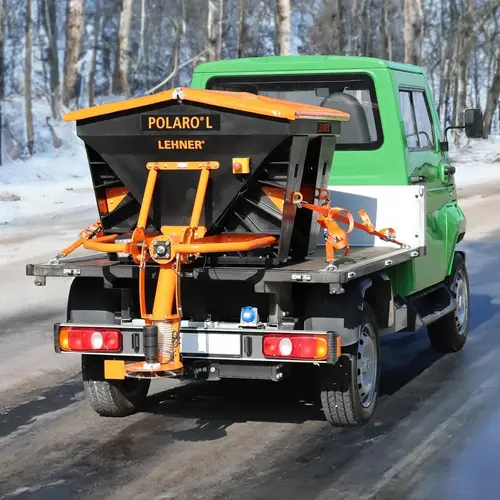
Loading-bed installation
Lehner POLARO L — 380 litre
Screw-fed spreading with dosage and width controlled from the cab. Kersten has demonstrated the POLARO L in a Kubota RTV loading bed.
Choose it when: Your bed dimensions and verified payload support the installation and planned fill level.
- 380 litre hopper · 140 kg empty weight
- 12 V supply · 0.8–6 m spreading width
- 1594 × 1199 × 884 mm listed dimensions
- Screw conveyor · optional AUTO-DOSIS
Prefer manual dosage? The POLARO 70 manual-dosing model sets flow at the machine while retaining driver-controlled spreading width. Electric dosing adds remote flow adjustment; speed-dependent dosing requires the correct AUTO-DOSIS or specified LISA configuration.
Hopper volume is not a payload allowance. The POLARO L listing estimates approximately 500 kg of salt at full capacity, plus 140 kg for the empty spreader. That is approximately 640 kg before fixings, people, tools or other carried equipment. Confirm a permissible fill level for your vehicle.
Prices describe individual listings, not complete fitted systems. All displayed prices exclude VAT. Vehicle-specific brackets, linkages, fitting, wiring, hydraulic kits and selected accessories may be additional. Live price updates run when this page is hosted on kerstenuk.com; otherwise the checked prices remain visible.
A better use of your site vehicle
Keep the UTV useful between transport jobs.
Choose equipment around the routes your team already maintains, then build a seasonal programme that makes practical use of the carrier.
Clear loose material regularly
Move leaves into collection areas and sweep dirt from hard routes. Removing organic deposits reduces the material available to build up into a growing medium.
Prepare the winter combination
Use a blade for snow clearance and a spreader for the planned treatment. Check the combined working load before specifying front and rear equipment together.
Change tools around the task
Choose a suitable attachment connection and a practical place to store each tool. Include parking supports, handling equipment and changeover access in the installation plan.
Mounting, power and load
Which attachment suits your utility vehicle?
Start with the exact make, model and year. Kubota RTV, John Deere Gator, Kawasaki Mule and electric utility vehicles have different mounting, power and load limits.
Most front tools need a connecting bracket between the linkage and attachment. The linkage supplies the lift arrangement; it does not automatically provide the implement’s drive power or the correct attachment connection.
| Working tool | Mounting route | Power and controls | Confirm before ordering |
|---|---|---|---|
| KM 15045 H sweeper | Approved front linkage + ABR 45 bracket | 20 L/min hydraulic drive; services for chosen options | Continuous flow, brush clearance, float and load with collector |
| LBV 6900 H blower | Approved front mounting + ABR-LBV bracket | 40 L/min recommended; outlet controls specified separately | Higher flow demand; do not assume a 30 L/min kit is sufficient |
| Faulkner Brothers UTV plough | Approved front 2-inch receiver installation | Integrated-battery electric lift; manual blade angling | Receiver rating, front axle load, width when angled and clearance |
| Kersten SCHN 16060 blade | Approved front linkage + plough bracket | Linkage lift/lower and hydraulic blade angling | Bracket, hydraulic services and complete front load |
| POLARO E mounted spreader | Vehicle-specific rear mounting | Suitable fused 12 V supply and cab controller | Mounting rating, filled load, cable routing and spinner height |
| POLARO L in-body spreader | Secured loading-bed installation | Suitable fused 12 V supply and cab controller | Bed dimensions, anchoring, axle loads and permissible fill level |
Hydraulic UTVs
A tipping-bed circuit is not proof of a continuous attachment supply. Confirm operating flow, pressure, cooling and return arrangements for the intended motor and controls.
Electric UTVs
Check the available 12 V auxiliary supply or suitable approved converter, including starting current and duty cycle. An integrated-battery plough lift avoids adding its lift demand to that supply.
Every working load
Include the bracket, tool, material, water, people and other equipment. Front leverage and rear overhang affect axle loading even when the nominal payload appears sufficient.
UTV installations and advice
See how the equipment works on site.
These Kersten articles show actual installation choices and explain why the vehicle’s available power matters. Confirm today’s specification for your own model.
Kubota RTV · case study
Hydraulic sweeper for Kubota RTV
See a front linkage, auxiliary hydraulic kit, ABR bracket and collecting sweeper brought together as a working installation.
Read the case study →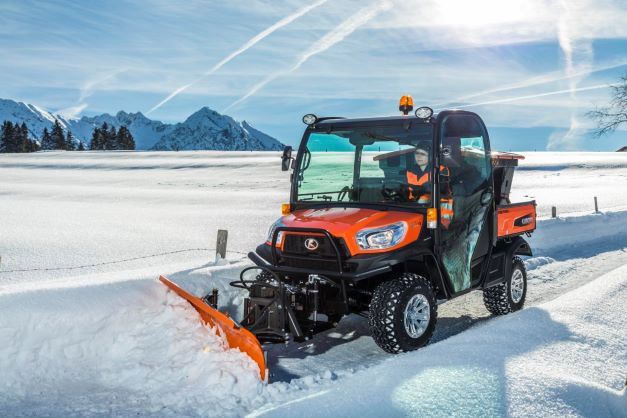
Kubota RTV · winter work
Winter equipment for the RTV
A Kersten hydraulic blade and Lehner POLARO L show the front-tool and loading-bed route to winter maintenance.
Read the case study →
Electric vehicles · technical advice
Salt spreaders for electric vehicles
Understand the role of separate spinner and agitator motors, controlled output and the vehicle’s auxiliary electrical supply.
Read the article →Your questions answered
Before you choose a UTV attachment.
Will these attachments fit any utility vehicle?
No. Confirm the exact model, mounting provision, hydraulic or electrical supply, axle ratings and permissible working load. A model family name or a receiver opening alone is not enough to approve an installation.
Do I need a front linkage for every attachment?
No. The Faulkner Brothers UTV plough uses an approved front 2-inch receiver installation. Kersten linkage-mounted tools need the relevant front mounting and connecting bracket. Lehner spreaders use an appropriate rear mount or secured loading-bed installation.
Does the Faulkner Brothers electric-lift plough angle electrically?
The 1.8 m electric-lift model featured here raises and lowers electrically using its integrated battery. Its three-position blade angling is manual. Confirm the chosen control specification in your quotation.
Can the Kubota RTV hydraulic kit run the LBV 6900 H?
The kit lists a motor circuit up to 30 L/min; the blower lists 40 L/min recommended oil flow. Do not treat them as a confirmed pairing. Kersten needs to check a suitable supply and installation for the exact vehicle and attachment.
What is the difference between POLARO and POLARO E?
On the manual-dosing POLARO, flow is set at the machine and spreading width is controlled from the seat. POLARO E adds electric dosage adjustment from the controller. Automatic adjustment with vehicle speed needs the appropriate specified AUTO-DOSIS or LISA configuration.
Can I fit a spreader to an electric UTV?
A Lehner spreader may suit an electric UTV with the correct mounting and a suitable 12 V supply. Confirm the auxiliary supply capacity, starting current, wiring and impact on working range. The traction battery voltage does not establish a suitable attachment connection.
How much salt can I carry?
Use the vehicle and mounting ratings to establish a permissible fill level. Include the spreader’s empty weight, material density, fixings, people and other equipment. A hopper does not have to be filled to its nominal volume.
Are these complete fitted-system prices?
No. Prices are for the individual listings excluding VAT. Linkages, brackets, hydraulic kits, wiring, fitting and selected accessories may be additional. Request a complete quotation for your UTV and intended work.
What should I send for a quotation or demonstration?
Send the UTV make, model, year and identification details; photographs of the front, rear receiver and loading bed; available hydraulic and 12 V supply details; vehicle load ratings; route widths and surfaces; and the debris, snow or spreading material you need to manage.
Build a complete working system
What should your utility vehicle do next?
Tell us the UTV, the surface and the job. We’ll help match the attachment, mounting, power and controls, and discuss a demonstration around your working conditions.