Professional salt, grit and material spreaders
Choose the spreader around the route, the carrier and where the material must land.
From powered pedestrian spreaders for paths to fixed-width tractor boxes, adjustable broadcast systems and high-capacity 12 V load-bed spreaders, Kersten UK can match the spreading principle to the site rather than simply choosing by hopper size.
Choose the operating format first
Five spreader types cover very different winter routes.
Capacity matters, but it comes after access, carrier type, spread pattern and control. Start with the way the machine needs to work, then choose hopper size.
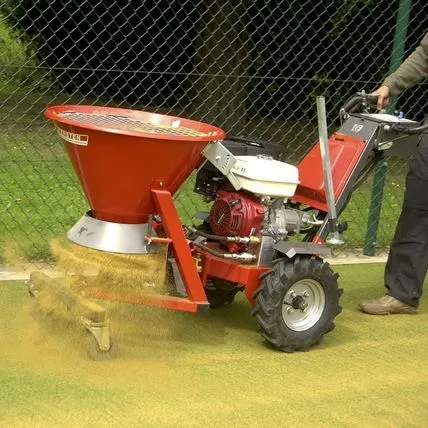
Powered pedestrian
Kersten SLDST attachments for two-wheel tractors and compact pedestrian routes where traction, manoeuvrability and a powered agitator matter.
Kersten range →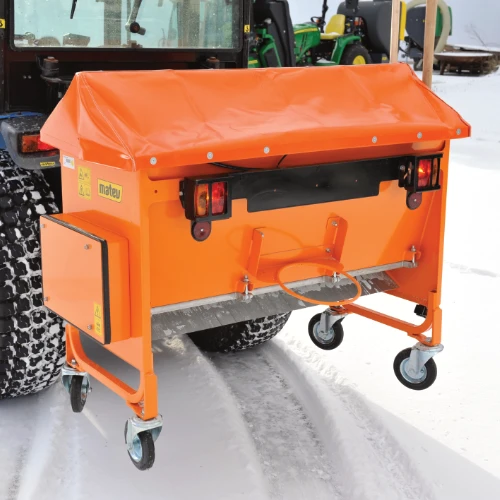
Fixed-width box
Matev SPR-BX places material only across the implement width, helping protect parked vehicles, façades, glazing and planted boundaries.
SPR-BX range →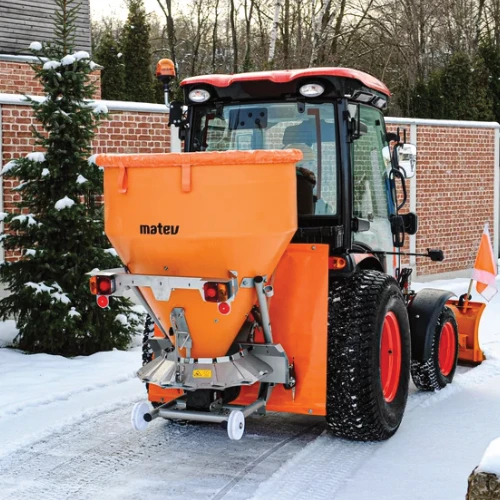
Tractor broadcast
Matev SPR-DS provides adjustable wide-area coverage for compact, municipal and agricultural tractors working mixed route widths.
SPR-DS range →.webp)
12 V universal
Lehner POLARO mounted spreaders suit ATVs, UTVs, tractors, pickups and other 12 V carriers with manual, electronic or LISA control.
POLARO range →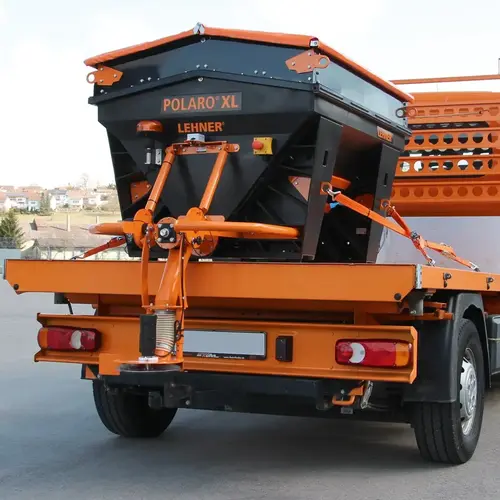
Load-bed spreaders
Lehner POLARO M/L/XL puts more material on the vehicle for longer municipal, estate and contractor routes with fewer refills.
M/L/XL range →Powered pedestrian and ride-on spreading
Kersten SLDST 70: compact powered spreading where access is tight.
The 70-litre SLDST family uses the carrier to power the spreading system, making it a strong fit for paths, cycle routes, campuses, estates and smaller car parks where a full-size tractor or vehicle-mounted hopper is unnecessary.
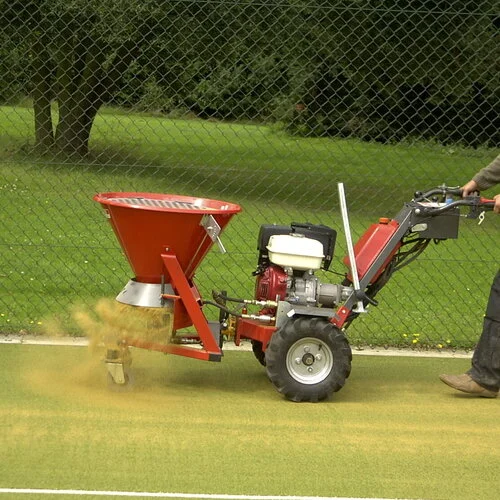
SLDST 70 K 35
Hydraulic 70-litre rotary spreader for the Kersten K820 Pro and K1500 families. A compact route solution for paths, entrances and smaller sites.
SLDST 70 H-KU 70
Hydraulic SLDST version matched to the K2100 professional two-wheel tractor, retaining compact access with the higher-capacity Kersten carrier.
SLDST 70 M-U 70
Mechanically driven version for compatible UBS Hydro, Alpin and Matador two-wheel tractor platforms where a PTO-style drive is the correct fit.
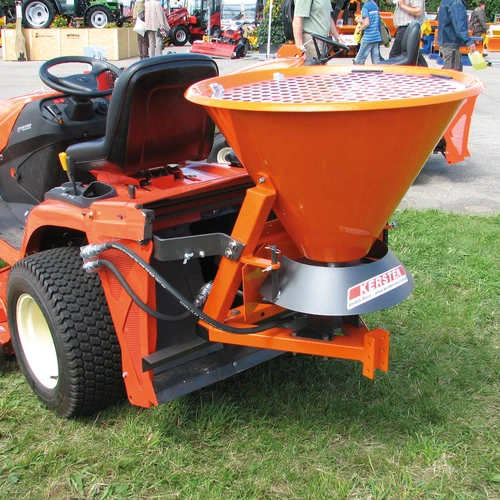
SLDST 70 H-FKDR
Rear-mounted hydraulic spreader for compatible ride-on mowers using the Kersten FKDR linkage route, turning an existing mower into a winter carrier.
Live prices are read from the linked product pages and are subject to VAT unless the product page states otherwise. Carrier, bracket, drive and accessory requirements can change the complete installed price.
Tractor-mounted spreading
Matev: control where the material lands, then choose the construction.
Matev gives tractor operators two genuinely different spreading principles. SPR-BX keeps material inside a fixed treatment width. SPR-DS broadcasts from 1–8 metres, then lets you choose value-focused ST steel or corrosion-resistant IX stainless construction.
SPR-BX fixed-width box spreaders
The defining advantage is containment. Material drops across the implement width instead of being thrown beyond it, helping protect parked vehicles, façades, glazing, planting and other sensitive boundaries.
Matev SPR-BX 80
The narrowest fixed-width Matev for footpaths, entrances and constrained tractor routes.
Why choose it: Maximum control in the tightest spaces; the treatment footprint stays inside 800 mm.
Matev SPR-BX 100
A balanced fixed-width option for compact tractors working pavements, estate roads and municipal routes.
Why choose it: More route capacity without giving up exact 1,000 mm edge-to-edge placement.
Matev SPR-BX 120
The largest SPR-BX combines the widest fixed treatment width with the greatest hopper capacity in the box-spreader family.
Why choose it: Best for longer routes where precise placement still matters more than broadcast reach.
SPR-DS adjustable broadcast spreaders
SPR-DS is the flexible route choice: narrow the pattern for paths and open it out for estate roads, car parks and larger areas. After selecting capacity, choose the construction around budget, salt exposure and maintenance regime.
Lower initial cost, same professional spreading concept.
ST uses robust steel construction and is the value-focused choice for fleets that can wash down and maintain the machine carefully after corrosive salt work. The PE hopper, stainless spreading plate and 1–8 m SPR-DS concept remain.
Jump to ST steel models →Higher corrosion resistance for frequent salt exposure.
IX upgrades the spreader structure to stainless steel. It is the stronger choice for intensive winter programmes, repeated salt exposure and buyers placing more weight on long-term corrosion resistance than the lowest purchase price.
Jump to IX stainless models →SPR-DS ST steel versions
Four capacities from 125 to 600 litres. Choose ST when purchase value is important and the spreader will receive disciplined washing and maintenance after winter use.

SPR-DS 125 ST
The most compact broadcast size for smaller tractors and shorter professional routes.
Why choose it: Lowest-capacity, value-focused entry to Matev's adjustable 1–8 m professional broadcast system.

SPR-DS 250 ST
The balanced mid-range ST size, combining useful route capacity with manageable dimensions.
Why choose it: A strong general-purpose size where you want professional broadcast control without moving to the heavier 400/600 L route.

SPR-DS 400 ST
Higher-capacity steel spreader for longer municipal, estate and contractor routes.
Why choose it: Reduces refill interruptions while keeping the lower-cost ST construction route.

SPR-DS 600 ST
The maximum-capacity ST version for long routes and high-output winter programmes.
Why choose it: Maximum route duration in the value-focused steel construction, subject to tractor payload and linkage capacity.
SPR-DS IX stainless-steel versions
The same four capacities with a stainless-steel spreader structure. Choose IX where salt exposure is frequent, washing opportunities are less predictable, or long-term corrosion resistance carries more weight.
SPR-DS 125 IX
Compact stainless-steel broadcast spreader for smaller tractors and tight professional routes.
Why choose it: Compact dimensions plus the strongest construction choice for repeated salt exposure.
SPR-DS 250 IX
A versatile stainless mid-range size for mixed municipal, estate and contractor routes.
Why choose it: Probably the most broadly useful IX size: manageable dimensions, useful capacity and increased corrosion resistance.
SPR-DS 400 IX
High-capacity stainless spreader for longer winter routes and repeated professional use.
Why choose it: A strong municipal/contractor combination of route capacity and corrosion-resistant construction.
SPR-DS 600 IX
The largest stainless SPR-DS for extensive routes where refill reduction and corrosion resistance are both priorities.
Why choose it: The premium high-capacity Matev option for intensive winter programmes, subject to tractor payload and linkage checks.
Prices above are read live from each individual Kersten UK product page when this page loads. They represent the displayed product-page price; required drive kits, agitators, linkage components, control systems and accessories may be additional depending on the model and tractor.
12 V vehicle-mounted spreading
Lehner POLARO: put professional dosing on almost any suitable 12 V carrier.
Lehner is the flexible vehicle route: ATVs, UTVs, tractors, loaders, pickups and municipal vehicles can use a POLARO where the mounting, electrical supply and payload are suitable.
POLARO manual dosing
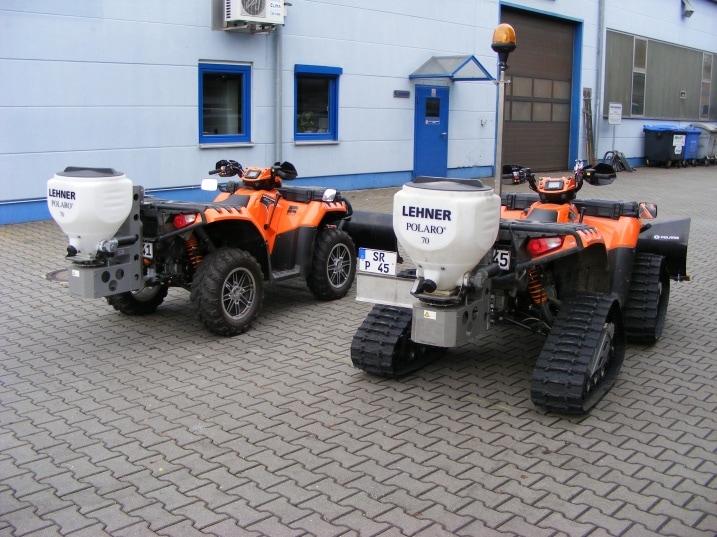
POLARO 70
Compact 12 V universal spreader for repeatable paths, entrances and smaller car parks.
POLARO 110
Versatile manual-dosing size for UTVs, compact tractors and pickups on mixed paths and medium car parks.
POLARO 170
More hopper capacity for longer winter routes while retaining straightforward manual rate setting.
POLARO 250
Largest manual universal hopper for higher-output car parks, industrial estates and road-maintenance rounds.
POLARO E electronic dosing
POLARO E 70
Compact electronic dosing for narrow routes where the operator needs to alter material rate from the driving position.
POLARO E 110
Strong all-rounder for pickups, compact tractors and utility vehicles covering varied surfaces and route widths.
POLARO E 170
Useful capacity for frequent winter-service work where repeatable in-cab dosing matters throughout the shift.
POLARO E 250
High-capacity electronic universal spreader for large depots, campuses, industrial estates and contractor routes.
POLARO E LISA app-led AUTO-DOSIS
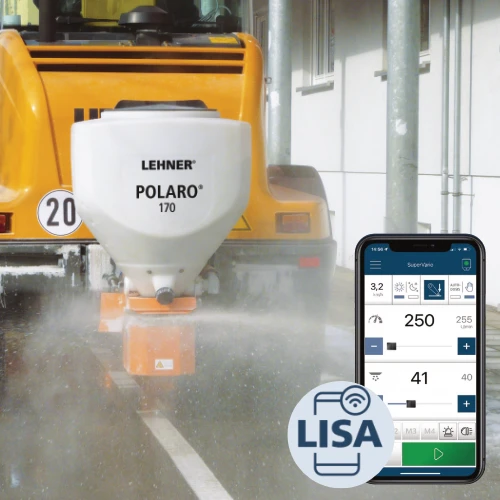
POLARO E LISA 70
Compact app-controlled model with speed-dependent AUTO-DOSIS for professional routes with changing vehicle speed.
POLARO E LISA 110
App-led 110 L model well matched to variable-speed paths and car parks where automatic dose adjustment improves consistency.
POLARO E LISA 170
Professional app-led setup for mixed-speed municipal, estate and contractor routes needing greater hopper capacity.
POLARO E LISA 250
High-capacity app-control option for extensive routes where speed-related dosing and fewer refills are both valuable.
POLARO M / L / XL load-bed spreaders
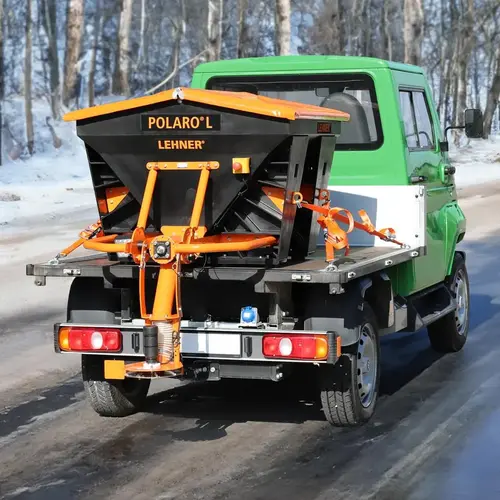
POLARO M 220
Insert-hopper route for small municipal vehicles, sweepers and pickups with a suitable loading bed and payload.
POLARO L 380
Professional in-body spreader for UTVs, pickups and compact municipal vehicles requiring substantially more route capacity.
POLARO XL 550
Largest listed POLARO for pickups, trucks and high-payload utility vehicles covering extensive winter-service rounds.
Live prices are fetched from each individual Kersten UK product page. Vehicle brackets, mounting hardware, electrical accessories and optional control packages can be additional.
Spreader range selector
Start with the carrier and the required spread pattern.
This quick guide points to the strongest starting family. Final specification still needs payload, linkage, electrical or hydraulic services, material, spread rate and route-speed checks.
Complete the winter route
Spreading treats ice. The same fleet may also need to move snow.
A complete winter-maintenance setup often combines de-icing with a blade for pushing and windrowing snow, or a snow blower where deeper accumulation cannot simply be stored at the side of the route.
Kersten SCHN snow ploughs
Professional blades for pedestrian power units, ride-on mowers and compact tractors. Choose the lighter SCHN 45 family or the taller SCHN 60 tractor-mounted range.
Explore SCHN 45 →Explore SCHN 60 →
Faulkner Brothers ploughs
Lightweight professional aluminium snow ploughs for UTVs, pickups and 4x4s, using vehicle-friendly mounting and electric or manual control routes.
Explore Faulkner Brothers ploughs →Cerruti snow blowers
Two-stage mechanically or hydraulically driven snow blowers for compact tractors and loaders when deeper snow needs to be collected and discharged rather than windrowed.
Explore Cerruti snow blowers →Go deeper by manufacturer
Detailed range pages sit behind this buying guide.
Use this page to select the operating format. Then move into the detailed manufacturer page for model-level specification, control choices, accessories and fitment.
Kersten
Powered 70 L spreaders
Carrier-specific SLDST spreaders for K-series, UBS, Matador and selected ride-on mower installations.
View the Kersten 70 L spreader page →Matev
Tractor-mounted spreaders
SPR-BX fixed-width box spreaders and SPR-DS adjustable broadcast systems for compact through agricultural tractors.
View the Matev spreader page →Lehner
POLARO 12 V spreaders
Universal mounted and load-bed systems with manual, electronic and LISA app-led dosing routes.
View the Lehner POLARO page →Spreader essentials
Common questions before specifying a salt or grit spreader.
When is a fixed-width box spreader better than a disc spreader?
Choose a fixed-width box when material must remain inside a defined path or implement width. A broadcast disc is better when one machine needs to cover changing widths and larger open areas.
Why choose a powered Kersten pedestrian spreader?
It gives a compact route machine a powered agitator and spreader rather than asking an operator to push a loaded hopper manually. It is particularly useful where narrow access and existing Kersten or compatible two-wheel tractors already define the fleet.
What is the difference between Matev ST and IX?
ST uses robust steel construction and is the value-focused choice where the machine can be cleaned carefully after salt work. IX upgrades the spreader structure to stainless steel for increased resistance to corrosion during intensive winter service.
What is the difference between Lehner manual, E and LISA control?
Manual models keep the material-rate setting simple. POLARO E adds powered dosing adjustment from the operator position. LISA adds smartphone control and compatible speed-related AUTO-DOSIS for routes where vehicle speed changes significantly.
Should I choose hopper capacity first?
No. Start with carrier compatibility and required spread pattern, then size the hopper around route length, payload and refill strategy. A larger hopper can make the vehicle unsuitable if payload, axle loading or rear overhang are ignored.
Do spreader prices include the complete installation?
Not always. Drive kits, agitators, brackets, control packages, covers, lighting and vehicle interfaces may be separate. The product page and final Kersten quotation should be used to confirm the complete installed specification.
When should a snow blower be considered instead of a plough?
A plough is the normal first choice for pushing or windrowing snow where there is somewhere to store it. A snow blower becomes more useful in deeper accumulations or confined routes where the snow needs to be collected and thrown clear.
Specify the full winter setup
Send us the vehicle, route and material.
Kersten UK can confirm the spreader family, hopper size, mounting arrangement, drive or electrical requirement, dosing control and the snow-clearing equipment that best matches the same route.