Kersten UK professional winter equipment
Professional snow ploughs for UTVs, 4x4s, tractors and compact carriers.
Start with the vehicle you already operate, then compare blade width, lift system and mounting route across the Faulkner Brothers, SCHN60 and SCHN45 ranges.
Start with the carrier
Choose the plough family that matches the vehicle and route.
Each family is designed around a different carrier class, mounting system and level of winter work.
 (1).webp)
Faulkner Brothers
Best for: driveways, car parks, industrial yards and dispersed sites reached by road.
- UTVs and RTVs
- 4x4 vehicles and pickups
- 12 V electric or manual operating options
 (1).webp)
SCHN60
Best for: roads, campuses, commercial car parks, estates and professional winter-maintenance rounds.
- Compact and sub-compact tractors
- Ride-on and municipal carriers
- Hydraulic or specified manual angling
.webp)
SCHN45
Best for: footpaths, entrances, driveways, small car parks and confined estate routes.
- Two-wheel tractors
- Ride-on mowers
- Compact and sub-compact tractors
Snow plough ranges
Compare the complete range by carrier and operating system.
Search by vehicle, blade width, manual, hydraulic or electric operation, or browse the three families in order below.
UTVs, 4x4s and pickups
Faulkner Brothers: mobile snow clearance between sites.
Lightweight aluminium ploughs for vehicles that need to travel by road between driveways, car parks, yards and dispersed properties. Choose the blade width and whether lift is manual or electric.
Faulkner Brothers 1.5 m UTV snow plough - manual lift
Narrower 150 cm aluminium UTV plough with manual lift and three-position manual angling.
Faulkner Brothers 1.5 m UTV snow plough - electric lift
150 cm aluminium UTV plough with integrated-battery electric lift and lower, plus manual blade angling.
Faulkner Brothers 1.8 m UTV snow plough - manual lift
180 cm aluminium UTV plough using a 2-inch receiver, manual lift and three-position blade angling.
Faulkner Brothers 1.8 m UTV snow plough - electric lift
180 cm UTV model with integrated-battery electric lift and lower, retaining manual three-position angling.
Faulkner Brothers 2.0 m 4x4 snow plough
Fully electric 200 cm aluminium plough for compatible 4x4 vehicles and 3.5-tonne pickups with a front receiver hitch.
Professional tractor range
SCHN60: higher-capacity clearing for regular winter work.
A 60 cm-high blade family for compact tractors, municipal carriers and professional winter routes. Six working widths allow the blade to match the carrier track, route width and snow volume.
Snow blade 130 cm - SCHN 13060 FK-ABR
The most compact 60 cm-high professional blade, suited to constrained tractor routes and narrow access.
Snow blade 140 cm - SCHN 14060 FK-ABR
A compact professional width for estate roads, paths and smaller car parks.
Snow blade 150 cm - SCHN 15060 FK-ABR
Balanced professional blade width for compact tractors maintaining roads, yards and car parks.
Snow blade 160 cm - SCHN 16060 FK-ABR
Mid-range 60 cm-high blade for suitable compact tractors and utility carriers requiring more coverage than the 150 cm model.
Snow blade 180 cm - SCHN 18060 FK-ABR
Higher-output blade for wider roads, commercial areas and regular professional winter routes.
Snow blade 200 cm - SCHN 20060 FK-ABR
Largest listed SCHN60 blade for suitable carriers clearing broad roads, yards and municipal-style routes.
Pedestrian, mower and compact-carrier range
SCHN45: choose the mounting group before the blade width.
The SCHN45 family covers several very different carrier types. The products are separated below so pedestrian machines, ride-on mowers and compact carriers are not mixed into one long list.
Pedestrian and multi-attachment machines
Compact blades for two-wheel tractors and multi-attachment power units where manoeuvrability matters most.
Snow blade 100 cm - SCHN 100 ST-K 35
100 cm spring-protected blade for Kersten K-series pedestrian two-wheel tractors, narrow paths, entrances and confined routes.
SCHN 100 FK-M-KU 70 - Snow Plough 100 cm
100 cm manual-angling blade for Kersten K-series, UBS-series and Matador M-Trac power units.
SCHN 125 FK-M-KU 70 - Snow Plough 125 cm
Wider 125 cm blade for compatible pedestrian power units where more output is required without moving to a tractor plough.
Ride-on mowers: manual kits
Complete manual-lift packages for listed John Deere, Kubota and Iseki ride-on mower models.
Snow Plough kit 125 cm for John Deere X300 and X540
Vehicle-specific 125 cm kit for selected John Deere X-series ride-on mowers, supplied with the required mounting arrangement.
Snow Plough kit 125 cm for Kubota GR series
Complete manual-lift and angling kit for compatible Kubota GR1600 and GR2120-series ride-on mowers.
Snow Plough kit 125 cm for Iseki SXG216
Complete 125 cm snow-plough kit developed for the Iseki SXG216 ride-on mower.
Ride-on mowers: hydraulic kits
Vehicle-specific blades for carriers equipped with the required hydraulic services and mounting hardware.
Snow blade 125 cm for John Deere X540
Hydraulic lift and angling package for compatible John Deere X300, X540 and X590 ride-on machines.
Snow blade 125 cm for Kubota GR series
Hydraulic 125 cm package for compatible Kubota GR-series ride-on mowers, including the mounting hardware.
Snow blade 125 cm with hydraulic lift and angling for Iseki SXG216
Hydraulic lift-and-angle 125 cm blade package for the Iseki SXG216.
Compact tractors and front-mounted carriers
Spring break-back blades for compatible front linkages, front-mounted mowers and compact tractors.
SNOW PLOUGH 110 cm Spring Break Back for FKDR linkage
110 cm spring break-back blade for ride-on mowers equipped with the Kersten FKDR front linkage.
SNOW PLOUGH 125 cm Spring Break Back for FKDR linkage
125 cm spring break-back blade for FKDR-equipped ride-on mowers and compact carriers.
SNOW PLOUGH 135 cm Spring Break Back for FKDR linkage
135 cm spring break-back blade for larger FKDR-equipped mower and compact-carrier routes.
Snow blade 125 cm working width - without ABR bracket
125 x 45 cm professional blade for a compatible compact carrier; the correct ABR mounting frame is specified separately.
Snow Plough Blade 135 x 45 cm for front-mounted mowers and compact tractors
135 x 45 cm professional hydraulic blade for compatible front-mounted mowers and compact tractors.
More SCHN45 products
Newly published SCHN45 products appear here when available.
Before ordering
Four checks protect the carrier and improve clearing performance.
Working and angled width
The blade must still cover the tyre track when angled, while remaining manageable through gates and narrow routes.
Lift and control system
Confirm whether the carrier provides mechanical lift, hydraulic services or the electrical capacity required by the selected system.
Mounting geometry
The mounting frame, receiver height and blade attack angle must suit the exact carrier model rather than a general vehicle category.
Snow storage and surface
Confirm where the windrow can remain, whether kerbs or gravel are present, and whether a blower is needed where snow cannot be pushed aside.
Winter service starts where the gritter lorry stops
Footways, car parks, estate roads, depots, school grounds and park paths. The ground your winter plan still has to cover — usually with the vehicles you already own.
Before we talk about machines
What the rest of this pack covers
Where winter duties actually sit, what a plan needs to contain, how to match the method to the fall, what to check before fitting equipment to your own vehicles, why precision spreading pays for itself, and a case study from a council doing exactly that.
Product recommendations come last, and only once we understand your sites.
Free demonstration
We have a large range to call on. If you would like to see any of it working — on your own surfaces, with your own operators — we are happy to arrange a demonstration at no cost.
Where the duty bites
Most winter service planning is written around the primary gritting network. The claims, the complaints and the reputational damage tend to arrive from everything else: the car park, the footway outside the leisure centre, the path to the depot door.
Highways Act 1980, s.41(1A)
A highway authority must ensure, so far as is reasonably practicable, that safe passage along a highway is not endangered by snow or ice. Inserted in 2003 after Goodes v East Sussex removed snow and ice from the general maintenance duty. In Smithson v Lynn (2021) the court held that the burden of proving reasonable practicability sits with the authority — and that rigid application of a policy, without reacting to events, can itself put you in breach.
Occupiers' Liability Acts 1957 & 1984
Car parks, parks, cemeteries, leisure and community buildings, housing land and school grounds are not highway. The duty here is to take such care as is reasonable to see that visitors are reasonably safe. This is where most winter slip claims against district, borough, town and parish councils originate — and where a gritter lorry was never going to help.
Health & Safety at Work etc. Act 1974
Depots, yards, refuse rounds and access routes are workplaces. Keeping them passable is a matter of employee safety and service continuity, not presentation. A blocked depot on the first morning of snow delays every other winter response you have planned.
What a plan is expected to contain
Winter service plans are generally built on the Well-managed Highway Infrastructure code of practice — section 3.7 covers winter service — alongside National Winter Service Research Group guidance. Between them they point at treatment of transport interchanges, promoted facilities such as community and leisure centres, priority for emergency services and critical infrastructure, priority for vulnerable users, and the resilience of your winter service resources.
Every one of those headings describes ground a lorry-based route cannot reach. Each needs an owner, a method and a machine.
The evidence question
If a claim lands, the question is not whether it snowed. It is whether you can show a reasoned policy, the resources to deliver it, and a record of what you actually did on the day.
Equipment that is fitted, serviced and rostered before the season is part of that answer.
Seven ingredients of a winter plan
Preparing for winter is rarely a matter of getting the plough out. Most of the cost and most of the risk is settled in September, by decisions that take an afternoon. This is the checklist from our planning guide.
Rough guide to spread rates
Full guide, with the reasoning behind each step: kerstenuk.com/effective-winter-maintenance-planning
Prevention beats clearance
Treating key surfaces before temperatures fall makes snow far less likely to bond, and stops ice forming at all. It is cheaper in labour, in material and in claims than clearing a compacted surface two days later.
Two items worth adding to the seven: book pre-season servicing while the workshop is quiet, and decide now how you will record times, routes and materials. Recording costs nothing in September and is the whole case in March.
Match the method to the fall
One machine will not cover a British winter. The useful question is not which is best, but which of the four is right for the depth, the surface and the point in the event you are at.
Depths are practical guidance for method selection, not machine limits. Snow type, surface, gradient and carrier all change the picture.
Certification and servicing
Kersten plough and snow blower mounts hold TÜV certification, and a pre-season service for ploughs and spreaders is offered ahead of each winter. Book it while the workshop is quiet rather than on the first cold morning.
More than one method
Most sites need two: something to treat before the event and something to clear after it. A spreader plus whichever clearing method matches your typical fall covers the great majority of British winters.
Fitting to a vehicle you already own
Ride-on mowers, compact tractors, UTVs, pickups and pedestrian power units mostly sit idle from November to March. Most will take a blade, a brush or a spreader, which turns a winter purchase into an attachment rather than a vehicle.
What the DfT guidance says to check
Summarised from the Department for Transport guidance note on temporary snow ploughs, which also carries worked examples from Wiltshire Council, Renfrewshire and Tesco. Responsibility for compliance rests with the driver of the vehicle. Read it in full at gov.uk/government/publications/temporary-snow-plough-use
What will take what — a starting point
| Carrier you may already run | Plough | Spreader | Blower | Sweeper |
|---|---|---|---|---|
| Pedestrian power unitKersten UBS, K1500 | SCHN45 blade | Kersten SLDST 70 | Kersten SCHNFR | Kersten brush |
| Ride-on mowere.g. John Deere X-series with FKDR linkage | SCHN45 mower kit | SLDST 70 H-FKDR | — | Mounted brush |
| Compact tractore.g. Kubota EK1-261 with front linkage | SCHN60 series | Matev SPR-BX / SPR-DS | Cerruti Basic / Intermediate | Wide area brush |
| UTV or ATVe.g. Kubota RTV | Faulkner Brothers 1.5 / 1.8m | POLARO 70–250 | — | — |
| 4x4 pickupe.g. Ford Ranger, Nissan Navara | Faulkner Brothers 2.0m | POLARO 110 / L / XL | — | — |
| Municipal sweepere.g. Hako Citymaster | SCHN60 mounted | POLARO M 220 | — | Fitted |
Indicative only. A mounted attachment is a complete system — linkage, power supply, bracket, controls and geometry all have to be confirmed against your exact model. Send us your vehicle list and we will check it: kerstenuk.com/Kersten-Machine-Attachment-Compatability-Centre
Why these ranges are built this way
Most winter attachments are specified on working width and hopper capacity. But on the vehicles a council actually has spare in January — pickups, UTVs, ride-on mowers, small tractors — the binding constraints are rarely width or capacity. They are weight on the front axle, and available electrical current. Both of our main ranges are engineered around those two limits, which is why they fit vehicles that other equipment rules out.
And three things that follow from both
The cost is in the salt
Salt is the recurring line in a winter budget, and the one most often spent without measurement. Over-application does not make a surface safer: it raises material cost, accelerates corrosion of vehicles and structures, and moves chloride into soft landscape and watercourses.
The variable you control is not how much salt exists in the store. It is how precisely it lands on the surface that needs it — which is a function of the spreader, not the operator's arm.
There is a second saving that rarely gets counted. A route that takes three hours instead of a full day can be finished before the site opens, which keeps the public off surfaces mid-treatment and takes a category of claim off the table entirely.
.webp)
Ask for the numbers before you specify
Bags of salt used per treatment run, hours of labour per run, and how much of each site actually gets treated. Most teams have never had cause to write these down — and they are usually where the business case is hiding. The case study overleaf is exactly that calculation, done by a council on its own sites.
Spreaders and ice management
Capacity matters, but it comes after access, carrier type, spread pattern and control. Start with the way the machine has to work on your route, then size the hopper.
Choose the operating format before the hopper size
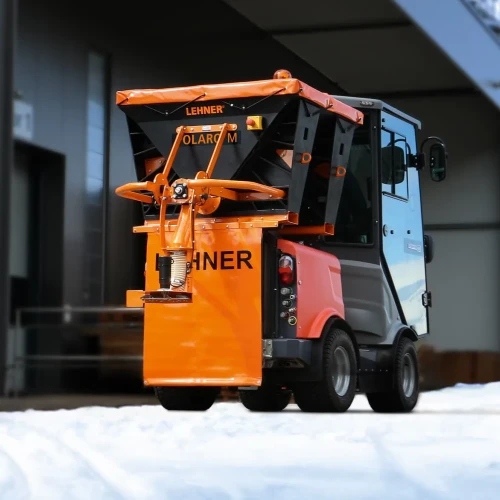
Lehner publishes the POLARO range as drawing around 30% of the current needed by other electric spreaders, which is what makes it workable on electric vans and utility vehicles where battery range is the constraint. Full range and live prices: kerstenuk.com/Salt-Spreaders-and-Ice-Management
Fixed width or broadcast?
A fixed-width box keeps material inside the implement width, which is what you want alongside parked cars, glazing, façades and planting. A broadcast disc is the better answer when one machine has to cover changing widths and open areas.
Manual, electronic or app-led?
Manual dosing is fine on a stable route. Electronic control lets the operator change rate from the driving position. Speed-related dosing keeps application consistent where vehicle speed varies across a round — which is where most over-application happens.
New Forest District Council
New Forest District Council grits 54 car parks across a district of some 750km², from Martin to Ringwood, Milford-on-Sea and Calshot. The work was done with pedestrian salt spreaders until the council bought two Lehner Polaro 110 tailgate spreaders for the back of its pickups.
Two effects worth separating
The salt and labour savings paid for the machines inside the first season. The second effect was the claims position: because the work now finishes before the car parks open, the public are no longer walking across sites mid-treatment. The council reported a reduction in insurance claims as a result.
The range
Start with the carrier you already operate, then compare blade width, lift system and mounting route. We are happy to demonstrate any of it.
Snow ploughs · three families, chosen by carrier
Full range, 25 ploughs with widths and mounting routes: kerstenuk.com/Pedestrian-tractor-mounted-Snow-plough-series
Snow blowers · when the snow has to leave the route
A blade is faster for ordinary snowfall where there is room to windrow it. A blower earns its place when the snow has to leave the route entirely — when banks start eating the usable width, or when it cannot be stacked beside entrances and parking.
Two stages, not one
A front auger cuts into the drift and breaks compacted snow, then a separate impeller throws it out through the chute. Splitting intake from discharge is why these machines cope with wet, heavy snow that stalls a single-stage paddle.
| Range | Carrier | Working width | Where it fits |
|---|---|---|---|
| Kersten SCHNFR | UBS power units | 600 / 800 mm | Narrow paths and gateways. Direct PTO drive, adjustable skids, 180° manual chute. |
| Cerruti Basic | 14–40 hp | 900–1400 mm | Compact tractors and out-front carriers on tighter routes, with hydraulic chute rotation. |
| Cerruti Intermediate | 26–55 hp | 1300–1600 mm | Deeper accumulations and repeated duty; a 700mm intake takes more snow per pass. |
| Cerruti Profy | 30–55 hp | 1400–2000 mm | High-output work on long roads, yards and estates, with deflector control. |
17 models. Horsepower alone is not enough — front linkage, PTO speed and height all have to match. Full range: kerstenuk.com/pedestrian-and-tractor-mounted-snow-blower-series
And the machine you already use in summer
A sweeper is the fourth winter tool. The brush that clears your paths in summer handles light snow — angled to wind-row, working down to the surface so it dries rather than refreezes, and kinder than a blade on gravel, block paving and soft edges.
We wish you every success, and hope this guide helps you achieve what you are aiming for — whether you choose to buy from us or not.
Kersten Compatibility Centre
Find the correct mounting route for your machine.
Select the carrier and winter application to identify the closest established mounting route. Kersten UK will then confirm the exact blade, bracket, services and carrier limits.
Build the complete winter fleet
Plough the snow, treat the surface and move deep accumulations.
A plough is one part of winter resilience. Pair it with controlled salt or grit application, or use a snow blower where there is nowhere suitable to windrow the snow.
Lehner spreaders
Apply salt or grit after ploughing, with 12 V systems for ATVs, UTVs, tractors, pickups and municipal vehicles.
View spreadersSnow blowers
Collect and discharge snow clear of the route where banks, walls or limited storage make ploughing alone impractical.
View snow blowersWinter maintenance equipment
Review the wider Kersten approach to snow clearance, ice management and keeping sites operational.
Explore winter equipmentSnow plough selection support
Send us the vehicle details and the route you need to clear.
We will match the carrier to the appropriate plough family, blade width, mounting bracket and control system.
- Carrier make, model and year
- Front linkage, subframe or receiver details
- Available hydraulic or 12 V electrical services
- Route width, surface and typical snow conditions