Hydraulic attachments for telehandlers
Lift more.
Keep your site clean.
Clear mud from access roads, collect yard debris and reclaim overgrown edges. Turn your telehandler into a cleaning carrier with the right hydraulic tool and floating connection.
Start with the job
What does your telehandler need to tackle?
Choose around the material, access width and finish you need. Then confirm the carrier interface, hydraulic supply and complete attachment load.

Sweep and collect
Clear soil and loose material from yards, tarmac and block paving.
Compare FKM 60 sweepers →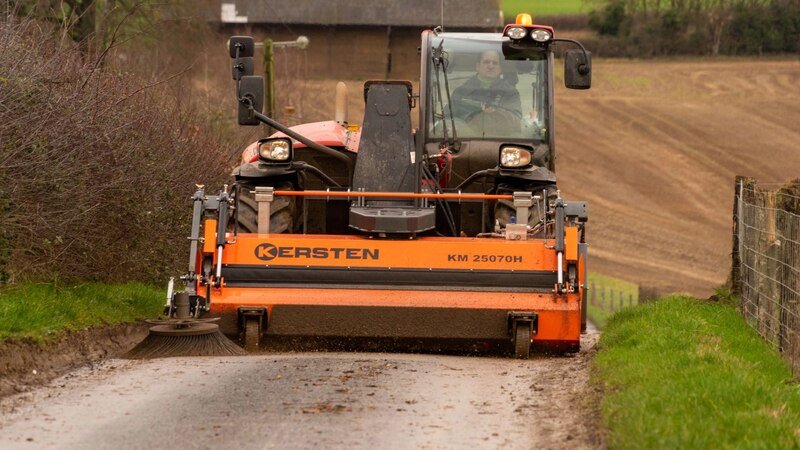
Move bulky debris
Compare larger rollers and widths for demanding sweeping routes.
Compare KM 70 sweepers →
Loosen, then clear
Choose the brush action and plan where the loosened material will go.
Compare weedbrushes →Choose the tool, then confirm the installation
Put your telehandler to work on surface maintenance.
Hydraulic sweepers remove loose material. Weedbrushes loosen established growth. These individual products are starting points for a carrier-specific quotation.
FKM 60 hydraulic sweepers
Compare three working widths around your routes and carrier. Floating collection, gully brushes and dust suppression can complete the working setup.
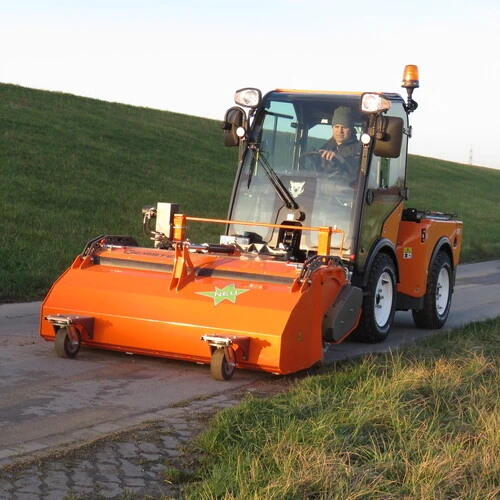
Narrower FKM 60 sweeping
FKM 19060 H
A 1.9 m hydraulic brush for routes where access and manoeuvring space limit the complete installation.
Choose it when: You need a narrower FKM 60 and your carrier meets the hydraulic requirement.
- Working width
- 190 cm
- Overall width
- 202 cm
- Brush diameter
- 60 cm
- Required flow
- 50 l/min minimum
- Listed sweeper weight
- 325 kg
Add the matched ABR 60 telehandler hitch and 190 cm collector where required. Allow for collector, water, bracket and debris weight.
View attachment →
Documented telehandler collection
FKM 22560 H
The 2.25 m model used in the Manitou MT625H and Merlo examples, with floating hitch and collection.
Choose it when: You want a proven medium-width telehandler sweeping route.
- Working width
- 225 cm
- Overall width
- 237 cm
- Brush diameter
- 60 cm
- Required flow
- 50 l/min minimum
- Listed sweeper weight
- 340 kg
Case-study setup: ABR 60 TELE and SSBF 22560 collector. The Manitou installation also includes a dust-suppression kit.
View attachment →
Wider FKM 60 sweeping
FKM 25060 H
Cover more ground per pass while retaining the 60 cm roller and optional floating collection arrangement.
Choose it when: Open routes justify 2.5 m coverage and the complete load suits your carrier.
- Working width
- 250 cm
- Overall width
- 262 cm
- Brush diameter
- 60 cm
- Required flow
- 50 l/min minimum
- Listed sweeper weight
- 350 kg
Specify the correct ABR 60 interface and matching 250 cm collector. Check working clearance with gully brushes and angling.
View attachment →KM 70 for demanding sweeping
A larger 70 cm roller and four current widths for carriers with a suitable hydraulic supply, interface and loaded capacity.

Large roller · narrower width
KM 22570 H
The narrowest current KM 70 combines a 70 cm roller with 2.25 m working coverage.
Choose it when: The job needs a large roller but access limits the width.
- Working width
- 225 cm
- Overall width
- 242 cm
- Brush diameter
- 70 cm
- Required flow
- 50 l/min
- Listed sweeper weight
- 530 kg
Requires a carrier-specific ABR 70 arrangement. The range is listed from 80 hp; horsepower alone does not establish fitment.
View attachment →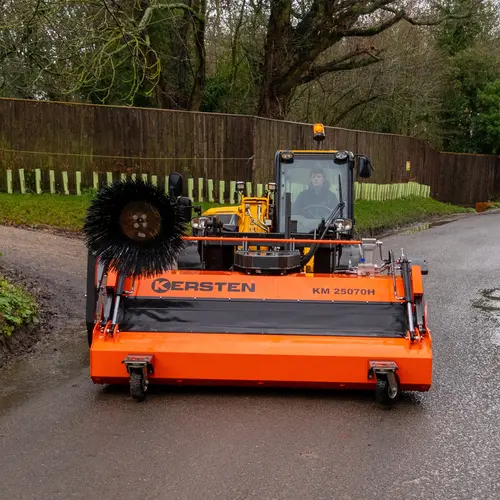
Mud clearance · Manitou example
KM 25070 H
A 2.5 m heavy-duty hydraulic brush with floating collection available for road and yard cleaning.
Choose it when: You need broad coverage and a verified carrier for the full installation.
- Working width
- 250 cm
- Overall width
- 267 cm
- Brush diameter
- 70 cm
- Required flow
- 50 l/min
- Listed sweeper weight
- 550 kg
Manitou MT835 example uses ABR 70 TELE, a floating collector and gully brush. Confirm the current bracket version and loaded capacity.
View attachment →| Wider KM 70 models | Key specification | Choose it when | Individual listing |
|---|---|---|---|
| KM 27070 H → | 270 cm working / 287 cm overall · 70 cm roller · 50 l/min · 580 kg | Your open routes justify more coverage than the 250 cm model. |
£8,350.00
Ex VAT · checked 13 Oct 2026 · individual listing
|
| KM 30070 H → | 300 cm working / 317 cm overall · 70 cm roller · 50 l/min · 630 kg | Expansive areas and a verified carrier suit the widest installation. |
£9,350.00
Ex VAT · checked 13 Oct 2026 · individual listing
|
Weights are the published sweeper weights, not complete loaded installations. Include the bracket, collector, water kit, accessories and debris when assessing the carrier.
Explore the complete KM 70 range →UB Easy weedbrushes for established growth
Choose radial or vertical action around the surface, available access and where the arisings will go.

Radial weedbrushing
UB EASY PAK DS
An 80 cm disc brush loosens established weeds, moss and compacted edge material on suitable hard surfaces.
Choose it when: Active loosening is needed before the material can be swept up.
- Brush diameter
- 80 cm
- Required flow
- 25 l/min minimum
- Listed carrier
- Over 45 hp
- Listed tool weight
- 101 kg
Specify the carrier-specific ABR-UB connection, brush tools and guard setup. Plan a following collection pass for the arisings.
View attachment →
Vertical path-edge brushing
UB EASY PAK VB
A vertical brush works along suitable path edges, with a different material direction from a radial disc.
Choose it when: A verge-side working method suits the surface and material destination.
- Brush diameter
- 84 cm
- Working width
- 69 cm
- Required flow
- 25 l/min minimum
- Listed carrier
- Over 45 hp
- Listed tool weight
- 108 kg
Confirm the loader interface, brush angle and guard arrangement. Redistribute arisings only where the site and verge are suitable.
View attachment →Build a complete working system. Listed prices are for individual products, excluding VAT. Bracket, collector, controls and options may be additional. Product images show the listed equipment, sometimes on another carrier; they do not establish fitment to your telehandler.
Already using a KM 60? Send its model and serial details when requesting a bracket, collector or replacement parts. View the KM 60 mounting information →.
Get the carrier connection right
The boom lifts the tool. The mounting controls how it follows the ground.
Match the actual interface
Send the make, model and photographs of the headstock or pallet carriage. A telehandler quick hitch, Euro interface and fork-tine mount are different connections. Specify the correct bracket and retention arrangement.
Let the brush follow the surface
The heavy boom can overload a rigidly mounted brush. A suitable floating connection allows ground following while the support wheels establish contact. Correct boom position and bracket setup remain essential.
Verify hydraulics and load
Confirm continuous implement flow, pressure, return and cooling. Assess the complete loaded attachment against the carrier’s approved limits, including the load centre, operating position and stability.
Complete the working package
Choose what happens to the material.
Floating collection
A matched collector removes material from the surface. Its ground-following arrangement helps collection over cambers and undulations. Select the correct width, emptying method and complete loaded weight.
Gully brushes and scrapers
A gully brush brings edge material into the main roller’s path. A matched scraper bar helps with adhered mud. Confirm clearance, hydraulic functions and the accessory specification for the selected sweeper.
Dust suppression
A water kit can help suppress dust when sweeping dry material. Include the tank, spray system, water load and controls in the quotation. It does not collect material or replace the correct brush setup.

Telehandler mounting
Specify the floating connection
ABR 60 TELE is the documented FKM 60 telehandler route. Match the headstock and bracket version; a bracket code alone does not approve every carrier.
View the ABR 60 TELE bracket →
Optional brush-contact control
Reduce avoidable brush pressure
KM Control uses sensor feedback and motorised height adjustment to regulate brush contact. It is listed for FKM 60 and KM 70; confirm the machine build, electrical supply and installation.
View KM Control →Collect or windrow? Collection removes debris from the surface. Angling without a collector moves it to one side for a separate collection step. Decide the material destination before specifying the brush guard, collector and angling controls.
Match the method to the surface
Good cleaning starts with controlled contact.
Support the tool correctly
Set the bracket, boom position and gauge wheels as specified. Do not use the boom to force the roller harder into the ground.
Follow changing ground levels
Let the approved floating hitch and collector respond to undulations. Monitor the sight guide and brush contact as the route changes.
Plan removal, not just movement
Choose collection for material that must leave the surface. For windrowing or weedbrushing, arrange the following clean-up pass.
See the working systems
Telehandler installations worth comparing.
See how the attachment, floating connection and working accessories were specified for different surfaces and carriers.
Manitou MT625H
Collect mud and sandy material
FKM 22560 H, ABR 60 TELE and floating collection, with dust suppression for the site’s dry summer conditions.
Read the case study →
Manitou MT835
Clear mud from a cambered road
KM 25070 H with a floating hitch, collector and gully brush for agricultural traffic routes.
Read the case study →
Merlo telehandler
Follow undulating ground
The installation list specifies FKM 22560 H, ABR 60 TELE and a floating collector for yard and road cleaning.
Read the case study →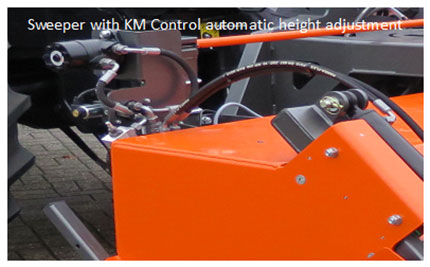
Brush-pressure control
Protect the working contact
Read how KM Control adjusts brush height and works alongside floating mounting and collection arrangements.
Read the article →Match your own carrier. These examples show specific installations. Confirm the current headstock, bracket, hydraulic connections, controls and complete load for your machine.
Before ordering
Your telehandler attachment questions answered.
Will a sweeper fit any telehandler?
No. Confirm the make, full model, headstock or tine interface, hydraulic equipment and approved load limits. Horsepower and lifting capacity alone do not establish attachment compatibility.
Why is a floating hitch important?
A heavy boom can put excessive pressure through a rigidly mounted brush. The matched floating connection lets the tool respond to surface changes, while correct boom position and gauge-wheel settings establish the working contact.
Can an attachment fit over pallet tines?
Suitable tine-mounted brackets are available for selected sweeping systems. Confirm tine dimensions, spacing, load centre, retention and the required ground-following arrangement. A tine mount is a different specification from a direct headstock connection.
How much hydraulic flow do these tools need?
The listed FKM 60 and KM 70 sweeper examples require 50 l/min. The UB Easy examples list at least 25 l/min. Confirm usable continuous implement flow, pressure, return routing and cooling for the exact working system.
What is the difference between a sweeper and weedbrush?
A roller sweeper moves loose material and can collect it with a matched box. A weedbrush actively loosens established vegetation and compacted edge deposits on suitable surfaces. Plan to remove the resulting arisings.
Do I need a collector?
Choose collection when the debris must leave the surface in the same operation. An angled brush without collection forms a windrow for a later clean-up step. Select the collector width, capacity and emptying method around the material and route.
Can I add KM Control?
KM Control is listed for FKM 60 and KM 70 sweepers. It automatically adjusts brush height using sensor feedback. Confirm compatibility with the machine build, height-adjustment mechanism, controls and electrical installation.
Are the prices for complete telehandler installations?
No. They are individual listing prices excluding VAT. Bracket, collector, water kit, controls and other accessories may be additional. Live prices refresh on kerstenuk.com; the checked fallback values remain if an update fails.
What should I send for a quotation?
Send the make, full model and serial details, headstock or pallet-carriage photographs, hydraulic connection details and available continuous flow. Include the debris, surface, access width, collection requirement and working conditions.
Specify a complete working system
What should your telehandler clear next?
Tell us the carrier, surface and material. We’ll help specify the attachment, floating connection, hydraulic requirements and working accessories.