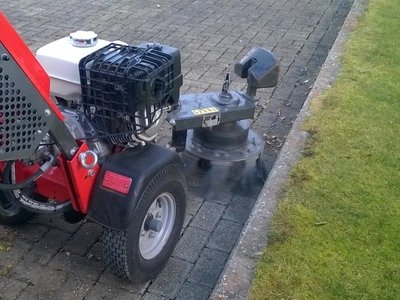
Block paving maintenance
Clear the growth.
Care for the joints.
Keep paths, plazas and car parks free of accumulating debris. Sweep for prevention, brush out established moss and weeds, then collect the arisings and check the jointing.
Start with the condition
Loose debris or established growth?
The right starting tool depends on what is attached to the paving. A routine sweep and a remedial weed-brushing pass solve different problems.
Loose leaves, grit and soil
Start with sweeping and collection. Remove material before it settles into sheltered joints, decomposes or becomes a growing medium.
Moss, weeds and anchored deposits
Use a suitable weed brush to cut and lift established material. Follow with collection: loosening it is only the first part of the job.
Loose blocks or persistent ponding
Inspect the construction before cleaning harder. Missing jointing, settlement, failed edge restraints or drainage defects need their own remedy.
Equipment for block paving
Choose the working method, then the machine.
A dedicated Weedo suits repeated remedial visits. An attachment system lets a compatible power unit change between operations. Plan the collection pass as well as the brush.
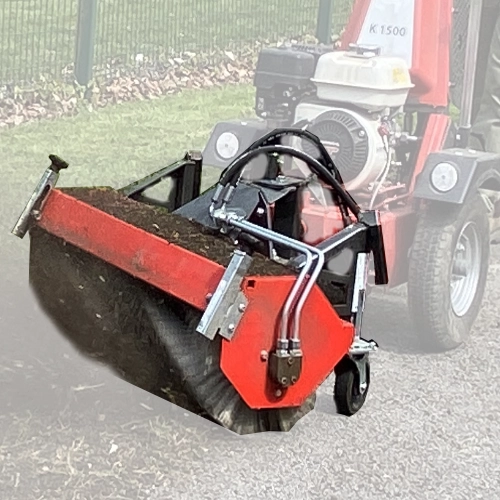
Routine sweeping & collection
EFKM 09032 H-K 35
A powered roller sweeper for loose leaves, grit and soil, and for collecting material loosened by remedial work.
Choose it when: You need regular cleansing with a compatible K-series power unit.
- 90 cm working width · 32 cm roller
- Hydraulic implement drive · K35 mounting
- Listed for K820, K820 Pro and K1500
- Power unit and collector priced separately
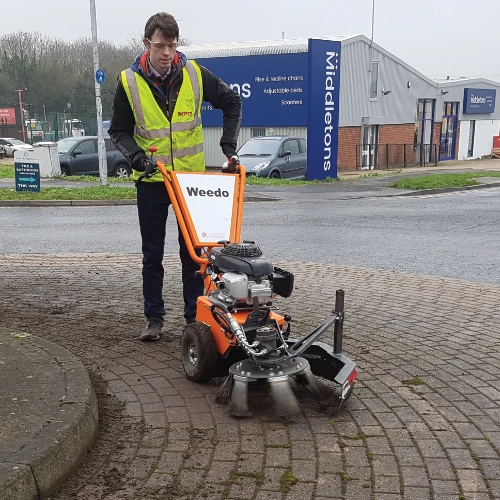
Petrol dedicated weed brush
Weedo II
A compact dedicated machine for lifting established moss, weeds and deposits from suitable paving and edges.
Choose it when: You move between smaller paved sites and prefer petrol refuelling.
- 50 cm brush · six replaceable tools
- Hydraulic brush drive · left/right rotation
- Adjustable head, contact height and guard
- Operator-guided · no powered wheel drive
%20(1)%20(1)%20(1).webp)
Battery-powered mechanical brushing
Weedo II E
The dedicated Weedo format with battery power. The rotating brush physically removes growth; this is not electrical weed treatment.
Choose it when: Battery operation suits your route and you can plan charged pairs.
- 50 cm brush · six replaceable tools
- Requires two EGO 56 V batteries
- Hydraulic brush drive · adjustable head
- Batteries and charger listed separately
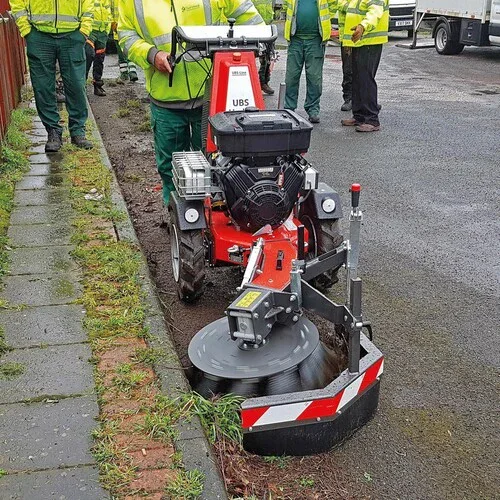
Mechanical attachment for UBS
WKB 60 M-U 70
A 60 cm brush attachment for compatible UBS and Matador carriers, with adjustable contact and interchangeable tools.
Choose it when: Your compatible mechanical-PTO power unit needs remedial paving and edge work.
- 60 cm brush plate · ten replaceable tools
- Mechanical implement drive
- 70 mm attachment system
- Carrier and optional equipment separate
Check the complete working combination. The sweeper and WKB prices are for attachments. Confirm the power unit, drive, mounting, brush sections, guards and collection equipment. A shared 70 mm connection does not mean hydraulic and mechanical attachments are interchangeable.
More ways to cover the site
Already have a carrier—or need another scale?
Why routine cleansing matters
Remove the material that helps growth return.
Leaves, plant debris and tracked-in soil collect where traffic and ordinary cleaning miss them: under benches, beside planters, against kerbs and in sheltered corners. Damp organic deposits give moss and weeds somewhere to establish.
Reduce incoming deposits
Keep grass clippings off the paving, clear seasonal leaf fall and contain soil from beds or nursery displays. Pay attention to watering and runoff that carry material into joints.
Keep loose material moving out
Schedule collection around the site’s actual use and debris load. A lightly contaminated surface is a different maintenance job from one carrying a layer of compacted soil.
Use remedial brushing where needed
Lift the material a routine sweep cannot release. Then collect it and return to a manageable cleaning programme instead of leaving loosened deposits on the surface.
Brush choice and setup
Use the contact the job needs.
Brush material, head angle, contact height and travel speed affect both the cleaning action and the finish. Trial a small area, inspect it and adjust before treating the whole site.
| Brush option | Working action | Selection point |
|---|---|---|
| Steel Versa | Wider wires lift and cut deposits; finer wires help sweep material away. | A general remedial option for suitable hard surfaces. Confirm compatibility and trial the finish. |
| Nylon Versa | A less aggressive brushing action for lighter work and more vulnerable finishes. | Not a direct replacement for heavy steel extraction. Check that it achieves the required clean. |
| Hausa cable tools | Stiff wire tools for heavier clearing and stubborn deposits. | Choose deliberately for the task; do not assume the most aggressive tool is the best option for decorative paving. |
Angle towards the deposit
Use the adjustable head to reach a joint, kerb line or camber. Direct the working tools where needed rather than loading the full surface indiscriminately.
Control contact height
Set the support wheel and brush contact as instructed. More pressure is not automatically more effective; excessive contact can increase wear and disturb jointing.
Contain and collect
Set the guard correctly and manage access around the work. Choose a collection method that keeps loosened material away from drains, planting and already-clean areas.
Decorative, sealed or newly laid paving? Ask the paving supplier which mechanical methods are permitted. Brushing can expose a previously hidden finish or existing damage. Confirm the permitted cleaning regime and jointing requirements before a full pass.
Look after the joints
Identify the paving system before topping up.
The material between blocks is part of the construction. Removing weeds and soil is useful; leaving the joints empty or filling them with an unsuitable material creates a different problem.
Conventional sand-jointed paving
Inspect joint levels after cleaning. Replenish losses with the paving supplier’s specified jointing sand and method. Check new installations before powered brushing or suction cleaning.
Permeable block paving
Water passes through the designed joints into the construction. Use the specified permeable joint aggregate; do not substitute ordinary jointing sand. Follow the system’s inspection and maintenance plan.
Mortar, resin or specialist joints
Confirm the jointing product and condition before mechanical cleaning. Cracked, weak or missing joints may need repair, and some finishes require a different cleaning approach.
Cleaning is not a structural repair. Recurrent ponding, rocking blocks, spreading joints or settlement may involve levels, edge restraints, bedding or drainage infrastructure. Investigate the cause. Do not excavate otherwise sound joints simply because the surface is dirty.
A complete maintenance pass
Inspect. Clear. Collect. Check.
1. Inspect and trial
Identify the paving and jointing. Note loose blocks, damaged surfaces and drainage issues. Select the least aggressive effective brush and test a representative area.
2. Release established material
Where needed, weed-brush joints, edges and deposits using controlled contact. A loose-debris-only job can start directly with sweeping.
3. Collect the arisings
Sweep and collect the loosened moss, soil and vegetation. Do not blow deposits into joints, gullies or neighbouring beds. For dry fine material, assess appropriate dust suppression.
4. Check the finished surface
Inspect the joints, block stability and finish. Replenish or repair as specified, clear drainage openings and plan the next inspection around incoming debris and regrowth.
Targeted weed treatment
Where does hot water or electrical treatment fit?
Some sites need targeted treatment alongside mechanical cleansing. Choose it around the vegetation, access and site conditions, then plan how dead material and accumulated soil will be removed.
Kersten articles and practical examples
See the approach in real maintenance work.
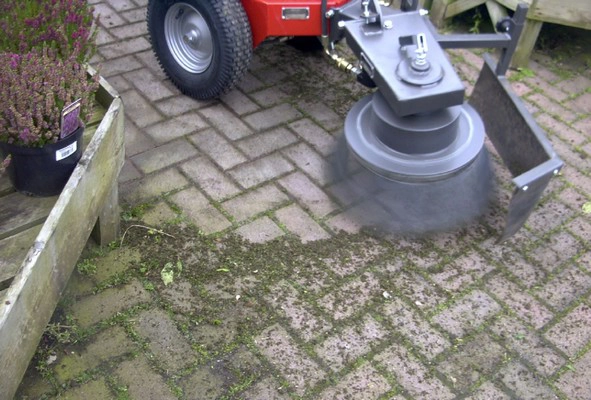
Garden-centre example
Cleaning beneath plant display benches
A Kersten example of weed brushing where plant debris, irrigation and sheltered paving combine to encourage deposits and growth.
Read the case example →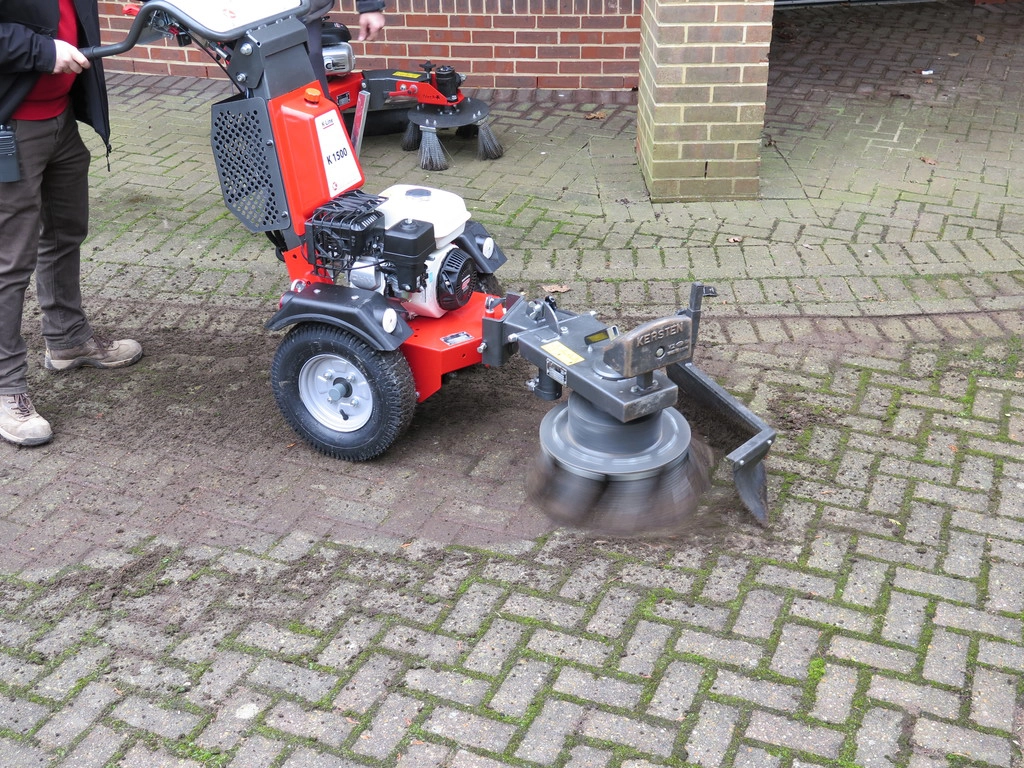
Block-paving care
Three threats to surface performance
Explore Kersten’s discussion of deposits, growth and jointing as part of a planned maintenance programme.
Read the Kersten article →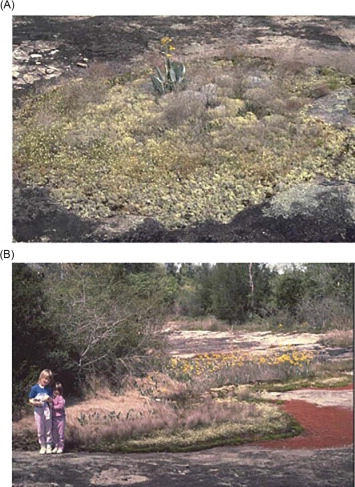
Preventative maintenance
Why accumulated soil matters
Understand why removing the growing medium belongs alongside treating visible weeds.
Read the Kersten article →Related maintenance routes
Follow the material or the next surface.
Common questions
Maintaining block paving
Should I use a sweeper or a weed brush?
Use a sweeper for loose debris and routine collection. Use a suitable weed brush when moss, weeds or deposits are established and a routine sweep cannot release them. Follow remedial brushing with collection.
Will weed brushing remove jointing material?
It can disturb jointing as it releases growth and deposits. Match the brush and contact to the paving, trial an area and inspect the joints afterwards. Replenish with the material and method specified for that paving system.
Can all block paving be re-sanded?
No. Conventional sand-jointed paving, permeable systems and bound joints need different materials and methods. Identify the construction before topping up; permeable joint aggregate must not be replaced with ordinary jointing sand.
Is the Weedo II E an electrical weedkiller?
No. It is a battery-powered mechanical weed brush: rotating tools physically lift growth and deposits. Electrical weed-treatment equipment uses a separate process that applies electrical energy to vegetation.
Can I pressure-wash the paving instead?
Check the paving supplier’s instructions. Pressure washing can remove jointing material and needs a plan for runoff and reinstatement. Choose the method around the finish, joints and deposit; do not assume either washing or brushing is suitable for every paving system.
Will cleaning cure puddles or moving blocks?
Cleaning can remove surface contamination and reveal defects. It does not repair settlement, failed restraints, bedding defects or a broken drain. Investigate recurring ponding and movement rather than increasing cleaning pressure.
How often should the paving be maintained?
Base the interval on leaf fall, surrounding planting, irrigation, traffic and inspections. Remove loose deposits before they become established. Use remedial brushing when the condition requires it, rather than applying an aggressive clean on every visit.
What should I send for a recommendation?
Send photographs, the paving and jointing type if known, the area, narrowest access, main deposits and existing carrier details. Explain whether the work is routine collection or recovery of a neglected surface, and whether collection equipment is already available.
Choose the complete working setup
Show us your paving and the job it needs.
Send photographs, site area, access width and existing machine details. We’ll help match the brush, collection method and carrier—and assess a suitable demonstration.