Reach street trees, planters and green infrastructure from the safety of the cab
Hydraulically controlled watering arms for councils, estates and contractors that need accurate placement, repeatable water volumes and practical reach around parked vehicles, verges and public spaces.
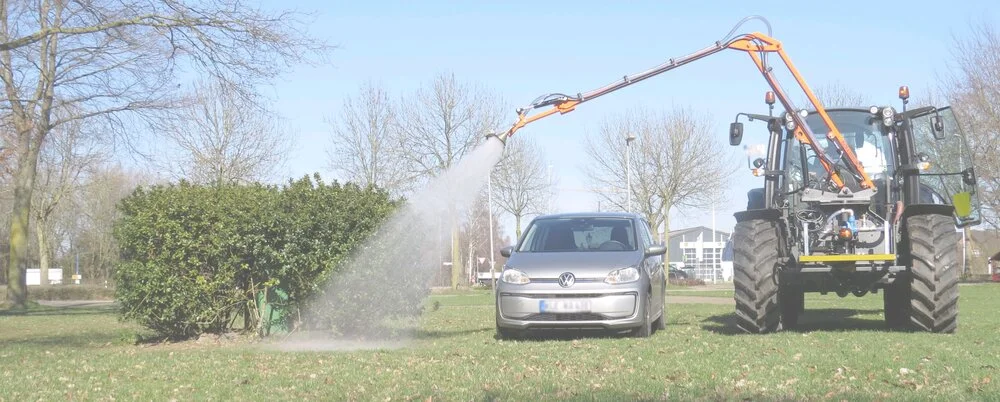
Designed around route-based irrigation
For teams responsible for living assets across difficult public sites
The most valuable gain is not simply reach. It is the ability to place water accurately, work from a mobile carrier and document a repeatable maintenance programme.
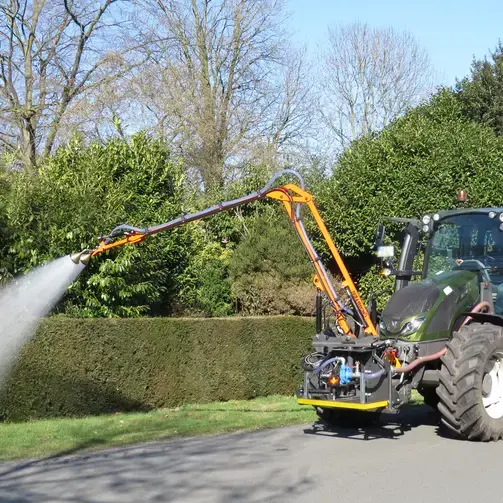 Urban forestry
Councils and street-tree teams
Reach tree pits across kerbs, verges and parked vehicles while applying a planned volume to each newly established tree.
Read the urban-tree investment article →Public realmParks, cemeteries and town centres
Move between beds, baskets, planters and rain gardens with adjustable reach and a choice of gentle or targeted spray patterns.
Explore the FS 3000 →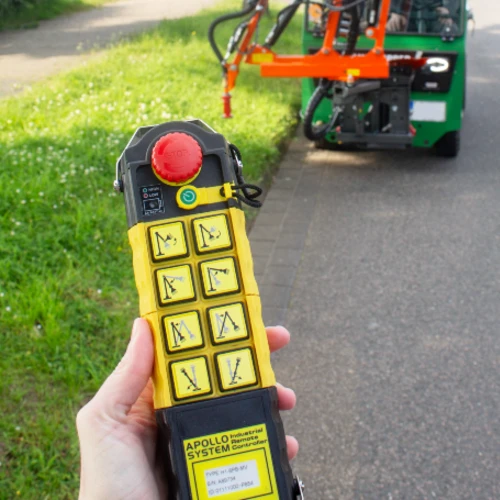 Estates
Campuses, estates and visitor sites
Use an existing compact tractor as a seasonal irrigation platform while keeping the operator in the cab.
Explore compact-tractor attachments →ContractingGrounds and arboriculture contractors
Build a repeatable route around tank capacity, dose per asset, travel time and auditable completion records.
Explore contractor support →A more controlled alternative to manual hose work
Put the water where it is needed without moving the whole vehicle into the planting area
The FS 3000 combines hydraulic reach, cab control and configurable spray heads. Optional dosing and reporting add consistency where contracts or planting specifications require evidence.
Reach around obstacles
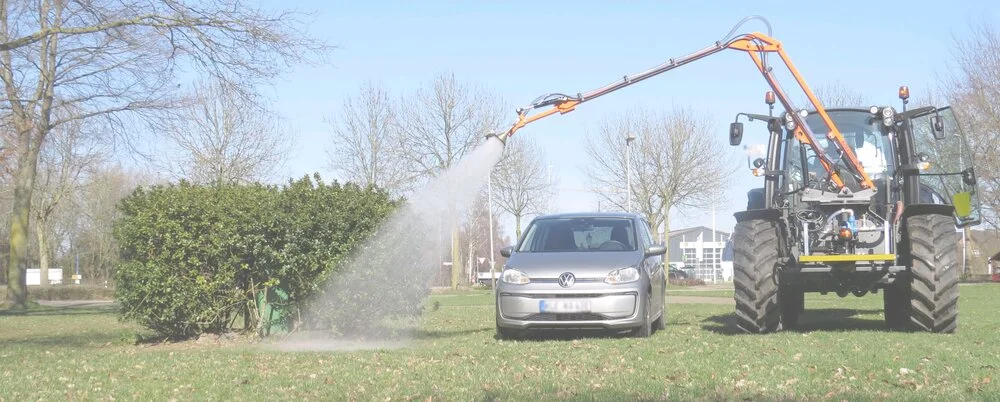
Hydraulic swivel and arm adjustment help the operator reach over kerbs, behind parked vehicles and into planting that cannot be approached directly.
Match the delivery pattern
Use a soft brass shower head for sensitive root zones or the adjustable PowerJet for stream, cone or mist delivery.
Record repeatable doses
Flow Control can automate defined quantities, hold preset volumes, monitor tank content and report watering events with GPS position.
From tank to root zone
A watering arm is one part of a complete mobile irrigation system
The carrier, tank, pump, controls, bracket and nozzle must be considered together. The correct package depends on route length, dose, access and the hydraulic services available.
Match the carrier and mounting frame
Confirm tractor model, linkage or bracket, axle capacity, ballast, hydraulic valves and transport dimensions before selecting the arm.
Size tank, pump and hose for the route
Calculate total litres per round, refill points, pump delivery and pressure rather than selecting tank capacity in isolation.
Select the head and control level
Choose gentle shower or variable PowerJet delivery, then decide whether manual operation, electric control, radio remote or measured dosing is required.
Compare the core watering-arm offer
Choose the working scale first, then build the controls and delivery package
The FS 3000 is the directly published compact-tractor product. The HTG 4000 route supports heavier-duty configurations. Flow Control and nozzle choices can then be added around the operational requirement.
Compact and sub-compact tractors
FS 3000 watering arm
The directly published Kersten arm for controlled irrigation across parks, streetscape and green infrastructure.
- 3,500 mm total arm reach
- Up to 7,000 mm spray coverage
- Four hydraulic movements; 177 kg basic unit
Heavy-duty routes
HTG 4000 range
Kersten's heavier-duty watering-arm route for high-output programmes and more difficult access.
- Kersten article describes 8 m reach
- 50 litre-per-minute pump configuration cited
- Confirm carrier, tank and complete specification
Measured and auditable
Flow Control with pump
Upgrade for repeatable quantities and contract reporting where every watering event needs to be controlled and recorded.
- Three preset watering volumes
- Tank-content monitoring
- Online GPS position and watering records
Variable delivery pattern
PowerJet nozzle
A manually adjustable delivery head for work that needs more control than a soft shower pattern.
- Power-jet setting
- Cone-jet setting
- Mist setting
Pricing note: public prices are read from the linked Kersten product pages after load where possible. Embedded values remain as fallbacks. Prices exclude VAT and do not represent a complete fitted system; brackets, nozzle, controls, pump, tank, hoses, electrical work, delivery and commissioning can materially change the quotation.
Build the complete configuration
Six decisions determine whether the system works efficiently on your route
The watering arm itself is only the visible part of the installation. These package choices should be resolved during fitment review.
1. Carrier and mounting
Confirm the exact tractor, mounting position and frame.
- Cat. 1 / Cat. 1N or municipal interface
- Front axle load, ballast and stability
- Folded height and transport envelope
2. Hydraulics and control
The FS 3000 requires four double-acting hydraulic services unless an appropriate control package is specified.
- Tractor flow and pressure
- Electric control box or radio remote
- Flow-control valve where required
3. Water source and delivery
Tank, pump, dose and refill logistics must match the number of assets on the route.
- Litres per tree or planter
- Total shift demand and refill points
- Pump capacity, filtration and hose size
Responsible professional operation
Plan the carrier, moving arm, water load and public interface together
A long hydraulic arm operating beside roads and occupied spaces introduces genuine clearance, stability and visibility risks. Manufacturer instructions and a task-specific risk assessment remain controlling.
- Use trained operators and inspect hydraulic hoses, pins, controls and locking points before work.
- Confirm axle loads, ballast and stability with the tank full and the arm at maximum outreach.
- Maintain clearance from people, traffic, buildings, overhead services and street furniture.
- Use an exclusion zone or traffic-management measures where the arm enters public or vehicle space.
- Fold, secure and verify the transport position before road travel.
- Check mirrors, cameras, lighting and operator sight lines for the complete carrier configuration.
- Control pressure and flow to avoid soil washout, runoff, damaged planting or water entering the carriageway.
- Use suitable water quality, tank hygiene, filtration and backflow controls for the intended source and application.
Products, fitment and technical support
Watering-arm resources and original destinations
The two original accessory hubs are retained alongside the complete product, manual, catalogue, compatibility and support routes.
FS 3000 accessories
Nozzles, control options, lighting, pump and flow-management components.
Open accessory hub → Original rangeHTG 4000 accessories
Retains the original heavy-duty watering-arm accessory destination.
Open accessory hub → Technical documentFS 3000 spare-parts list
E00155 R01, published for machines from serial number 71962.
Open document → CatalogueKersten tractor attachments
Download the wider attachment catalogue and compare carrier options.
Open catalogue → FitmentMachine compatibility centre
Start with the exact tractor and mounting interface before requesting a configuration.
Check compatibility → Carrier guideCompact-tractor attachments
Understand how a front linkage turns a compact tractor into a year-round tool carrier.
Explore compact tractors → Carrier guideAgricultural-tractor attachments
Review the wider attachment context for larger tractors and heavier-duty applications.
Explore agricultural tractors → Project supportRequest a route assessment
Discuss carrier fitment, tank and pump logistics, reach and required watering records.
Talk to Kersten → (1).webp)
 (1).webp)
.webp)
Planting is the easy half
A street tree costs £1,500 to £3,000 to source, plant and secure. Keeping it alive through its first three summers costs a fraction of that — and it is the part most programmes have no plan for.
Before we talk about machines
We don't only want to help you find the right equipment for tree establishment — we want to arm you with the knowledge and the best practice to get the most out of it.
We work with a lot of councils, contractors and estates facing the same problem: more trees going in the ground every year, hotter and drier summers, and no more staff. The resources below have been useful to them, whether or not they end up buying anything from us.
LTOA and Arboricultural Association benchmarks
The London Tree Officers Association and the Arboricultural Association publish practical guidance on quantity and frequency during establishment. BS 8545, Trees: from nursery to independence in the landscape, is the standard covering aftercare in full.
Kersten watering arms
Published specifications, accessory hubs, spare-parts documentation and the compatibility centre, so a carrier can be checked before anything is quoted.
A route assessment
Send us the number of trees, the target dose, your carrier and hydraulic services, tank and pump details and the route constraints, and we will work through a practical configuration with you before you specify anything.
Product recommendations come last, and only after a conversation about your sites.
The commitment, and the loss
The UK is in the middle of one of its most ambitious planting programmes, with over £1 billion allocated during this parliament to tree planting and forestry, new National Forests and expanded urban canopies. The planting is going well. The survival is not.
What the recent investigations found
A HortWeek investigation into trees planted by councils found high death rates, attributed to drought, vandalism and lack of maintenance. Tree experts responding to it made the same two points: trees need maintenance or they will die, and heavier nursery stock tends to do better.
It is not an isolated finding. In 2023 it was reported that some 400,000 trees planted as part of roadwork schemes had died, with commentators noting that organisations were still focusing on how many trees go in the ground rather than on the aftercare that keeps them there.
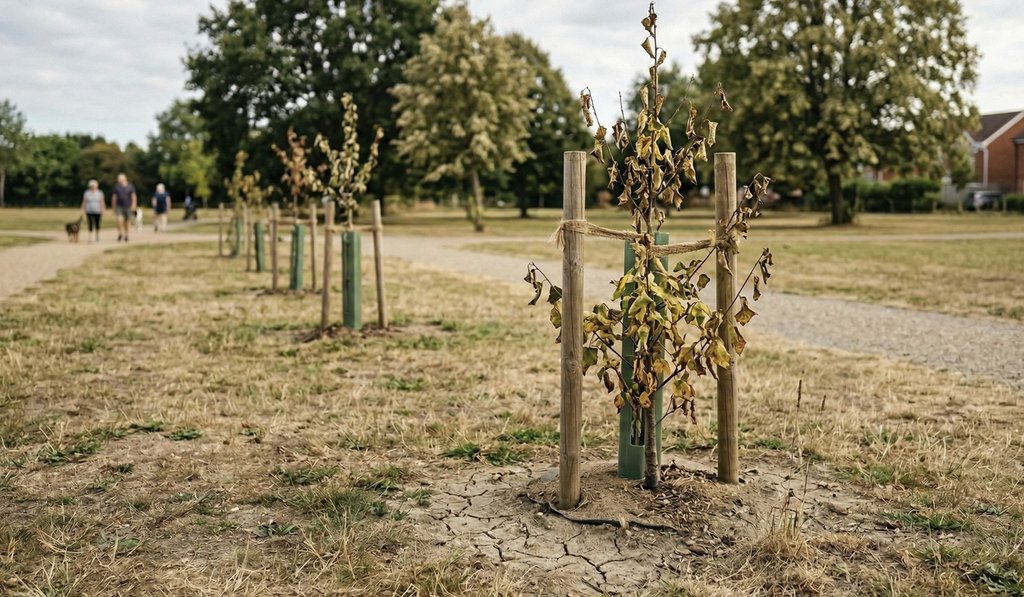

Drought is the principal killer
Not vandalism, and not disease. Research cited by bodies including the Forestry Commission and Fund4Trees puts urban failure rates at 30% to 50% in the first few years, with drought stress the dominant cause. Applied to the current national investment, that is hundreds of millions of pounds of public money at risk.
And the losses arrive late
A tree stressed in one hot summer often dies one to three years later, once depleted reserves, reduced root mass and secondary pests have done their work. Mortality figures therefore lag the drought that caused them — which is why a good season is not evidence that the programme is working.
Figures on this page are drawn from published sources and quoted as such: the £1 billion allocation and the £1,500–£3,000 planting cost from Kersten's own article, the 30–50% failure range from research cited by the Forestry Commission and Fund4Trees, the council findings from HortWeek, and the roadworks figure from 2023 reporting. They describe the sector, not your authority. Your own planting and replacement records are the better guide.
Where aftercare becomes a duty
Watering is easy to treat as discretionary because it has no dedicated statutory duty of its own. In practice it is written into several obligations an authority has already accepted — most explicitly in planning policy.
NPPF · tree-lined streets
Policies and decisions should ensure new streets are tree-lined and that appropriate measures are in place to secure the long-term maintenance of newly-planted trees. Inspectors have refused landscaping schemes by reference to this policy. This is the clearest statement in national policy that planting without an aftercare arrangement is not compliant.
Planting funds and BNG
Planting grants commonly carry survival expectations and maintenance payments. Where trees form part of a biodiversity net gain habitat, the secured plan runs for thirty years with monitoring built in. A dead tree is then not just a loss — it is a shortfall against a plan someone will audit.
BS 8545
Trees: from nursery to independence in the landscape sets out the establishment process, including irrigation, through to the point at which a tree no longer needs support. Independence is a defined end point, not a hopeful assumption.
Environment Act 2021
Public authorities in England must consider what they can do to conserve and enhance biodiversity, and there are consultation requirements before felling street trees. Canopy targets and Local Nature Recovery Strategies sit alongside. Replacing a tree you failed to water is a poor answer to a canopy commitment.
Highways Act 1980
Authorities have powers to plant and maintain trees in the highway, and the ordinary duties around obstruction and safe passage apply to what grows there — including a dying tree that becomes a hazard. Removal, stump grinding and reinstatement all cost more than the watering visits would have.
Temporary Use Bans
Water companies typically exempt newly planted trees, generally up to around three years old, from hosepipe restrictions — the period when watering matters most. Confirm the current wording with your own supplier before the season. A drought order is not a reason to stop; it is usually the reason to start.
The question that gets asked when a tree fails
Not whether it was hot, but whether it was maintained. Members, grant bodies and — where a contractor planted it — the other party to the contract will all ask the same thing, and the answer needs to be a record rather than a recollection. Section 07 covers what that record can look like. This page is a summary for discussion and not legal advice; confirm the obligations, grant conditions and contract terms that apply to your own programme.
The first three years
A newly planted tree is, in effect, a container plant buried in the ground. Its roots occupy the root ball and little else, so it can only draw on the water in that small volume until it grows out into the surrounding soil.
In UK conditions that takes about three years. Until then the tree depends on what falls into, or is poured into, the pit — and a street tree pit is usually surrounded by sealed surface that sheds rainfall rather than delivering it.
Climate has changed the arithmetic. Summers are hotter and drier, with 40°C peaks recorded in 2022, and groundwater fluctuates more. The establishment period has not got shorter; the conditions during it have got harder.
Published benchmarks · LTOA and Arboricultural Association
Volume is only half of it
Water has to percolate down into the root ball, not run across the surface and into the gutter. A soft shower head delivers gently enough to soak in; a hard jet displaces mulch, scours the pit and can leave the tree no better off while the tank empties at the same rate.
A little and often is the wrong instinct
Frequent light watering encourages shallow rooting exactly where the soil dries fastest. The benchmarks are built around a substantial dose at a weekly interval, which draws roots down and outward — which is what independence actually means.
Designing the watering round
The benchmark tells you what one tree needs. The round tells you whether you can deliver it. Most programmes fail here rather than at the specification: the dose is right, the arithmetic was never done, and by July the rounds are three weeks apart.
| Step | Worked example | Why it matters |
|---|---|---|
| Trees in establishment Years 1–3 only | 500 trees | Only trees inside the window need the round. Anything older comes off the list, which is why planting dates have to be recorded. |
| Dose per tree | 75 litres | Set from tree size and pit volume, within the 50–100 litre benchmark. Write it into the specification so it is not left to the operator. |
| Litres per full pass | 37,500 litres | Trees × dose. This is the number that determines everything downstream. |
| Refills per pass | 13 at 3,000 L | Tank capacity divided into the pass. Each refill is travel plus fill time, and it is usually the largest single loss in the day. |
| Passes per season | About 22 | Weekly from May to September, more during drought alerts. Multiply the pass cost by this to get the true seasonal figure. |
| Productive field days | Your own figure | Weather, access, parked cars, staff availability and competing work all reduce it. Establish it in year one and plan the following year against it. |
Illustrative arithmetic to show the shape of the calculation, not a recommendation. Substitute your own tree numbers, dose, tank capacity and refill points.
Refilling decides the day
The lesson is the same one that governs hot water weeding: water supply, not machine output, sets the achievable round. If the bowser travels far between fills, refill and travel time can dominate the shift and make any figure quoted in trees per hour meaningless. Record treatment time, refill time and travel time separately from the first day. It costs nothing, and it tells you whether the answer is a larger tank, a second filling point, a different route order — or simply an earlier start.
Order the round by need
Not by geography alone. Sort by planting date and exposure first, then optimise the driving. A first-year tree in a sealed pit on a south-facing street is a different asset from a third-year tree in a verge, and treating them as one round is how the vulnerable ones get missed when the day runs short.
Watering arms
The gain is not simply reach. It is the ability to place water accurately from a mobile carrier, with the operator in the cab, and to repeat the same dose at every asset on the round.

| Item | Key figures | Where it fits |
|---|---|---|
| FS 3000 watering arm | 3,500 mm arm reach · up to 7,000 mm spray coverage · four hydraulic movements · 177 kg basic unit | The published Kersten arm for sub-compact and compact tractors. Street trees, tree pits, beds, planters and rain gardens. |
| HTG 4000 range | 8 m reach and a 50 L/min pump configuration | The heavier-duty route for high-output programmes and more difficult access. Confirm carrier, tank and full specification. |
| Flow Control with pump | Three preset volumes · tank-content monitoring · online GPS position and watering records | Where every watering event needs to be controlled and recorded — contract delivery, grant-funded planting and disputed failures. |
| PowerJet nozzle | Power-jet, cone and mist settings, manually adjustable | Work needing more control than a soft shower pattern. The brass shower head remains the choice for sensitive root zones. |
| 180° hydraulic swivel | Delivery head positioned either side of the carrier | Working both kerbs on a route without turning the vehicle, which is often what makes a street practical at all. |
A watering arm is not a complete system on its own: brackets, nozzle, controls, pump, tank, hoses, electrical work, delivery and commissioning all form part of the specification. Full range: Kersten tractor-mounted watering arms.
Who it suits
Council street-tree teams reaching pits across kerbs and parked vehicles; parks, cemeteries and town centres moving between beds, baskets and planters; estates using an existing compact tractor as a seasonal irrigation platform; and contractors who need a repeatable route with auditable completion records.
Choose the head, not just the arm
The soft brass shower head suits sensitive root zones and newly mulched pits. The PowerJet gives stream, cone or mist where the target is further away or the delivery needs more direction. Both matter more to the outcome than another metre of reach.
Specifying the complete system
The arm is the visible part. Carrier, bracket, hydraulics, controls, pump, tank, hose routing and nozzle all have to be resolved together, because the wrong combination produces a machine that reaches the tree and cannot deliver to it.
Confirm the exact tractor, mounting position and frame before selecting the arm: Cat. 1 / Cat. 1N or municipal interface, front axle load, ballast and stability, folded height and transport envelope, and operator sight lines.
The FS 3000 requires four double-acting hydraulic services unless an appropriate control package is specified. Confirm tractor flow and pressure, electric control box or radio remote, flow-control valve where required, and electrical supply for controls and reporting.
Tank, pump, dose and refill logistics must match the number of assets on the route: litres per tree and total shift demand, refill points along the route, pump capacity, filtration and hose size, and water quality, tank hygiene and backflow controls.
Responsible operation · a long hydraulic arm beside a live street
- Trained operators, with hoses, pins, controls and locking points inspected before work
- Axle loads, ballast and stability confirmed with the tank full and the arm at full outreach
- Clearance maintained from people, traffic, buildings, overhead services and street furniture
- Exclusion zone or traffic management where the arm enters public or vehicle space
- Arm folded, secured and verified in transport position before road travel
- Pressure and flow controlled to avoid soil washout, runoff or water entering the carriageway
Ask for a fitment review, not a quotation
Send the carrier make, model and mounting interface, the hydraulic services available, the tank and pump arrangement, the number of assets, the target litres per asset, the route constraints and whether reporting is required. That is enough for a practical configuration review — and it catches the problems that are expensive to discover after delivery. Manufacturer instructions and a task-specific risk assessment remain controlling in all cases.
Measured dosing and the audit trail
When a tree fails, the question is whether it was maintained properly. A hose and a memory are not an answer. A recorded dose, at a recorded position, on a recorded date, is.
The Flow Control package automates defined quantities: three preset volumes, automatic shut-off once the dose is delivered, and monitoring of adjustable tank content. The operator stops guessing, and every tree on the round receives exactly what the specification requires.
The reporting side records the position, time and quantity dispensed to the cloud, viewable on a map or as a data table. That converts a maintenance activity into evidence.
What the record is worth, and to whom
Assurance
Demonstrable compliance with the maintenance measures that planning policy, grant conditions and a BNG plan all assume are in place.
Payment
Indisputable evidence that the schedule was followed, which protects both revenue and reputation when a planting fails for reasons outside your control.
Learning
A dataset showing which sites needed more water, which species struggled and where the round ran short — so the following year is planned rather than repeated.
Zero waste, by design
Water is a constrained resource and increasingly a scrutinised one. A system that shuts off at a preset volume delivers the specification and no more, which matters both to the tank logistics and to the conversation about watering during a drought order.
Record what you would want in a dispute
Location, date, time, volume, and the tree's planting year. Add a note field for anything the operator saw — a damaged stake, a missing grille, a pit that will not take water. The observations are often worth as much as the dose data.
One carrier, three jobs
A watering round runs from May to September. On its own, that is a machine and a bowser standing idle for more than half the year — which is exactly the objection a capital panel will raise. The answer is that the same water, the same tank and the same carrier do two other jobs.
The Eco Weedkiller Pro range — the Pro 10 and the Pro 20 Dual — heats water on demand at 99–101°C for non-chemical weed control, runs hoses up to 80 metres, and supports one or two operators with continuous refilling. The Pro 20 offers selectable 10 or 20 litres per minute, reaching the higher output with two users. The same units are specified for pressure washing and cleaning work.
| Season | Job | What the system does |
|---|---|---|
| Spring | Non-chemical weed control | Hot water treatment on hard surfaces and joints, most efficient when growth is young and the surface has already been mechanically reset. |
| Summer | Tree and planter watering | The watering round: measured doses at recorded positions, weekly through the establishment window, twice weekly during drought alerts. |
| Autumn and winter | Pressure washing and cleaning | Hard-surface cleaning, street furniture, signage, depot and yard work — using the same pump, hoses and vehicle. |
Configuration matters: tank, pump, heating, hose and nozzle requirements differ between the three duties, and a system specified for one may need additional components for the others. Ask for the combined specification up front rather than adding to it later.
This is usually the argument that wins the capital case
A watering arm justified only by summer tree rounds is a seasonal asset. The same carrier, tank and pump justified across weed control, tree establishment and surface cleaning is a year-round one — and the business case stops depending on any single service's budget.
The cost of losing a tree
A failed tree is not one cost. It is the original planting written off, a removal, a replacement at today's prices, canopy years the site does not have while the replacement establishes — and, increasingly, an explanation owed to whoever funded it.
| Cost element | Indicative | Notes |
|---|---|---|
| Original planting | £1,500–£3,000 | Sourcing, planting and securing a street tree, including pit, crate and topsoil. Already spent. |
| Removal and reinstatement | Your own rate | Take-down, stump grinding, disposal, and making the pit or surface safe. Often a separate budget from the one that planted it. |
| Replacement planting | £1,500–£3,000 | The same cost again, at current prices, for a tree that starts its own three-year establishment window from zero. |
| Lost canopy years | Not costed | Shade, cooling, interception and amenity the site does not receive during the gap. It appears in canopy-cover reporting, not in a ledger. |
| Grant and scheme exposure | Scheme dependent | Survival expectations, maintenance payments and BNG monitoring obligations may all be affected. Check the conditions attached to your own funding. |
Planting cost range as published by Kersten; every other line should be filled in from your own rates and funding conditions. The point is the shape of the total, not the precision of any figure in it.
Against the cost of a visit
Twenty-two weekly passes over a growing season, on a round covering hundreds of trees from one vehicle, works out at a few pounds of labour, fuel and water per tree per year. Three seasons of that is a small fraction of a single replacement.
The arithmetic is not close, which is why the argument is rarely about whether watering is worth doing. It is about whether the round can actually be delivered with the staff available — and that is a question about equipment and route design rather than about horticulture.
Put it in one sentence
Don't let a £3,000 asset die for want of a £5 watering visit. It is a blunt way to open a committee paper, and it is the whole business case.
Next steps
Planting date, size, pit type and exposure for everything in years one to three. This is the round, and it is usually shorter than the planting list suggests.
Dose, litres per pass, refills, passes per season and productive field days, using Section 04. It takes an afternoon and it decides the specification.
Send us the carrier, hydraulic services, tank and pump details. We confirm what will physically work before anything is quoted.
Reach, spray pattern, stability and route time proved on your own street, with your own operators. No charge and no obligation.
Where to read more
Watering arms for compact tractors
Specifications, accessories and carrier compatibility for the FS 3000 and the wider range.
Hot water weed control
The Pro range that shares the tank, pump and carrier with your watering round.
Attachment compatibility centre
Check a carrier and attachment combination before anything is quoted.
We wish you every success, and hope this guide helps you achieve what you are aiming for — whether you choose to buy from us or not.
Practical specification questions
Before you request a watering-arm quotation
These answers summarise the published Kersten product information. The final quotation, carrier instructions and current manuals control the supplied configuration.
What is the reach of the FS 3000 watering arm?
The published FS 3000 specification gives a total arm reach of 3,500 mm and spray coverage of up to 7,000 mm. Actual working access still depends on the carrier, mounting position, site geometry and safe operating clearance.
What is the difference between the FS 3000 and HTG 4000 ranges?
The FS 3000 is the documented sub-compact and compact-tractor system with 3.5 m arm reach. Kersten's urban-tree article positions the HTG 4000 as the heavier-duty option, describing an 8 m reach and a 50 litre-per-minute pump configuration. Final selection should be confirmed against the carrier, tank, pump and route requirements.
Which spray head should I choose?
The brass shower head is intended for a softer flow around sensitive planting and root zones. The PowerJet nozzle provides adjustable power-jet, cone and mist patterns where a more targeted or variable delivery is required.
Can the operator control the arm from the cab?
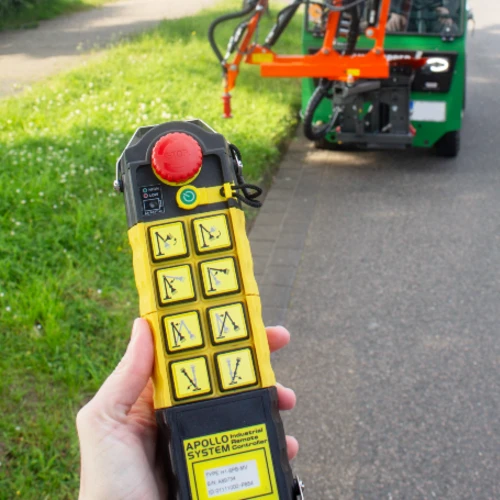
Yes. The FS 3000 product page lists electric control-box and radio-remote options for the four arm movements. The correct control package and any required flow-control valve must be matched to the tractor's hydraulic output.
What does the Flow Control option add?
The published Flow Control package supports defined watering quantities, three preset volumes, monitoring of adjustable tank content and online reporting with GPS position and watering records.
Does the watering arm include the mounting frame, nozzle and controls?
Do not assume so. The live FS 3000 page presents the nozzle, control unit and compatible bracket as required selections. The final quotation should identify the arm, mounting interface, control system, nozzle, pump, hoses and any lighting or reporting options.
What must be checked before fitting a watering arm to a tractor?
Confirm front-linkage or mounting compatibility, hydraulic valve requirement and flow, electrical supply, axle loads, ballast, transport height, folded dimensions, visibility, tank and pump arrangement, hose routing and the carrier manufacturer's limits.
Is a site demonstration recommended?
Yes. A demonstration or fitment review helps confirm reach around parked vehicles and street furniture, spray pattern, flow, stability, visibility and the practical route time before procurement.
Planning, evidence and wider context
Useful reading for irrigation and tractor-attachment programmes
The first article directly compares the FS 3000 and HTG 4000 in an urban-tree watering context. The other routes support carrier and landscape planning.
Saving Our Streets: protecting the £1 billion tree investment
Why measured, traceable watering matters during tree establishment, with FS 3000 and HTG 4000 range context.
Read article →More Kersten attachment articles and case studies
Browse the current tractor-attachment article channel for carrier, fitment and fleet-use examples.
Browse articles →Ground-cover plants, moisture retention and lower-maintenance landscapes
Supporting landscape guidance on moisture conservation, erosion control and reduced maintenance pressure.
Read guidance →Build the watering route around the carrier, dose and access—not a brochure headline
Send Kersten your tractor, hydraulic services, tank and pump details, number of assets, dose per asset and route constraints for a practical configuration review.