Glyphosate resistance has reached the UK.
Glyphosate resistance has reached the UK. The new amenity guidelines point to prevention as WRAG and the Amenity Forum produce new guidance.
Glyphosate resistance has reached the UK. The new amenity guidelines point to prevention

In 2025, the UK confirmed its first glyphosate-resistant weed populations, in Italian ryegrass on arable land. For anyone managing weeds on pavements, car parks and hard surfaces, that should be a wake-up call. Glyphosate is the most-used herbicide in amenity weed control, and the conditions that drive resistance are common in our sector.
On 8 October 2026, the Weed Resistance Action Group (WRAG) and the Amenity Forum published updated Guidelines for managing glyphosate resistance risk in amenity weed control (UK). The guidance was updated by James Clarke (WRAG Chair), Lynn Tatnell (Principal Weed Scientist, ADAS), John Cussans (ADAS) and Barrie Hunt, building on the original amenity guidance from 2009. It was launched at the Amenity Forum Annual Conference at the British Motor Museum, Gaydon. Its central message is blunt: the risk of glyphosate resistance in amenity situations is high.
Why amenity is high risk
Hard surfaces are often treated again and again, with no cultivation and very little soil disturbance. Every plant that survives a treatment can set seed and pass on its tolerance. Repeat spraying of the same survivors is, in the guidelines' words, the situation that "presents the highest risk".
The six key messages
- Glyphosate resistance is now present in UK agriculture.
- The risk of glyphosate resistance in amenity situations is high.
- Use glyphosate at the correct dose, on small, actively growing weeds, in optimum conditions.
- Make sure glyphosate use sits within an integrated pest management (IPM) or integrated vegetation management approach.
- Monitor and act on survivors.
- Consider resistance testing of survivors if needed.
The most important practical instruction is about survivors: "Do not retreat surviving weeds with glyphosate!" Remove them instead, so they cannot spread. The guidelines also stress using full recommended dose rates, because reduced rates are proven to increase resistance risk.
Brushing and sweeping are now part of resistance management
What stands out for us is how clearly the guidelines link resistance to prevention. They advise users to "plan to apply the herbicide following brushing or sweeping or, ideally in rotation with brushing or sweeping regimes." Removing small weeds and the build-up of debris means larger weeds are less able to survive treatment. Litter can shield weeds from spray, and dust can reduce how much herbicide a plant takes up.
They also note that mechanical techniques "can provide very effective control of small annual weeds", while control of perennials can be limited unless their roots are removed.

Launched at the Amenity Forum conference
Around 80 people from across the sector attended this year's conference, themed "Navigating Change: Regulation, Stewardship and the Future of Amenity Management" (Landscape & Amenity report). James Clarke, Chair of WRAG, said that "managing the risk of resistance is about good stewardship", and Ian Graham, Chair of the Amenity Forum, said that protecting glyphosate's "continued effectiveness depends on responsible use and good stewardship" (Landscape & Amenity).
Lynn Tatnell of ADAS presented the guidelines. Her presentation featured Kersten weed-brushing equipment to illustrate preventative brushing, and discussed the role of soil depth in weed establishment. It was good to see that link made so clearly in front of the sector.
What the Bracknell trial adds: depth decides which weeds survive
The guidelines explain why brushing helps. Our Integrated Weed Management Trial with Bracknell Town Council and Complete Weed Control adds evidence on when it matters most.

Across six urban sites and 502 species-depth measurements, we found that the weeds growing on hard surfaces are strongly stratified by the depth of accumulated detritus, the soil-like material that builds up in joints, kerbs and channels. That relationship is the basis of a four-stage framework, set out in full in our scientific paper on Pavement Ecological Succession.
| Stage | Detritus depth | Root state | What it means |
|---|---|---|---|
| 1. Prevention | Up to 10mm | Surface only, no anchorage | A routine brush or sweep resets the surface |
| 2. Window open | 11–25mm | Floating in the detritus | Brushing lifts the whole plant, root and all |
| 3. Window closed | 11–25mm | Anchored into cracks and joints | The top breaks off; the root stays and regrows |
| 4. Structural failure | More than 25mm | Woody roots into the sub-base | Surface damage; repair rather than maintenance |
Stages 2 and 3 share the same depth, so depth alone can't tell them apart. A simple Kick Test can: if the plant and detritus move as one unit, the window is still open.
This matters for resistance. Stage 3 and 4 plants are established, often perennial, with roots protected in the surface. They are exactly the large, hard-to-kill weeds the guidelines warn are most likely to survive treatment. Keeping surfaces at Stages 1 and 2 means any herbicide that is still used meets small weeds on clean surfaces, as the guidelines recommend.
The trial also measured how much herbicide was needed. At the first application in June 2026, across five comparable sites, plots that were brushed before spraying used 1,133ml of active substance, against 2,218ml on spray-only plots: a 49% reduction. Removing the detritus first reduced both the area and the amount of weed that needed treating. The full end-of-season results will follow.
We've written more about this in The 25mm Rule: Time & Depth Determine Weed Control Success.
What to do now
- Brush or sweep first. Build regular detritus removal into your programme, and time any herbicide to follow it, as the guidelines recommend.
- Keep surfaces shallow. Aim to keep detritus below 10mm, and act on sites in the 11–25mm band before roots anchor.
- Never re-spray survivors. Remove them mechanically and record where they were.
- Check results after every application. Good records help you spot any loss of control early.
- Rotate methods. Brushing, thermal and chemical control used in sequence reduce the pressure that selects for resistance.
- Test if in doubt. Suspected resistance can be checked through an adviser or ADAS (weeds@adas.co.uk).
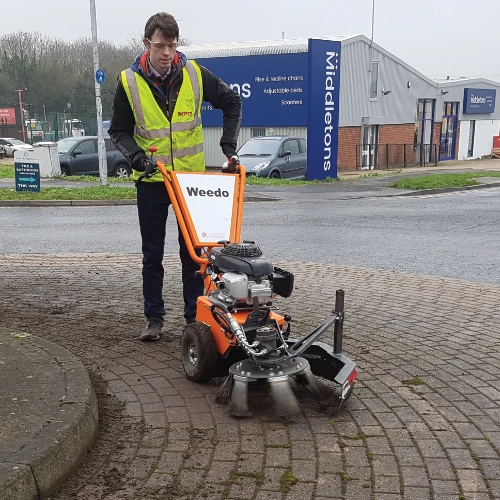
Resistance gives councils and contractors one more strong reason to move from reactive spraying to prevention. If you'd like help assessing your sites or building brushing into your programme, see our mechanical weed removal range, our National Action Plan guide for councils, or talk to our team.

No comments yet. Login to start a new discussion Start a new discussion