Landmark Integrated Weed Management Trial Protecting surfaces by treating the cause
The Bracknell trial is testing how mechanical extraction, precision herbicide application and surface-condition diagnosis can reduce pesticide use while protecting hard urban infrastructure.
A collaboration between Bracknell Town Council, Kersten UK and Complete Weed Control.

Urban trial sites
Car parks, park edges, kerbs, paths, an enclosed paved area and a residential footway.
Species-depth pairs
Baseline measurements linking vegetation, detritus depth and root anchorage state.
Diagnostic stages
A practical framework from prevention through to structural failure.
Less active substance
Brush-and-spray compared with spray-only across five comparable sites in June 2026.
The research question
What changes when the growth medium is removed before treatment?
Conventional visual weed assessment focuses on what can be seen above the surface. The trial examines the less visible variables that determine risk, cost and the correct maintenance response.
Baseline research found that weed height and density alone do not reliably indicate detritus depth, root anchorage or hidden damage beneath the vegetation.
The trial therefore combines depth measurement, root anchorage behaviour and indicator species to identify the point at which ordinary maintenance is still viable.
The central operational distinction lies between Stage 2 and Stage 3. Both occupy the same 11 to 25mm depth band, yet one remains mechanically extractable while the other has become an anchored structural defect.
Pavement Ecological Succession
Four stages of accumulation and infrastructure risk
Depth is important, but it is not enough. Stage 2 and Stage 3 share the same depth range and must be distinguished by root anchorage behaviour.
Prevention
Up to 10mmPioneer zone with surface-only roots and no current infrastructure risk.
- Root state
- No anchorage into the pavement.
- Kick Test
- Moves freely with no root resistance.
- Response
- Routine sweeping or preventative reset.
Window Open
11 to 25mmFloating roots remain within the detritus matrix. Mechanical extraction is still viable.
- Root state
- Floating within accumulated material.
- Kick Test
- The whole mass lifts as a complete unit.
- Response
- Urgent mechanical extraction.
Window Closed
11 to 25mmRoots have bonded into pavement defects even though the measured depth may appear identical to Stage 2.
- Root state
- Anchored into cracks and joints.
- Kick Test
- Growth breaks at the substrate and leaves roots behind.
- Response
- Manage as an emerging structural defect.
Structural Failure
More than 25mmWoody and lignified roots penetrate the sub-base and accelerate joint and edge failure.
- Root state
- Firmly anchored, often into the sub-base.
- Kick Test
- The stem snaps above the surface, leaving the root system.
- Response
- Reconstruction or capital repair is likely.
The critical field diagnostic
The Kick Test distinguishes maintenance from structural repair
Select a condition below and apply the simulated test to see how root behaviour changes the diagnosis.
A simple test for a costly ambiguity
Stage 2 and Stage 3 can look similar from above and occupy the same 11 to 25mm depth range. The difference is whether the roots remain floating in the detritus or have anchored into the pavement.
- 1 Identify the base of the weed and detritus mass.
- 2 Apply controlled lateral foot pressure at the base.
- 3 Observe whether the complete mass moves, breaks at the substrate or snaps above the surface.
Pavement Weed Kick Test Diagnostic
This simulator illustrates the remediation thresholds proposed by the Bracknell trial framework.
This is an educational simulator, not a substitute for competent site inspection, risk assessment or engineering advice.
Indicator species
The most obvious weeds are not necessarily the best warning signs
Statistical analysis identified three species groups with meaningful stage concentration. Meadow grass and dandelion were generalists across the accumulation gradient.
Moss
χ² = 18.0, p < 0.001
Moss is a reliable early-stage indicator. Its presence largely rules out the Stage 4 structural damage zone and supports preventative or early intervention.
Oakleaf Fleabane
χ² = 7.8, p = 0.021
85% of observations occurred in the 11 to 25mm floating-root band. Combined with a passing Kick Test, it can signal that the intervention window remains open.
Bramble
χ² = 15.6, p < 0.001
Bramble was not recorded at Stage 1. Its woody root system is a strong warning that the mechanical intervention window may have closed.
What extraction revealed
Damage can remain invisible until the growth medium is removed
Physical extraction across the trial sites exposed a gradient from minor surface pitting to complete edge loss.

Resurfacing does not remove a buried root system
At one trial site, extraction revealed a previous resurfacing course laid over established bramble roots. The plants were recolonising the newer surface from roots sealed beneath it.
That observation supports a key infrastructure principle: covering an unextracted biological growth medium does not reset the succession process.
- Visual inspection may miss sub-surface anchorage.
- Root systems can persist beneath later surface courses.
- Stage 3 intervention may require more than brushing.
- Early extraction protects the maintenance-cost window.
The statistical basis
A measured framework, not a visual rule of thumb
The baseline scientific paper documents the site design, measurement protocol, statistical analysis and proposed diagnostic framework.
Pavement Ecological Succession: A Species-Depth Diagnostic Framework for Hard Urban Surfaces
Based on 502 valid species-depth measurement pairs across six Bracknell sites. Species assemblages were significantly stratified by depth band, with three statistically robust indicator species identified.
June 2026 trial update
Mechanical extraction reduced active substance use by 49%
Across five comparable sites, the brush-and-spray plots required substantially less active substance during the first pesticide application than equivalent spray-only plots.
Spray-only plots used 2,218ml of active substance. The equivalent brush-and-spray plots used 1,133ml.
Removing the detritus matrix first reduced both the target surface area and the weed biomass requiring chemical treatment.
The Elms was excluded from this comparison because the brushed and unbrushed plots did not have sufficiently comparable baseline surface conditions.
Trial progress
From baseline measurement to end-of-season reporting
Monitoring began in February 2026 and is following treatment efficacy, recolonisation, detritus re-accumulation and herbicide reduction across the growing season.
From research to practical delivery
Learn how to apply the framework on real surfaces
Kersten's monthly Integrated Weed Management Workshop connects the research to field diagnosis, method selection, machinery operation and the business case for preventative maintenance.
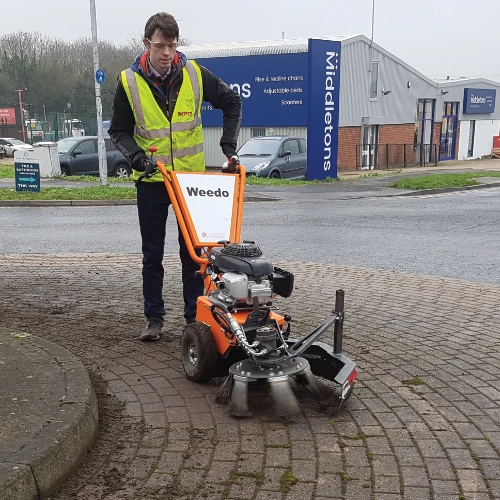
Integrated Weed Management Workshop
Diagnose the stage before selecting the treatment
Join Sean Faulkner at Pierces Farm for a practical training day covering pavement succession, the Kick Test, indicator species, mechanical extraction, thermal and electric weed control, and programme costing.
- First Wednesday each month
- Starting October 2026
- Maximum 10 attendees
- £150 + VAT per person
- Hands-on machinery sessions
- Lunch and resources included
Public and stakeholder feedback
Have you visited one of the Bracknell trial sites?
Share what you observed. The existing Google Form is embedded below and continues to use its current response collection and access settings.
Bracknell Weed Management Trial Feedback
Rate the plots, record the date of your visit and add any observations about appearance, effectiveness or site-specific conditions.
The form is hosted by Google. Any sign-in requirement, permissions, questions and response destination are controlled by the existing Google Form settings.
Frequently asked questions
Understanding the trial and its practical implications
What is the purpose of the Bracknell IWM Trial?
What is Pavement Ecological Succession?
Why are Stage 2 and Stage 3 difficult to distinguish?
Which species are useful indicators?
How did brushing reduce active substance use?
When will the full trial results be available?
The cheapest intervention window is the one that has not yet closed
Download the scientific baseline paper, attend the practical workshop or speak to Kersten about applying Integrated Weed Management principles across your own sites.