"Don't walk here": what our streets tell people, and why culture follows the street
Every street sends a message about who it is for. Too many of ours say "don't walk here". Lessons from Amsterdam and Tokyo.
"Don't walk here": what our streets tell people, and why culture follows the street
Every street sends a message about who it is for. Too many of ours say "don't walk here". Lessons from Amsterdam and Tokyo suggest that the way people behave on a street follows the street itself, and that good design only keeps working if the street is looked after.
Walking architecture and driving architecture
One idea from the House of Lords Built Environment Committee's evidence session on 3 November has stayed with me.
The urbanist Patricia Brown MBE drew a distinction between walking architecture and driving architecture, a point David Milner of Create Streets came back to later in the session. Much of our built environment, the argument went, simply screams "don't walk here".
You can usually tell within a few seconds who a place was designed for. Driving architecture is built for speed and to be read from a distance: wide junction corners, guardrails, blank frontages, big signs, and footways treated as whatever is left over once the road has been drawn. Walking architecture works at about 5 km/h. It gives you things to look at, somewhere to sit, a crossing where you actually want to cross, and a pavement wide and even enough that you don't have to think about it.
The pavement outside my school
I know what a "don't walk here" street looks like, because I grew up walking along one. My primary school in Grazeley, just south of Reading, had almost no proper parking. Children wove between wing mirrors and puddles at drop-off, and when my classmate John was hit by a car outside the gates, the road felt different from then on.
The same narrow strip of pavement still runs beneath the hedge line. Over the years, more than half its original width in places has disappeared under soil, leaf litter and vegetation, and the kerb has softened into something closer to a shallow ramp. As I wrote in my book, The Weeds Are Not the Problem: "The pavement has not simply become narrower. It has become less capable of protecting the people using it."
Nobody designed that pavement to say "don't walk here". It came to say it, slowly, through years of being managed reactively.
Amsterdam: culture came downstream of the street
Amsterdam is the example everyone reaches for, and it is more interesting than it first looks. Cycling was already huge there before the war. It fell sharply in the 1950s and 60s as cars took over, and only recovered after the protests of the 1970s about children killed on the roads, when the city rebuilt its streets around bikes.
So the infrastructure did not just encourage a cycling culture. It decided which culture survived. People do what the street makes easy and safe, and stop doing what it makes hard, even things they once loved.
Which raises the question for the UK: what do we want downstream of our infrastructure?
Tokyo: where rubbish passes through but never stays
Bins came up as another cultural difference, and Japan is the striking example. Visitors are often surprised by how few public litter bins there are. Many were removed from stations and streets after the 1995 sarin gas attack on the Tokyo subway and never came back. The habit that replaced them is simple: you take your rubbish home. In one survey, the lack of bins was visitors' single biggest frustration with Japan.
Household waste works differently too. There are no wheelie bins living permanently on the pavement. Rubbish is carefully sorted, each type has its own collection day, and households take their bags to a shared collection point on the morning it is due, often under a net to keep the crows off. By the afternoon the point is empty again. Neighbourhood associations look after these points, and a bag put out on the wrong day is left behind with a sticker on it.
The result is a street where rubbish passes through for a few hours and then is gone. The clean streets are not mainly the product of street cleaning. They come from a system that people's habits have grown around, just as Amsterdam's cycling habits grew around its streets.
Closer to home: Europe's cleaning culture
There is a third example, closer to my own field. In Germany, the Netherlands and France, a culture of keeping hard surfaces clean is deeply embedded. Kerb edges in many French towns are swept at frequencies that would surprise most British council officers. Soil and leaves are removed before they build up, so edges stay defined and weeds never get much to grow in.
When those countries moved away from chemical weed control, they did it from that cleaner starting point. Britain has been trying to make the same change from a street network carrying decades of built-up detritus, which is one reason so many alternative weed control trials here have struggled to match European results. Again, the outcome followed the system and the habits around it.
What our streets are saying
Walk down many British residential streets and the message is different: wheelie bins left on the footway all week, overflowing litter bins, black bags split open by foxes. Bins on the pavement take up exactly the width that wheelchair and pushchair users need. And they all say the same thing: nobody is really looking after this.
Part of the reason is that "who looks after this?" can be a genuinely hard question. One example that stuck with me: Bond Street, one of the best-known shopping streets in the country, reportedly has 47 different refuse operators collecting from different bins. When a bin overflows or bags are left out, working out whose responsibility it is becomes a job in itself. Every one of those operators runs its own vehicles along the same street, on its own timetable. It is the same fragmentation I see at the kerb edge, where one body owns the road, another the verge, and drainage, cleansing and grounds maintenance sit in separate departments, while water flows downhill regardless.
Compare that with a single shared collection point, collected at a set time by one operator. Responsibility is obvious, there is one vehicle instead of dozens, and the cost and carbon of collection fall dramatically. Japan's approach is not just tidier. It is simpler to run.
Litter and detritus are different problems, but they end up in the same place. Plastic, cans and wrappers are blown to the kerb edge and simply sit there, looking untidy. Alongside them, soil and leaf litter build up into detritus, the growing medium for weeds. Together they make a kerb line that looks neglected. The 2026 Code of Practice on Litter and Refuse recognises how closely these issues sit together, noting that weeds and detritus are interlinked.
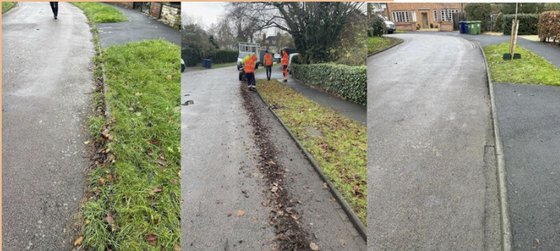
Design invites walking. Maintenance keeps the invitation open.
This is where the walking architecture argument meets day-to-day street care. Design tells people whether a place is meant for walking. Maintenance tells them whether that is still true.
A well-designed street left to go to seed ends up sending the same message as a badly designed one. A footway narrowed by soil and turf, a channel full of weeds, water pooling at the crossing point: each quietly says "don't come here". A new pedestrianised square cannot fix that if the routes leading to it have been left to decline.
The cost of getting this wrong is real. Living Streets research has found that nearly one in three people aged 65 and over (31%) are stopped from walking more, or at all, by the condition of their local pavements, and 48% say they would walk more if pavements were better maintained. Emergency hospital admissions for pedestrian falls were estimated to cost almost £100 million in 2019.
The good news is that people notice care just as quickly as they notice neglect. A freshly edged verge, an open drainage channel, a footway restored to its full width: these tell people that somebody is still paying attention. When Hull ran its Love Your Neighbourhood programme, residents did not just describe cleaner streets. They said they felt happier about where they lived. People choose to walk somewhere because the last time they did, it felt fine.
What we want downstream
If culture follows the street, then the culture we want should shape how we design and look after it:
- Children walking to school and playing out, because parents trust the street.
- Older and disabled people staying independent for longer, because the walk to the shops has no trip hazards and the footway is wide enough.
- People lingering, which keeps high streets alive and lets neighbours see each other.
- A sense that someone cares about the place, which is where trust in local services starts.
What councils can do
- Treat the footway as the main event, not what is left over. Protect its full width from encroaching soil, growth and parked bins.
- Look at how bins live on the street, not just how often they are emptied. Clear presentation times and shared collection points on narrow streets can free the footway.
- Make responsibility simple. Where many commercial operators serve the same street, coordinating or zoning collections so that one operator covers an area cuts vehicle movements, cost and carbon, and makes it clear who to call.
- Clear kerb edges and channels regularly, so litter is removed and soil and leaf litter do not build up into detritus.
The bottom line
Amsterdam, Tokyo and Europe's cleaner towns all show that habits follow the street. If we want a walking culture, the street has to say "walk here", and keep saying it. That depends on design, and just as much on whether the kerb edge, the footway and the bins are looked after every week.
I explore many of these ideas further in my book, The Weeds Are Not the Problem. To talk about keeping your walking routes clear, or to arrange a demonstration, contact Kersten UK.
Sources: House of Lords Built Environment Committee oral evidence session, 3 November 2026. Sean Faulkner, The Weeds Are Not the Problem. Living Streets research on older people and pavements, as cited in the book. Hull City Council, Love Your Neighbourhood programme. Code of Practice on Litter and Refuse (2026). On Japan: Time Out Tokyo and Japan Today.

No comments yet. Login to start a new discussion Start a new discussion