Surface maintenance business case builder
Build the business case for a more effective maintenance programme
Compare manual scraping, chemical pesticide treatment, an integrated Kersten programme and thermal-only treatment. The model separates the first structural reset from lower-material Year 2 maintenance and adds the larger whole-life council case: fewer reactive gully visits, slip-and-trip claims and pothole-related repairs.
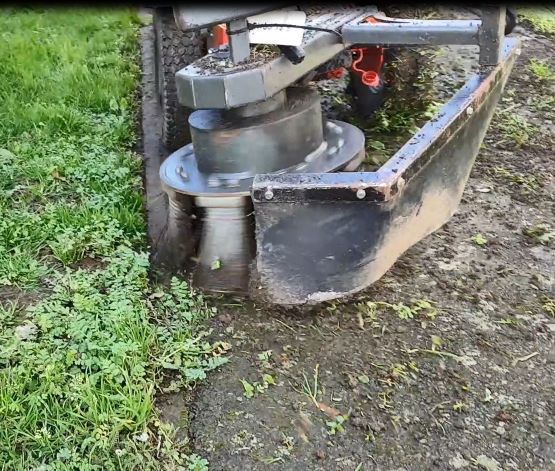
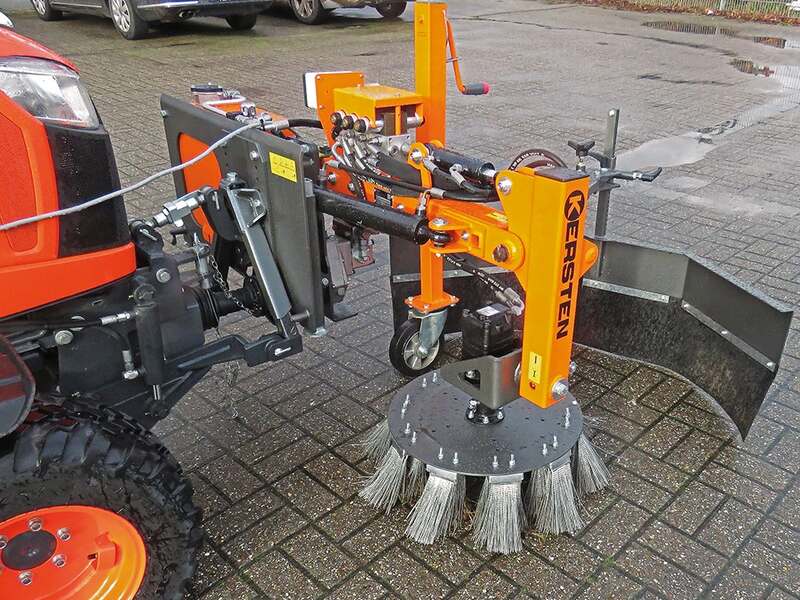
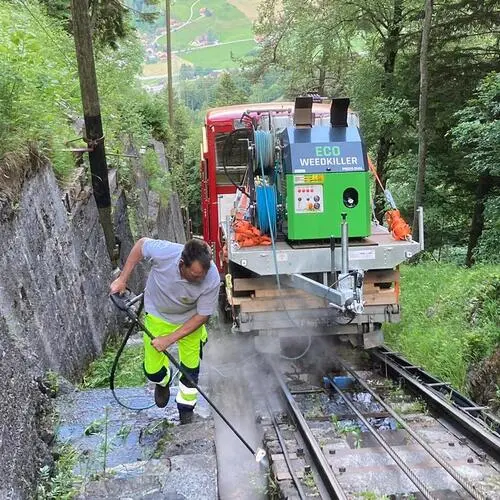
Real Kersten equipment
See the extraction, collection and follow-up system
These images are served from Kersten UK website assets and link to the relevant product or case-study pages.
Linear kilometres treated each year. Enter 25 for a 25 km programme.
Your programme assumptions
Every starting figure can be changed. Use local costs and measured trial data wherever these are available.
Common operating costs
These values apply across the four comparison methods.
Pay plus employer costs, leave and operational overhead.
The Year 2 reduction applies to the mass collected and disposed of, not to the number of metres maintained. The full route can still be covered after the initial reset.
Build the Kersten fleet package
Use one machine or combine several types and quantities. Capital cost and daily capacity are added together.
Mechanical treatment and cleanup
Productivity is condition-dependent. The calculator uses the fleet capacity above, with editable cleanup and disposal assumptions.
For example, road sweeper, driver, transport and related running cost.
Editable planning allowance for mobilisation, weather, access, servicing and competing work.
A 500-1,000 metre day and a 3,500 metre day can both be credible. The decisive variables are the mass being removed, access, number of passes and how quickly material is collected after the machine.
Suppression and comparison methods
The integrated programme models a pre-season brush followed by substantially less suppression. On tarmac, the starting assumption is a 50% first-pass reduction in suppression coverage, followed by spot treatment only where needed. Block paving starts higher because deep, narrow joints can retain more growth medium. Stand-alone spraying and stand-alone thermal treatment both default to three full applications per year because neither removes the accumulated soil.
Planning allowance for a Pro 20 with useful added features. The calculator automatically sizes the thermal fleet needed to cover the network.
Used to show the percentage of the annual programme that the selected kit could realistically cover.
Central planning allowance, not a national fact. Replace it with the authority's treatment calendar and local availability.
The Pro 20 reaches its 20 l/min dual-output mode with two users.
At two-user output the published fuel consumption is 20 litres/hour, so £30/hour is broadly a fuel-only allowance at about £1.50/litre. Labour, vehicle and servicing are added separately.
Conservative field-planning rate below the audit's engineering ceiling, allowing for hose movement, access, refilling and stop-start work.
Defaults to half the targeted rate because retained soil produces denser and more extensive weed growth.
Broad benchmark derived from an awarded three-application UK city contract. Includes labour, vehicle and product rather than product cost alone.
Three full applications are included by default.
Three full applications at the slower thermal-only output are included by default.
The audit's engineering model produced approximately 15,000 m/day for early treatment and 11,500 m/day for later treatment from a 20 l/min flow, a 0.25 m treatment head and 60% utilisation. Those were not measured Pro 20 route outputs. This calculator now uses lower field-planning defaults and sizes capital to the number of units needed.
Advanced method assumptions
Operative cost benchmark from the anonymised contractor evidence used in the audit. Disposal is added separately.
Downstream council costs avoided
The machine purchase is only part of the case. This section estimates the larger whole-life value of reducing drainage loading, claims exposure and carriageway deterioration across the network covered by the programme.
Editable reference-network rate derived from an anonymised authority model. Replace it with the authority's own pothole, patching and reactive carriageway expenditure divided by the network kilometres actually covered. Do not treat a general roads-capital allocation as wholly avoidable pothole spend.
Allows for the lag between preventative work, fewer defects and financial savings.
Normalised from 37,675 annual attendances across a 3,600 km reference network.
The audit evidenced the attendance volume but not the achievable reduction. Keep this editable and validate locally.
Illustrative starting value. A published council example reported about £140 reactively versus £9.31 in a planned programme.
Advanced downstream event assumptions
Default based on an anonymised five-year local-authority dataset, rounded from an average successful settlement of approximately £12,816. Replace it with the authority's own mature settled-claim average where available.
Calculated from the submitted-claim rate and settlement probability.
How the all-in comparison works: each method now carries treatment and equipment costs plus planned gully emptying, reactive gully callouts, expected slip/trip claim cost and attributable road/pothole exposure. Manual scraping, spraying and thermal-only treatment retain the full reference downstream exposure because the model does not assume they create the additional preventative benefit of complete extraction. The integrated programme applies the selected reductions. The whole-life road figure and direct pothole-repair floor are two views of the same damage burden and are never added together.
Productivity needs context
Output is a workflow result, not a fixed machine claim
Surface condition and collection method can change daily output dramatically. Use a measured trial to replace these ranges with your own figures.
High material volumes reduce forward progress
500-1,000 m/dayA realistic range where significant overburden, anchored growth, repeat positioning or slower cleanup limits the programme.
UBS 16 path edging and kerb lines
Up to 3,500 m/dayOne mechanical pass followed by a road sweeper. The operator had refined the complete system rather than treating the machine as a standalone process.
Winter work can create additional revenue capacity
More usable daysPath edging can keep a trained team productive outside the main growing season, subject to ground conditions and deep frost.
“It does what it says on the tin. The operator has fine-tuned his system and can achieve up to 3,500 metres of edges per day. The 16 hp twin-cylinder engine has loads of power for this job. It is only the deep frost that stops us; there is no shortage of siding to do.”
Four operating models
The comparison is about outcomes as well as treatment price
A low-cost pass can remain expensive if it leaves the growth medium in place and creates repeat demand.
Labour-led removal plus cleanup
Can remove visible material, but access to the full kerb profile and output per person are usually the limiting factors.
- High labour requirement
- Disposal still applies
- Residual material can remain in tight locations
Fast visible suppression
Often covers large distances quickly, but it does not remove soil, detritus or the physical conditions that support future establishment.
- Low material handling
- Repeat treatment remains necessary
- Professional use and local policy constraints apply
Pre-season extraction plus targeted suppression
Removes the growth medium first, then uses substantially less follow-up treatment on the weeds that remain or re-establish. The tarmac default assumes half-area suppression after the pre-season brush and only targeted follow-up thereafter; every coverage factor remains editable.
- Year 1 structural reset
- Lower disposal mass from Year 2
- Less full-area suppression
Non-chemical suppression without extraction
Useful around joints, cracks, furniture and sensitive areas, but repeated full-area treatment is less efficient where the growth medium remains.
- No pesticide product
- Water and energy demand
- More treatment required at late growth stages
Transparent assumptions
Where the starting values come from
The page uses editable defaults rather than presenting a universal national cost. Published and operational sources provide a starting point; customer data should replace them.
£0.332 per metre before disposal
The manual default now follows the anonymised contractor benchmark used in the supplied audit. At 75% extraction and the default material and disposal values, this produces approximately £0.758 per metre rather than adding a separate £450-per-day sweeper charge on top.
Approximately £40.70 per km per application
Hull awarded a £449,004 two-year contract for three city-wide applications each year. Normalised across its published 731 km road network and 1,109 km of footpaths and cycleways, the broad service rate is about £40.70 per managed-network km per application. The scope is not identical to kerb-line metres, so the figure remains editable.
View the awarded contract →Configured Pro 20 fleet sizing
The thermal model starts with a £45,000 planning allowance per configured Pro 20 and automatically multiplies the purchase where one unit cannot cover the selected route within the available field days. Confirm tanks, reels, carrier, fitment, delivery, commissioning, VAT treatment and final quotation.
View the Pro 20 Dual →UK National Living Wage
The calculator uses a loaded commercial labour cost, not minimum wage. The statutory rate is a useful floor when checking local assumptions.
Check current GOV.UK rates →Official weekly road fuel prices
Petrol is editable because the national average changes weekly and local commercial purchasing may differ.
Open official fuel statistics →Manufacturer-rated fuel use
Honda publishes rated consumption for GX200, GX270 and GX390 engines. Real machine use varies with load, speed, conditions and maintenance.
View a Honda engine specification →WRAP gate-fee reporting
Local disposal routes, waste classification, transfer and haulage can materially change the cost per tonne.
Review the UK Gate Fees report →Anonymised operational modelling
The Year 1 / Year 2 distinction, starting material mass, disposal calculation and conservative 50% post-reset reduction are adapted from an anonymised audit supplied to Kersten UK.
UK Pesticides National Action Plan 2025
The comparison should sit within an Integrated Pest Management approach, with interventions kept to levels that are ecologically and economically justified.
Read the national plan →ALARM 2025 benchmarks
The starting values use £81.62 for a reactive pothole repair and £207 in staff administration for every road-user compensation claim. Settlement assumptions remain separately editable.
Review Asphalt Industry Alliance figures →Planned versus reactive cleansing
The £100 default is deliberately editable. Public reporting on a Lancashire council review cited approximately £140 for a reactive clean versus £9.31 for a planned clean, illustrating why local schedules must replace the default.
Read the council programme →Published flow, fuel and coverage inputs
The Pro 20 publishes selectable 10 or 20 l/min weed-control output, two-user operation and fuel consumption of 11 l/hour with one user or 20 l/hour with two. Kersten also states that fully greened areas typically require 2-2.5 litres/m². The daily route figures remain planning assumptions because access, weed density, hose handling and refilling determine actual field output.
View Pro 20 specifications →Anonymised council evidence
The event defaults are normalised from an anonymised 3,600 km reference network: 10.47 planned gully emptying attendances, 1.28 reactive gully incidents, 3.80 potholes filled and 0.0266 submitted slip/trip claims per network kilometre per year. At the default 7.4% settlement probability, that equals about 0.0020 successful claims per km per year, or roughly one successful claim per 508 network km each year. These are planning proxies, not universal national averages.
Important: This tool produces illustrative scenarios from user-selected assumptions. It is not a quotation, engineering assessment, actuarial forecast, legal advice, pesticide recommendation or promise that any authority will achieve the displayed savings. Reference data are anonymised and do not imply endorsement by a named authority. Objective savings claims should be checked against local budgets, claims records, drainage records, treatment logs and measured trials before being used in procurement or public communications. Productivity varies with surface condition, material depth, joint geometry, access, traffic management, collection method, operator skill and weather. Chemical products must only be selected and applied by competent professionals in accordance with their authorisation, label and applicable policy. Ask Kersten to validate machine fitment and arrange a measured trial before relying on the results.
Turn the indicative model into a verified business case
Send Kersten your assumptions, surface type, route length, proposed fleet and downstream risk model. The contact form will be pre-filled so the team can check fitment, productivity, treatment sequence, local evidence requirements and pricing.