Beyond potholes, and beneath them: why the humble pavement is a political winner
Ask the public what would most show their council is getting the basics right, and the answer, after potholes, is not a new bypass or a shiny bus. It is a decent pavement.
Beyond potholes, and beneath them: why the humble pavement is a political winner
Ask the public what would most show their council is getting the basics right, and the answer, after potholes, is not a new bypass or a shiny bus. It is a decent pavement. New research from Create Streets shows this is one of the few things voters of every party agree on. It also shows that much of what people dislike about their pavements starts somewhere they rarely look: the kerb edge.
I came across the report in the House of Lords. On 3 November I attended an oral evidence session of the Built Environment Committee, which is looking into how our public spaces are managed and cared for. The discussion kept coming back to the everyday condition of streets and the places people actually use, and it was there that Beyond Potholes was brought to my attention. Reading it on the train home, I was struck by how closely the public's priorities match what we see at the kerb edge every day.
2nd better pavements rank second only to filling potholes in the public's street priorities |
4 of 5 parties' voters pick well-maintained pavements as their top street basic, with clean streets the other big choice |
40% and 38% of Conservative and Reform voters chose well-maintained pavements as the single best sign of a council getting the basics right |
£500 a year: what pothole damage costs the average driver, according to the Department for Transport |
The politics of everyday competence
Create Streets' report, Beyond Potholes, is built on national polling of more than 2,000 adults by Deltapoll, a ranking exercise that forced people to choose between priorities, and focus groups with voters who have lost faith in the main parties. Its central argument is simple: people judge the state through the streets they use every day.
Potholes come first because they are visible and everywhere. But the next priority, by a clear margin, is better pavements, ahead of train stations, street lighting, crossings and new buses. Road widening, often presented as the answer to everything, comes eighth.
How to read this chart. Rather than asking people to rate each improvement on its own, where everything tends to score as "important", the poll used a ranking method called MaxDiff. People were shown sets of improvements and asked which mattered most and which mattered least. The percentages show each improvement's share of total priority. Better pavements, at 11.1%, sit well clear of everything except potholes, and score higher than new road surfaces, train stations and street lighting. Road widening and new buses score just over half as much.
Most striking is how widely the view is shared. Asked which single improvement would most make them think their council is getting the basics right, "well-maintained pavements without cracks or trip hazards" came top. Forty per cent of Conservative voters and 38% of Reform voters chose it, along with 31% of Liberal Democrats and 24% of Labour voters. Clean streets came second. In a divided country, that is rare common ground.
How to read this chart. Each pair of bars shows the share of each party's voters who picked pavements (green) or clean streets (grey) as the single improvement that would most show their council is getting the basics right. Pavements win for four of the five parties, often by a wide margin. Among Conservative and Reform voters, pavements score more than three times as high as anything else. Green voters are the one exception, putting clean streets narrowly ahead. Kerb-edge detritus links both answers: it is part of what makes a pavement look neglected, and it is the dirt that "clean streets" are supposed to be free of.
For councillors and MPs of any party, the message is clear. The street outside someone's front door is where they decide whether the system works.
What residents are actually describing
Listen to the focus groups and a familiar picture emerges. One resident described "the amount of overgrowth... you have got to take a really wide berth around the pathways". The report talks about "water pooling where you wish to cross", and "the pavement that floods or narrows just when it needs to be clear".
Narrowed footways, pooling water and growth along the edges are exactly what we find when we measure kerb-edge detritus: the soil, grit and leaf litter that builds up along kerbs and footway edges. Left alone, it:
- narrows the footway, as soil and turf creep across the edge, often below the 2 m width the Department for Transport recommends for wheelchair users and pushchairs
- holds water, acting like a damp sponge against the surface and blocking the gullies that should carry it away
- feeds weeds, whose roots open up joints and cracks and create the trip hazards residents complain about
The report rightly targets pavement parking, litter and botched utility reinstatements. But some of the most visible pavement problems share one upstream cause that rarely makes it into the debate.

Why this is a winner for any council
Tackling kerb-edge detritus ticks every box a politician looks for.
- It is visible. A cleared kerb line looks transformed the same day. Residents notice.
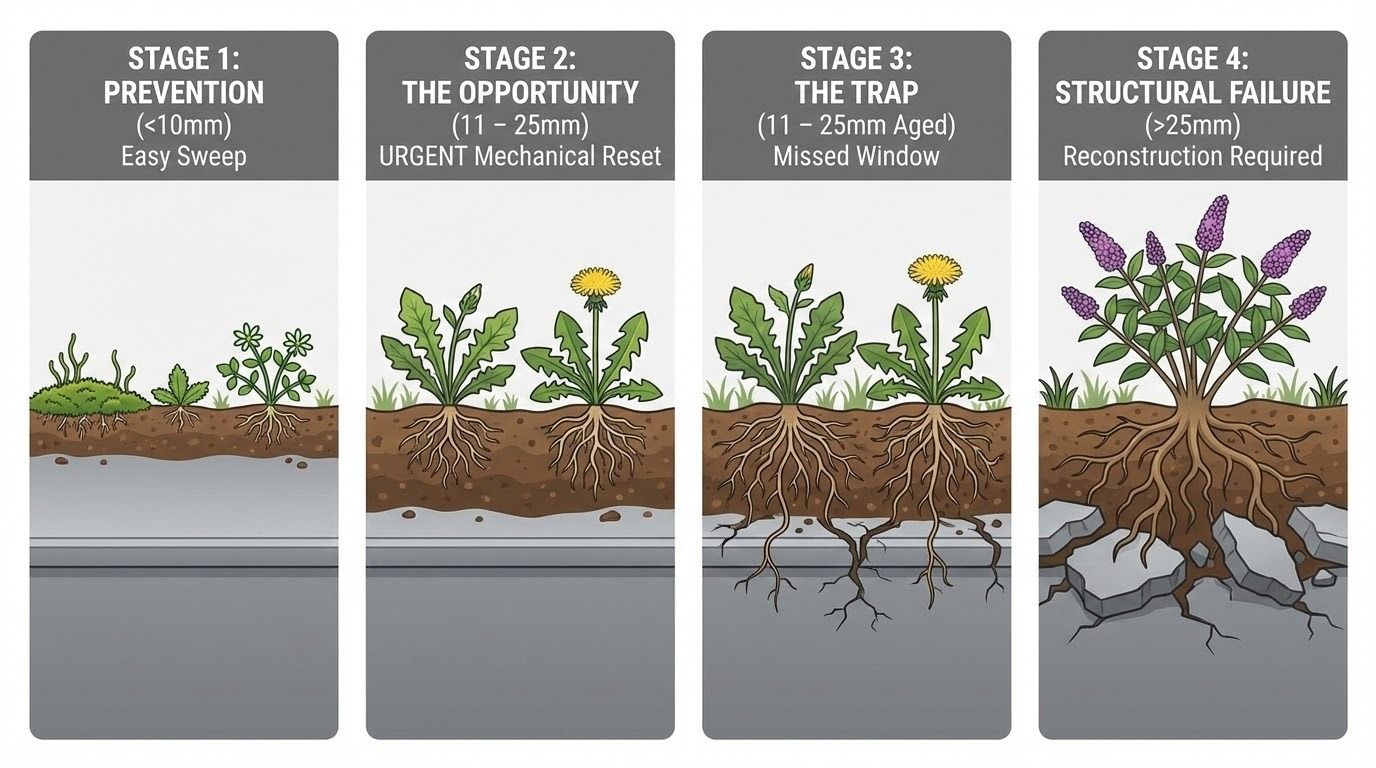
- It is cheap, if done early. Removing detritus while it is 10 to 25 mm deep, before roots anchor into the surface, costs under £10 per square metre. Once roots have anchored and the edge fails, repairs cost £75 to £150.
- It prevents the number one complaint. Blocked gullies and water held at the edge speed up pothole formation. In one city council's records, streets with blocked-gully complaints had 2.3 times as many potholes.
- It helps the people who most need a usable pavement: older people, disabled people and parents with pushchairs.
- It reduces chemical use. In the Bracknell trial, removing detritus before treatment cut the herbicide used by 49%, which matters to residents who want fewer pesticides in public spaces.
With the record £18.62 billion local road repair backlog reported in the AIA's ALARM 2026 survey, councils cannot resurface their way out of the problem quickly. Keeping kerbs and footway edges clear is one of the few things that delivers visible improvement now, at modest cost, while protecting the roads councils do resurface.
What councils can do this winter
- Start with the routes people walk. High streets, routes to schools, stations and bus stops, and residential streets where complaints cluster.
- Clear kerb lines and gullies before spring, when growth and detritus build fastest.
- Measure the edge. A simple depth check shows where action is cheap and where it is becoming a repair.
- Use the right kit for narrow streets. Pedestrian sweepers and weed brushes reach the kerb where larger machines cannot.
- Tell residents. Before-and-after photos of a cleared street are the "everyday competence" the polling says people want to see.
The bottom line
The public has told us what it wants: decent pavements and clean streets, regardless of how it votes. Some of the quickest, cheapest and most visible ways to deliver both start at the kerb edge. For any council looking to show it is getting the basics right, that is a good place to start.
To talk about prevention on your streets, or to arrange a demonstration, contact Kersten UK.
Sources: Polling and focus group findings from Create Streets, Beyond Potholes (September 2026), based on Deltapoll and More in Common research. Pothole damage cost from the Department for Transport, as cited in the report. Road backlog from the AIA's ALARM survey report 2026. Kerb-edge cost figures from the Bracknell IWM Trial and published highway maintenance benchmarks.

No comments yet. Login to start a new discussion Start a new discussion