RALA Mover-1000 electric trolleys
Move up to a tonne without making the operator carry it.
Battery-powered transport platforms for materials, equipment and mobile systems where vans, forklifts and larger vehicles are either unnecessary or simply cannot reach.
Choose the footprint, not the payload
All three carry serious weight. The main decision is how much platform you need.
The Mover-1000 family is built around the same heavy-load principle, but the bed grows from a compact EUR-pallet-sized M to the long XL platform for larger tanks, machines and bulky loads.

Mover-1000 M
The compact member of the range. It is sized around a EUR 1/1 pallet and is the easiest option to manoeuvre where access, storage and turning space are limited.

Mover-1000 L
The balanced all-rounder: more platform length and width than the M while remaining compact enough for footpaths, sites, nurseries and mobile maintenance systems.

Mover-1000 XL
The long-platform model for larger equipment packages, tanks and bulky loads. It is also the RALA platform used for Kersten's larger Eco Weedkiller Pro 20 configuration.
Quick comparison
Which Mover-1000 is the right size?
Do not automatically choose the longest platform. A smaller trolley is easier to store, manoeuvre and transport; a larger platform earns its place when the load itself needs the space.
| Model | Platform size | Load capacity | Best suited to | Kersten hot-water route |
|---|---|---|---|---|
| M | 82 × 122 × 50 cm | 1,000 kg | EUR pallets, compact loads, narrow access and smaller Eco Weedkiller packages | SP Mini and SP3 |
| L | 102 × 152 × 50 cm | 1,000 kg | General materials handling, grounds work, nurseries and mobile equipment | SP6 and Pro 10 |
| XL | 102 × 202 × 50 cm | 1,000 kg | Longer or bulkier systems, larger tanks and equipment packages | Pro 20 |
What does an electric trolley actually solve?
Move the load to the job without turning every journey into manual handling.
RALA's trolley concept is useful where the load is too heavy or repetitive for sensible manual movement, but the route is too narrow, soft or awkward for conventional vehicle access.
Building & landscaping
Move paving materials, tools, bags, machines and other heavy site loads across ramps and uneven ground.
Nurseries & agriculture
Transport plants, materials, equipment and bulky loads without repeatedly loading a larger vehicle.
Warehouses & estates
Move heavy equipment between buildings or work areas while retaining pedestrian-scale manoeuvrability.
Mobile maintenance systems
Use the platform as a carrier for tanks, pressure equipment, hot-water weed control or customised systems.
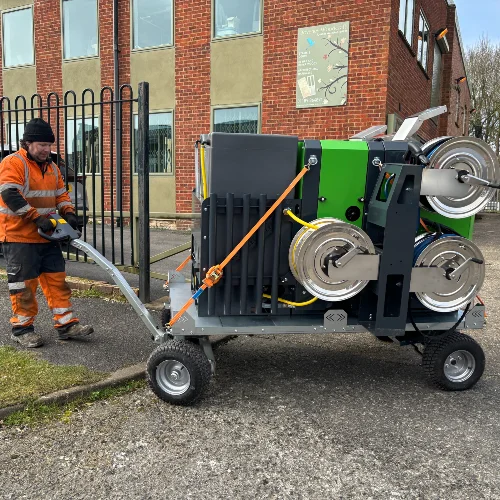
More than a flatbed
Build a mobile system around the trolley.
The platform can carry more than loose materials. Kersten already uses the RALA trolley as the mobile base for Eco Weedkiller hot-water systems, creating a self-contained electric transport platform for professional weed-management work.
- M: the compact choice for Eco Weedkiller SP Mini and SP3 systems.
- L: the correct platform for SP6 and Pro 10 packages.
- XL: the larger platform for the Pro 20 system.
- Custom builds: RALA states that the platform can be adapted to individual dimensions and specialist structures.
Planning a custom carrier? Send the overall dimensions, loaded mass, centre of gravity and intended route so the platform can be specified around the real working load.
Before choosing a trolley
Match the trolley to the route as well as the load.
A one-tonne payload rating is only part of the decision. The practical specification also depends on access width, gradients, loading method and how the equipment is secured.
Measure the load
Record the actual footprint, total loaded weight and whether anything overhangs the deck.
Measure the route
Check gates, paths, ramps, cambers, turning areas and where the trolley will be loaded and stored.
Plan restraint
Water tanks, machines and stacked materials need suitable mounting or restraint for the intended terrain.
Plan the working day
Consider distance, gradients, payload and charging opportunities rather than choosing battery capacity by headline runtime alone.
Frequently asked questions
RALA electric trolley questions
What is the difference between the M, L and XL?
The main difference is platform footprint. The M is 82 × 122 cm, the L is 102 × 152 cm and the XL is 102 × 202 cm. All are intended for heavy-load pedestrian transport, so choose around the size of the load and the access available.
How much can a RALA Mover-1000 carry?
The M, L and XL are all specified by RALA with a 1,000 kg load capacity. The load still needs to be stable, correctly positioned and appropriately restrained for the route being used.
Can the trolley work outdoors?
RALA describes the Mover as suitable for challenging environments, uneven and soft surfaces, and as CE marked and built to withstand water. Site conditions, gradients and traction should still be assessed before use.
Can the trolley be customised?
Yes. RALA states that the Mover can be extended or adapted to individual dimensions and can be built around specialist equipment. Kersten UK can discuss a trolley around the load or system you need to move.
Which trolley is used with Eco Weedkiller equipment?
Use the M for SP Mini and SP3, the L for SP6 and Pro 10, and the XL for Pro 20.
Is the M available from Kersten UK?
The M is part of RALA's current Mover-1000 range. Contact Kersten UK for UK specification, availability and pricing.
Need to move a particular load?
Send us the load dimensions and the route.
Tell us what you need to carry, the loaded weight, the narrowest access point and any slopes or ramps. We can help narrow the choice between M, L and XL.