The New Math of Weed Management: Beyond the Litre, Into the "Load"
For decades, the standard metric for weed control was volume: "How many litres of glyphosate did we spray?" But as we enter 2026, that metric is officially obsolete.
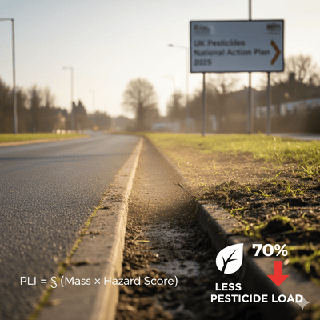
Under the UK Pesticides National Action Plan (NAP) 2025, the government has introduced a more sophisticated metric: the Pesticide Load Indicator (PLI). This shift changes everything for councils and contractors. It moves the goalposts from simply "killing weeds" to "Measuring the Potential Pressure on the Environment."
The PLI Formula: The Science of "Hazard x Exposure"
A Pesticide Load is not just a measurement of volume. According to the Agriculture & Environment Research Unit (AERU) at the University of Hertfordshire, it is a calculation of the Mass of Active Substance multiplied by its specific Hazard Scores.
The formula used by DEFRA and auditors looks like this:
 PLI=∑i=1n(Massi×HazardScorei)
Where:
- Mass (Massi): The total weight of the chemical active substance applied.
- Hazard Score (S): A value between 0 and 1 assigned across 20 metrics: 16 for ecotoxicity (bees, birds, aquatic plants) and 4 for environmental behavior (how long it stays in the soil).
The Reality Check: Because the PLI tracks Persistence and Mobility, a chemical that stays in the silt for months will have a "load" score significantly higher than one that breaks down in days; even if the application volume is identical.
Is the Amenity Sector Next?
While the PLI is currently being applied primarily in the arable sector, the NAP Target Explainer is clear: Amenity is next.
The government has committed to securing more comprehensive data on pesticide use in public spaces to bring them under the same indicator framework. Furthermore, the NAP 2025 mandates that "sustainable physical, biological, and other non-chemical methods must be preferred." Waiting for a formal audit before changing your strategy is a high-risk move for local authorities.
The "Alternative Chemical" Trap: Pelargonic Acid
Many organizations attempt to lower their impact by switching to substances like Pelargonic Acid. However, from a PLI perspective, this can backfire.
Data from the Pesticide Properties Database (PPDB) reveals a "Mass Gap." Pelargonic acid often requires application rates significantly higher by weight than glyphosate to be effective. Because the PLI formula multiplies Mass by Hazard, the sheer volume of "softer" chemicals used can result in a higher total Pesticide Load than a targeted application of a traditional herbicide.
The Lesson: You cannot simply spray your way to a low PLI score. You must manage the environment to reduce the need for spray.
The Kersten Strategy: A Comparison of Load
Let’s look at a typical 10km section of an A-road to compare the "Status Quo" against a Mechanical-First strategy.
Strategy A: The Status Quo (Blanket Sprays)
- Action: Two blanket sprays per year.
- Estimated Mass: 1,800g of Active Substance.
- Annual Math: (900g \times 0.7) + (900g \times 0.7) = 1,260
Strategy B: Mechanical-First (Nominal 70% Reduction)
By using a Kersten UBS Mechanical Brush to perform a "Spring Reset," we remove the silt and habitat that allows weeds to thrive.
- The Spring Reset: Removes the bulk of the detritus. PLI Load: 0.
- Targeted Follow-up: Because the habitat is gone, subsequent weed growth is significantly reduced. Even with a conservative estimate, this allows for highly targeted spot-treatment rather than blanket spraying.
- The Result: A nominal 70% reduction in total annual chemical mass used.
The Verdict:
| Metric | Status Quo (Blanket) | Mechanical-First Strategy |
| Active Substance Mass | 1,800g | 540g |
| Total Annual PLI Load | 1,260 Units | 378 Units |
| Improvement | Baseline | Significant Load Reduction |
Why "Mechanical First" is the Only Way to Lead
Chemical alone kills the plant but leaves the dirt. This dirt holds moisture and protects the seedbank, which mathematically guarantees you will need repeat applications; compounding your PLI score every time.
By using a mechanical reset, you aren't just reducing chemical use; you are removing the "Environmental Fate" metrics. You remove the silt that allows chemicals to persist and leach into drains.
Disclaimer: The percentages used above are nominal and provided for illustrative purposes to demonstrate the principles of the Pesticide Load Indicator. Actual reductions in herbicide use will vary based on site conditions, weather, and operator proficiency.
Is your weed management strategy ready for future audits? At Kersten UK, we provide the machinery and methodology to help you transition to a low-load future.

No comments yet. Login to start a new discussion Start a new discussion